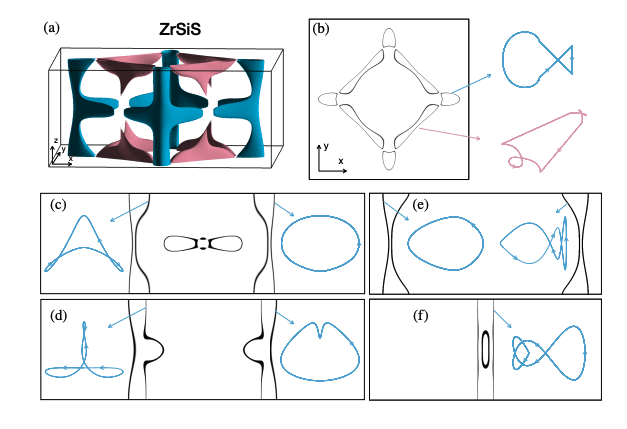
In a study published on April 16, 2025, ShengNan Zhang and Oleg V. Yazyev explored magnetoresistance in ZrSi (S, Se, Te) nodal-line semimetals, revealing that semiclassical theory accurately captures their unique butterfly-shaped anisotropic magnetoresistance without requiring topological concepts.
The study presents a first-principles analysis of magnetoresistance in ZrSi(S, Se, Te) topological nodal-line semimetals, demonstrating that experimental features, including butterfly-shaped anisotropic magnetoresistance (AMR), are accurately reproduced using semiclassical Boltzmann transport theory without invoking topology.
The research explains Fermi surface geometry’s role in magnetotransport and interprets atypical Hall resistance through the same framework. These findings establish magnetotransport as a powerful tool for analyzing Fermi surface geometry, complementing ARPES and oscillation measurements, while clarifying the interplay between topology and transport properties.
In the realm of quantum materials, researchers have unveiled a promising new substance, ZrSiSe, which could significantly impact electronics and spintronics. This discovery, detailed in recent studies, highlights ZrSiSe as a topological semimetal with notable magnetoresistance (MR), offering potential for future technological innovations.
ZrSiSe emerged from advanced computational methods, including density functional theory (DFT) and Wannier interpolation, which allowed precise modeling of its electronic behavior. This material’s structure captures attention due to its unique electronic properties, particularly as a topological semimetal characterized by a distinct band structure and robust surface states.
ZrSiSe exhibits high magnetoresistance under specific conditions, where resistance significantly changes in magnetic fields. This property is intriguing for both fundamental physics and practical applications. The material’s MR suggests potential use in magnetic sensors and memory devices, crucial for sensitivity to magnetic fields. Additionally, ZrSiSe could contribute to quantum computing as a topological semimetal, leveraging its electronic properties for novel computational architectures.
While the discovery is significant, further research is essential to fully harness ZrSiSe’s potential. Experimental studies are needed to validate theoretical findings and explore behavior under various conditions. Collaborative efforts between theorists and experimentalists will be key in advancing this field and translating discoveries into practical applications.
The discovery of ZrSiSe represents a promising development in quantum materials research, offering insights into topological phenomena and potential technological innovations. As scientists continue exploring its properties, it holds the promise of contributing to next-generation electronic devices and quantum technologies. Stay tuned for further updates as this exciting field evolves.
👉 More information
🗞 Magnetoresistance in ZrSi ( S, Se, Te) nodal-line semimetals
🧠 DOI: https://doi.org/10.48550/arXiv.2504.12547