

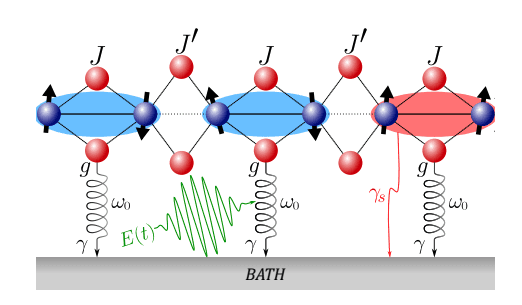
In Pulsed Magnetophononics in Gapped Quantum Magnets, published on April 23, 2025, researchers B. Demazure, M. Krebs, G. S. Uhrig, and B. Normand explore the modulation of magnetic interactions at ultrafast timescales through magnetophononics, revealing low-frequency oscillations in quantum materials like CuGeO.
The study investigates magnetophononics, where lattice excitations control magnetic interactions. Using pulsed laser driving, researchers observed low-frequency oscillations between lattice and spin sectors in a gapped magnet, identified as a nonequilibrium collective mode arising from beating between repelling phonon-bitriplon excitations. A phonon-bitriplon approximation was developed to capture hybridisation and sum-frequency effects. The findings were applied to CuGeO, suggesting criteria for observing these phenomena in experiments.
Recent terahertz spectroscopy research has demonstrated that the spin-Peierls transition in CuGeO3 occurs in two distinct stages. The process begins with a distortion of the lattice structure, followed by a subsequent breakdown of magnetic order. This sequential mechanism underscores the temporal nature of these transitions, which do not occur simultaneously but rather follow a defined progression.
Terahertz spectroscopy plays a critical role in this research due to its ability to detect rapid lattice distortions associated with spin-Peierls transitions. This technique operates at frequencies between microwave and infrared ranges, providing a unique window into the high-speed interactions within materials.
The study highlights the importance of quantum fluctuations—random atomic-level changes—in shaping macroscopic material properties. In CuGeO3, these fluctuations stabilise specific magnetic states and influence phonon behaviour, contributing to the material’s distinctive characteristics.
While research on spin-Peierls systems has been ongoing since the 1990s, recent advancements have benefited from modern spectroscopy techniques and computational tools such as Julia and SciPy. These tools enable researchers to simulate and analyse the complex interactions between spins and phonons, enhancing our understanding of these quantum phenomena.
The two-stage transition—lattice distortion followed by magnetic order breakdown—is significant for understanding how material properties evolve under varying conditions. This insight could be valuable for developing materials with tailored properties for technological applications.
This research advances our understanding of quantum materials and opens new possibilities for controlling material properties in future technologies, such as advanced electronics. By elucidating the mechanisms behind spin-Peierls transitions, scientists are laying the groundwork for innovations that could effectively harness these quantum effects.
In conclusion, studying CuGeO3 using terahertz spectroscopy and computational methods has provided a clearer understanding of spin-Peierls transitions, emphasising the importance of sequential processes and quantum fluctuations. This work holds promise for both fundamental science and applied technology.
👉 More information
🗞 Pulsed Magnetophononics in Gapped Quantum Magnets
🧠 DOI: https://doi.org/10.48550/arXiv.2504.16847


