

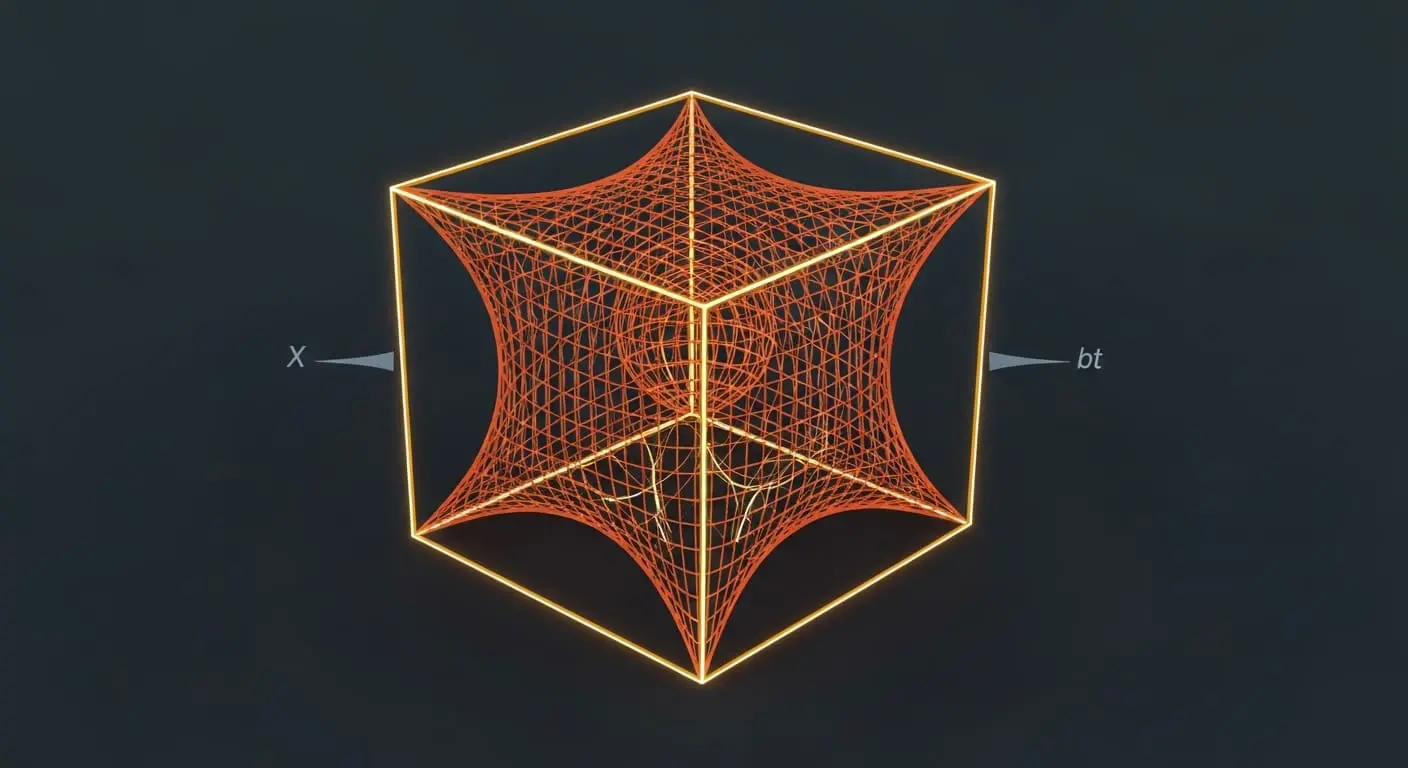
José J. Gil, at the Institute for Quantum Computing, and the Department of Physics, and colleagues uncovered a previously unknown relationship between key experimental parameters governing measurement precision in polarized double-slit interferometry. An exact identity linking fringe visibility components, path predictability, and state mixedness was revealed, specifically that the sum of their squares always equals one. This universal algebraic relation, derived from the positivity of the reduced state, unifies existing relationships and offers a new framework for interpreting quantum measurements within the Jaynes maximum-entropy formalism. The research further isolates the contribution of phase-sensitive information to coherence, providing a refined method for detecting environmental influences on quantum systems.
Fringe visibility, path predictability, and mixedness define quantum coherence
Previously, comprehensively quantifying the coherence of a quantum state demanded the complete reconstruction of its density matrix, a complex and resource-intensive undertaking. The density matrix, a mathematical representation of the quantum state, fully describes the probabilities of all possible measurement outcomes. However, this new research demonstrates that an exact identity permits the determination of coherence from only four readily measurable invariants: the in-phase component of fringe visibility (VA), the quadrature component of fringe visibility (VN), path predictability (P), and state mixedness (I). The core finding is that VA2 + VN2 + P2 + I2 consistently equals one, a constraint previously unrecognised within the context of polarized double-slit interferometry. This single equation elegantly unifies the Englert-Greenberger-Yasin (EGY) relation and the Jakob-Bergou relation, both of which independently connect these parameters under specific conditions. The EGY relation, for instance, highlights a trade-off between the visibility of interference fringes and the knowledge of which path the particle took, while the Jakob-Bergou relation focuses on the relationship between visibility and the purity of the quantum state. By encompassing both within a single identity, the researchers offer a simplified and more complete framework for understanding quantum complementarity, the wave-particle duality, and enabling more precise measurements of environmental influences on quantum systems. Furthermore, the methodology separates the measurable components of visibility using phase-shifted interferometry, a technique where the relative phase between the two paths in the double-slit experiment is systematically varied.
Experiments employing polarized double-slit setups and path-dephasing channels confirm the identity remains valid even with environmental influences, such as phase noise, altering the state’s coherence. Path-dephasing channels introduce random phase shifts, effectively blurring the interference pattern and reducing coherence. The fact that the identity holds true even in the presence of such noise underscores its robustness and potential for practical applications in quantum technologies. Polarisation is used to encode and manipulate the quantum state, offering additional control and measurement possibilities. The use of polarisation allows for a more refined analysis of the coherence properties, as it provides an additional degree of freedom to investigate the quantum state.
A unified measure links quantum visibility, predictability and state mixedness
A firm connection between how quantum properties are measured is reshaping our understanding of coherence, the phenomenon underpinning quantum technologies such as quantum computing and quantum communication. Coherence is essential for maintaining the superposition of quantum states, allowing quantum computers to perform calculations that are impossible for classical computers. A single equation now describes fringe visibility, path predictability, and mixedness, simplifying analysis of complex quantum states and potentially accelerating the development of these technologies. However, the work explicitly focuses on ‘normalized’ density matrices, raising an important question regarding the extent to which this neat relationship holds true when dealing with real-world quantum systems, inevitably subject to noise and imperfections that distort these idealised conditions. A normalized density matrix represents a pure quantum state, meaning it is free from any classical uncertainty. Real-world systems, however, are rarely perfectly isolated and are always subject to some degree of environmental interaction, leading to mixed states and decoherence.
Real quantum systems invariably suffer from noise and imperfections, and acknowledging this reliance on idealised conditions is therefore important. Establishing this baseline, a relationship valid for perfect, normalized states, allows for understanding coherence in perfect conditions, unifying the Englert-Greenberger-Yasin and Jakob-Bergou relations. Defining this fundamental relationship separates the two components of visibility measurable by phase-shifted interferometry, providing a more detailed picture of the interference pattern and its sensitivity to external disturbances, and admits a natural interpretation within the Jaynes maximum-entropy framework, aiding diagnosis of environmental coupling. The Jaynes maximum-entropy principle provides a method for inferring the most likely quantum state given incomplete information, and this framework allows the researchers to quantify the information lost due to environmental interactions.
The need to fully characterise the density matrix to determine coherence is now superseded, simplifying the analysis of complex quantum systems. This simplification is particularly significant for systems with many degrees of freedom, where the density matrix can become extremely large and difficult to manage. Identifying the components of visibility responsible for phase-sensitive information allows for a more refined diagnosis of how external factors disturb quantum behaviour. This is crucial for developing strategies to protect quantum coherence from decoherence, a major challenge in building practical quantum technologies. This connection between fringe visibility, path predictability, and mixedness, a measure of uncertainty, provides a precise algebraic identity for properties of quantum states within a double-slit experiment, and enables the development of techniques to assess the impact of decoherence on quantum systems. The ability to accurately quantify decoherence is essential for optimising the performance of quantum devices and ensuring their reliability.
Furthermore, the framework established by this research has implications for quantum metrology, the science of using quantum phenomena to enhance measurement precision. By understanding the fundamental limits on coherence, researchers can develop new techniques for improving the accuracy of measurements beyond the classical limit. The precise relationship between these invariants offers a new tool for characterising and controlling quantum states, paving the way for advancements in various quantum technologies.
The researchers demonstrated an algebraic identity linking four measurable properties, in-phase and quadrature visibility components, path predictability, and mixedness, within a polarized double-slit experiment. This finding simplifies the characterisation of quantum states, removing the need to fully define the density matrix and offering a more efficient method for analysing complex systems. The work reveals how visibility components relate to phase-sensitive information, allowing for improved diagnosis of environmental coupling and its effect on quantum behaviour. According to the authors, this framework provides a means to quantify information lost due to interactions with the environment.
👉 More information
🗞 A universal complementarity identity for polarized double-slit interferometry
🧠 ArXiv: https://arxiv.org/abs/2604.18760




See today’s quantum computing news on Quantum Zeitgeist for the latest breakthroughs in qubits, hardware, algorithms, and industry deals.



