

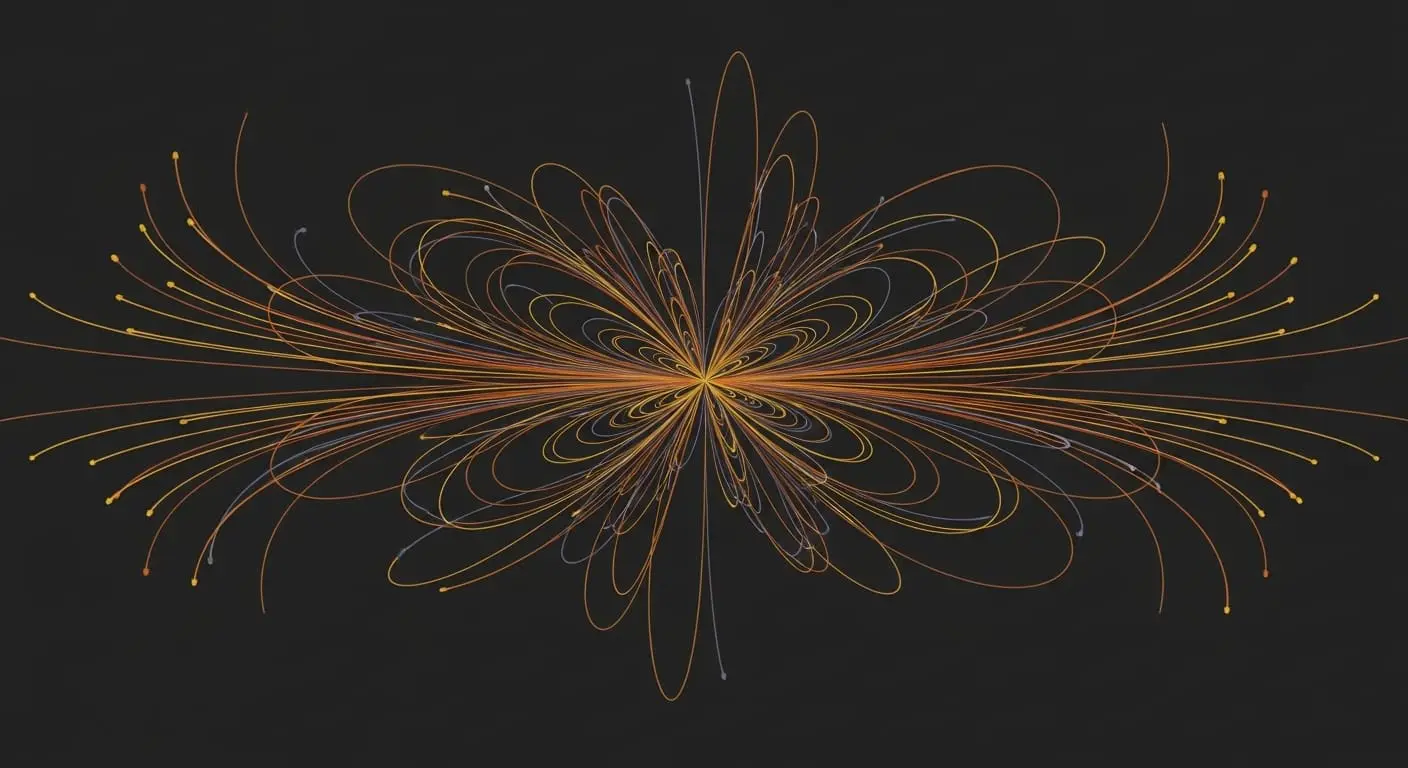
Researchers at the Weizmann Institute of Science, led by Alexander Poddubny, present a detailed theoretical investigation of the two-particle spectrum, ω(K), for a chiral waveguide quantum electrodynamic (QED) setup comprising an array of two-level atoms interacting directionally with photons propagating along the waveguide. The study demonstrates the existence of distinct solutions with Imω ≤ 0 for each pair centre-of-mass momentum K, corresponding to bound, antibound and resonance states, in addition to the continuum of scattering states. Critically, this work extends previous investigations by revealing these states consistently across the entire range of centre-of-mass momenta, and importantly establishes a gapless real part to the spectrum, potentially influencing the development of novel photonic devices and advanced quantum information processing techniques.
Complete spectral mapping via tight-binding modelling of chiral waveguide quantum electrodynamics
The dimensionless phase, φ = ω₀d/c, where ω₀ represents the atomic resonant frequency, d is the spacing between atoms, and c is the speed of light, now fully defines the complete two-particle spectrum for chiral waveguide QED. This represents a significant advancement over prior calculations, which were limited to a restricted range of φ values, hindering a comprehensive understanding of the system’s behaviour. The computational complexity of the long-range coupling inherent in these systems previously prevented a full spectral mapping. However, a key innovation in this work was the recasting of the problem as a tight-binding model. This simplification allowed researchers to effectively address the many-body interactions without sacrificing accuracy. The tight-binding approach approximates the continuous wave equation with a discrete set of equations, significantly reducing computational demands.
Utilising the Sherman-Morrison formula, an analytical tool for inverting matrices, the researchers were able to efficiently calculate the two-particle spectrum. This approach revealed a consistent spectrum across all centre-of-mass momentums, definitively identifying bound, antibound and resonance states alongside the expected continuum of scattering states. The presence of a gapless real part of the spectrum is particularly noteworthy. A gapless spectrum implies that there are states with arbitrarily low energy, potentially enabling the creation of slow light and enhancing light-matter interactions. This characteristic is crucial for applications in areas such as optical buffers and efficient energy transfer within photonic circuits. Further analysis revealed a tridiagonal matrix structure for the effective Hamiltonian governing photon pairs. This simplification is a direct consequence of the tight-binding approximation and dramatically reduces computational complexity, allowing for a more detailed investigation of the parameters influencing state formation. Specifically, the chirality parameter, which dictates the direction of photon propagation, and the atomic resonant frequency, ω₀, were identified as key determinants of the observed spectral features.
Boundary conditions imposed at the edges of the waveguide were found to significantly impact the formation of bound states. These conditions introduce energy shifts due to confinement effects and modify the tunneling matrix elements between atoms, altering the strength of the interaction. The precise nature of these boundary conditions, whether they are perfectly reflecting or partially transmitting, dictates the allowed energy levels and the stability of the bound states. Understanding these effects is crucial for designing waveguides with specific properties and controlling the behaviour of photons and atoms within them. The study highlights that the interplay between the chirality of the waveguide, the atomic resonant frequency, and the boundary conditions determines the overall spectral landscape and the characteristics of the resulting bound, antibound, and resonance states.
Mapping the complete energy spectrum of light-matter interactions within these chiral waveguide QED systems offers tantalising prospects for building new photonic devices and enhancing quantum information processing capabilities. The ability to control the formation and properties of bound states, for example, could lead to the development of highly efficient optical cavities for storing and manipulating photons. Similarly, the unique characteristics of antibound states, while requiring further investigation, may offer novel pathways for creating robust quantum states. This work, however, remains firmly within the realm of theoretical physics, necessitating experimental confirmation of the predicted states to establish their physical reality. The theoretical predictions regarding the influence of the system’s parameters, including the chirality parameter and atomic resonant frequency, on the observed spectral features and the formation of these states are detailed within this study, providing a roadmap for future experimental investigations.
Investigating the impact of varying these parameters, such as the atomic spacing, d, and the strength of the light-matter coupling, could unlock further control over light-matter interactions and optimise device performance. Photons and two-level atoms exchange energy within a chiral waveguide QED system, as detailed by this theoretical work, establishing a complete energy spectrum. Consistent behaviour is now demonstrated across all measurable momenta, providing a thorough picture of particle interactions, unlike previous investigations restricted to limited momentum ranges. Bound states represent tightly linked particles, exhibiting strong correlations and long lifetimes, while resonance states are loosely associated and easily disrupted by external perturbations. Antibound states represent a unique spectral feature, characterised by negative energies and potentially offering novel functionalities in quantum technologies, though their precise role requires further investigation. The identification and characterisation of these states represent a significant step towards harnessing the power of chiral waveguide QED for advanced photonic applications.
The research demonstrated a complete two-particle energy spectrum within a chiral waveguide QED system, comprising bound, resonance and antibound states across all centre-of-mass momenta. This is significant because it provides a comprehensive understanding of how photons and two-level atoms interact within this system, extending beyond the limited ranges of previous studies. The identification of these distinct states, particularly the unique antibound states, may offer novel functionalities, though further investigation is needed to fully characterise their properties. The authors suggest that varying parameters like atomic spacing and light-matter coupling could offer further control over these interactions.
👉 More information
🗞 Bound, antibound and resonance two-photon states in chiral waveguide QED
🧠 ArXiv: https://arxiv.org/abs/2604.20602



See today’s quantum computing news on Quantum Zeitgeist for the latest breakthroughs in qubits, hardware, algorithms, and industry deals.



