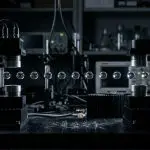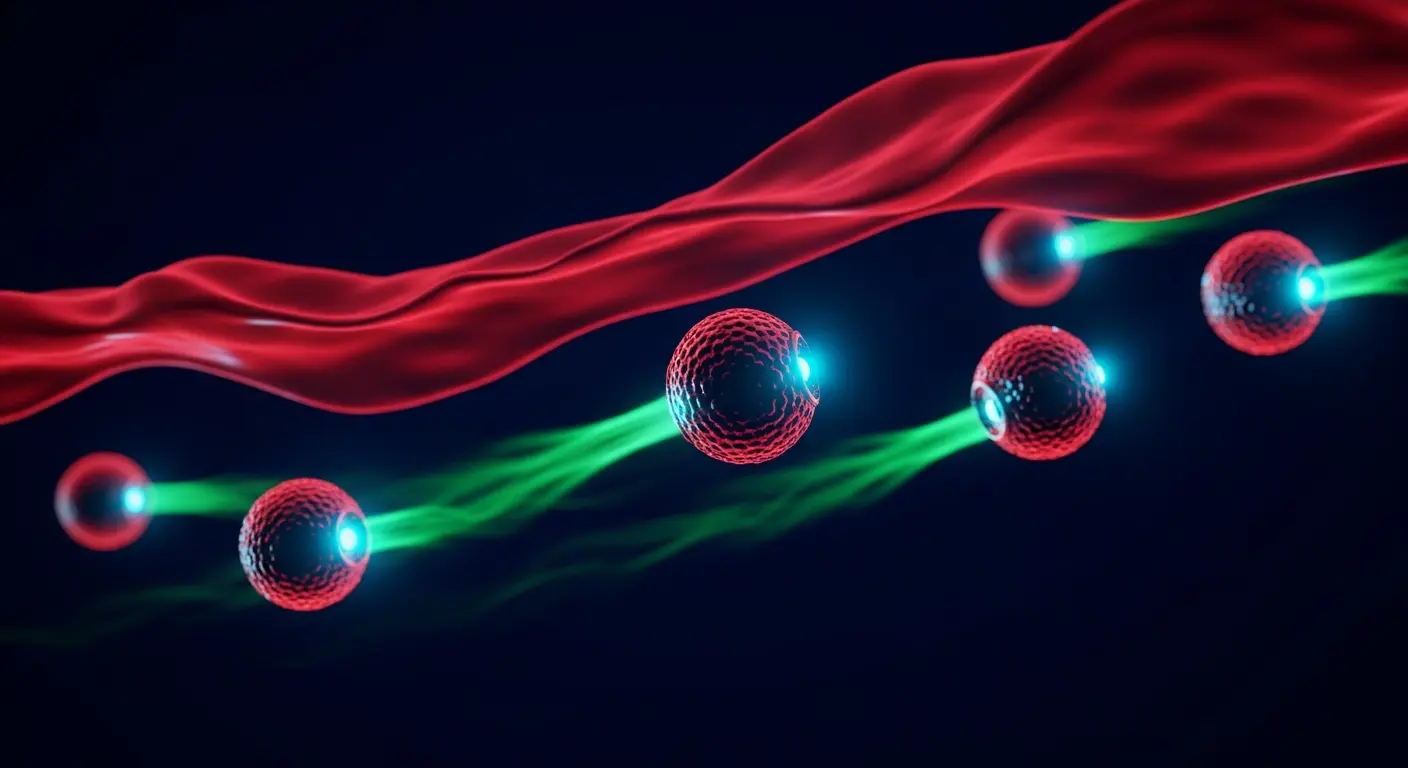
Yu-Han Tseng of Yale University, and colleagues from Lawrence Berkeley National Laboratory, detected momentum transfer from individual collisions between gas particles and an optically levitated nanoparticle. The team report accurate measurement of gas partial pressures through observed event rates and a sensitive assessment of nanoparticle surface properties via spectral shape analysis. Levitated optomechanical sensors achieve the sensitivity needed for precision measurements of fundamental particle interactions, and the findings provide a proof-of-principle for a new primary pressure sensor based on detecting single gas particle impacts.
Impulse signal reconstruction enables single gas particle collision quantification and pressure
Reconstruction of impulse signals as small as 200 keV/$c$ represents a tenfold improvement over previous limits, which previously hindered the detection of individual gas particle collisions. Prior research in this area lacked the sensitivity to isolate the minuscule momentum transfer from a single gas molecule impacting a micro- or nanoscale object. Traditional methods lacked the sensitivity to discern these events from background noise and thermal fluctuations. This breakthrough was achieved through a combination of advanced optical trapping techniques and sophisticated signal processing algorithms. The optical trap, created using a highly focused laser beam, stably levitates the nanoparticle, effectively isolating it from external disturbances. Simultaneously, precise monitoring of the nanoparticle’s motion allows for the detection of even the smallest impulses resulting from gas particle collisions. Accurate measurement of gas partial pressures is now achieved through observed event rates, and spectral shape analysis provides a sensitive assessment of the nanoparticle’s surface temperature and properties.
The research team verified accurate gas partial pressure measurements, aligning with readings from a cold cathode gauge within the 10−8 to 10−7 mbar range, with uncertainties accounted for in the comparison. The cold cathode gauge served as an independent reference standard, allowing validation of the novel measurement technique. Discrepancies between the two methods were carefully analysed and attributed to systematic errors and limitations in the theoretical modelling. A minimum resolvable partial pressure of approximately 2×10⁻⁹ mbar was established using the current setup. This sensitivity is crucial for applications requiring precise pressure control, such as in vacuum systems and gas-handling experiments.
Detailed analysis of impulse event rates for krypton, xenon, and sulfur hexafluoride revealed good agreement with theoretical models, enabling the team to extract the nanoparticle’s surface temperature and thermal accommodation coefficient. The thermal accommodation coefficient, a measure of how efficiently energy is transferred between the gas particle and the nanoparticle surface, provides valuable insights into the surface properties and composition of the nanoparticle. Observed temperatures near 293 K are consistent with existing silica measurements, although upper limits were reported due to boundary conditions in the analysis. These boundary conditions relate to the assumptions made in the thermal modelling and the limitations of the experimental setup in accurately determining the nanoparticle’s temperature distribution.
Individual molecular impacts measured enabling ultra-sensitive optomechanical sensing
Detecting the minuscule impacts of individual gas molecules upon a levitated nanoparticle offers a pathway towards remarkably sensitive measurements, with potential to revolutionise fields ranging from fundamental physics to industrial process control. The principle behind this sensitivity lies in the exquisite balance between the optical trapping force and the momentum transfer from the colliding gas particle. By carefully controlling the trapping parameters and precisely measuring the nanoparticle’s response, even single collisions can be detected and quantified.
This demonstration, while relying on a high-vacuum environment and specific gas choices, establishes a new sensitivity benchmark for optomechanical sensors, paving the way for future refinements capable of operating in more complex gaseous environments and broadening their practical utility. The high-vacuum environment is necessary to minimise the frequency of collisions and reduce the influence of background gas molecules. Future research will focus on developing techniques to mitigate these effects and enable operation at higher pressures.
A silica nanosphere was utilised in the study to confirm the feasibility of quantifying gas composition by measuring the rate of these impacts, alongside providing a means to characterise the nanoparticle’s surface temperature. Silica was chosen for its well-defined optical properties and its relative ease of fabrication into spherical nanoparticles of uniform size and shape. The size of the nanoparticle is a critical parameter, as it affects both the optical trapping efficiency and the magnitude of the impulse signal.
Establishing measurable impulses as small as 200 keV/$c$ opens questions regarding the limits of sensitivity for detecting even weaker interactions. This could potentially extend to the detection of interactions with even rarer gas species or particles with lower mass. This work therefore establishes a foundation for exploring fundamental particle physics and developing novel primary pressure standards independent of conventional calibration techniques. Current pressure standards rely on secondary measurements derived from macroscopic properties, such as the force exerted on a diaphragm. A primary pressure standard based on single particle collisions would offer a more fundamental and potentially more accurate approach.
The ability to measure these interactions could lead to advancements in both fundamental scientific understanding and practical applications in precision measurement and control systems. Potential applications include ultra-sensitive gas sensors for environmental monitoring, leak detection in vacuum systems, and control of chemical reactions at the single-molecule level. Furthermore, the principles underlying this research could be extended to other optomechanical systems, such as those used in gravitational wave detection and quantum information processing.
The research successfully detected momentum transfers from individual collisions between krypton, xenon, sulfur hexafluoride, and a silica nanoparticle held in place by light. This demonstrates that levitated optomechanical sensors are sensitive enough to measure fundamental particle interactions and accurately quantify gas partial pressures. The observed impulse signals, as small as 200 keV/$c$, also provide a way to characterise the nanoparticle’s surface temperature. Researchers intend to refine techniques to allow operation at higher pressures and further explore the limits of this sensitivity.
👉 More information
🗞 Optomechanical Detection of Individual Gas Collisions
🧠 ArXiv: https://arxiv.org/abs/2604.18371



See today’s quantum computing news on Quantum Zeitgeist for the latest breakthroughs in qubits, hardware, algorithms, and industry deals.