
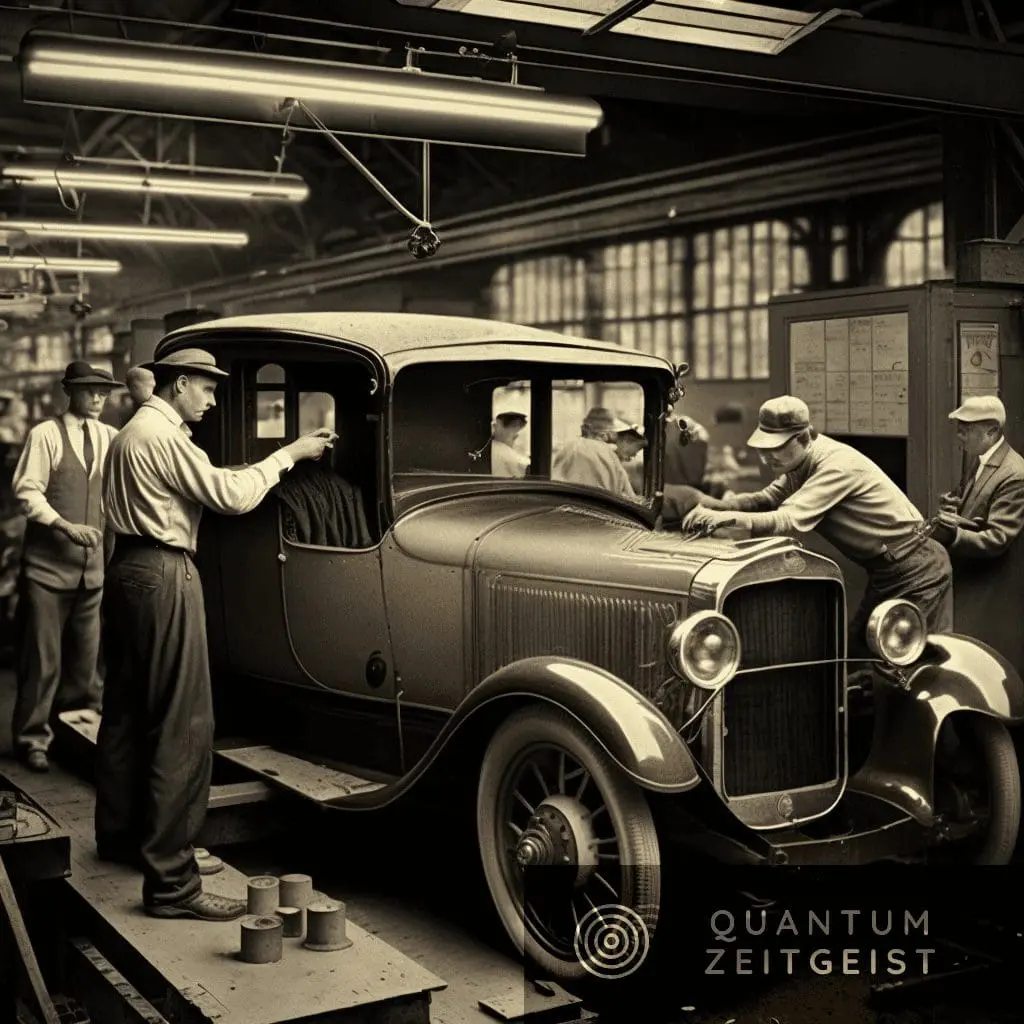
We have seen rapid development, especially in technology, over the last two centuries. Civilization has witnessed the adoption of electricity, computing and mass information. That has led some to suggest that the Quantum information age may usher in a new industrial revolution.
Historical development of the Qubit
The history of the qubit, or quantum bit, dates back to the early days of quantum mechanics in the 1900s. It was initially introduced as a mathematical concept to describe the properties of particles on a quantum level.
In the 1950s, physicist Richard Feynman proposed using quantum computers for specific tasks that would be difficult or impossible for classical computers. However, it wasn’t until the 1980s that physicists such as Paul Benioff and Yuri Manin seriously explored using quantum mechanical systems for computation.
In 1985, physicist David Deutsch proposed the first quantum algorithm, which could solve problems exponentially faster than the best-known classical algorithm. Then in 1994, mathematician Peter Shor developed an algorithm that could factor large numbers exponentially more quickly than the best-known classical algorithm, demonstrating the potential of quantum computers for cryptography.
The first solid-state qubits were demonstrated in 1995 using nuclear magnetic resonance (NMR) techniques. Since then, other qubit technologies have been explored, including superconducting qubits, trapped ions, and quantum dots.
Significant advances in qubit coherence and entanglement were made in the 2000s, leading to rapid growth and considerable investment in quantum computing by governments and industry in the 2010s. Companies such as IBM, Google, and Microsoft have developed quantum hardware and software in the race to develop a practical quantum computer.
Researchers continue to explore new qubit technologies and improve the coherence and stability of qubits, to develop a practical quantum computer that can solve problems beyond the capabilities of classical computers. The development of quantum error correction codes and fault-tolerant quantum computing is an active area of research.
Why quantum could be a technological accelerant
The digital and silicon revolution didn’t just give us faster machines. It had a halo effect on a vast range of other industries. You can call it an accelerant. Might we see the same thing for the Quantum revolution, where quantum physics embeds itself into the fabric of the next wave of technological and even societal developments?
The invention of the integrated circuit, or the microchip, made from silicon, revolutionized the electronics industry and paved the way for modern computers, smartphones, and other digital devices. Integrated circuits have led to exponential growth in computing power and have enabled the development of new technologies, such as artificial intelligence, the Internet of Things, and autonomous vehicles.
Quantum computing has the potential to accelerate progress in various industries, including chemistry, finance, materials science, logistics, and more.
One of the most promising applications of quantum computing is in the field of chemistry. Quantum computers can simulate the behaviour of molecules at a quantum level, which is very difficult for classical computers. This ability can be used to design new drugs and materials and optimize chemical processes and catalysts. For example, researchers at IBM have used a quantum computer to simulate the behaviour of a small molecule involved in the nitrogen fixation process, which could lead to the development of more efficient fertilizers.
Another industry that could benefit from quantum computing is finance. Quantum computers can analyze complex financial data and perform optimization tasks much faster than classical computers, such as portfolio optimization and risk analysis. This could lead to more efficient trading strategies and better risk management. Companies like Goldman Sachs and JP Morgan are already exploring quantum computing in finance.
In materials science, quantum computers can be used to predict the properties of new materials, such as superconductors and topological insulators, that could have applications in energy, electronics, and other fields. For example, researchers at Google and the University of California, Santa Barbara, have used a quantum computer to simulate the behaviour of a superconductor, which could lead to the development of new materials for energy storage and transmission.
In logistics, quantum computing can optimize supply chain management and route optimization, which could lead to significant cost savings and efficiency gains. For example, Volkswagen is using a quantum computer to optimize the schedules of its 1,500 delivery trucks in Brazil, reducing delivery times by 20%.
Overall, quantum computing has the potential to revolutionize many industries and enable the development of new technologies that were previously impossible. However, significant technical challenges remain in the development of practical quantum computers, and it may be several years before quantum computing becomes widely adopted in the industry.
Is Quantum just a new name for existing technologies?
No. Quantum technologies are fundamentally a new way to store, manipulate and transmit information. Be aware it’s not simply a “faster” way of doing things or a fancy name. Quantum Computing, Quantum Security are new technologies based on the fundamentals of quantum physics.
A quantum bit, or qubit, differs from a classical bit (binary bit) because it can exist in a state of superposition, which means it can be simultaneously in multiple states. In contrast, a classical bit can only live in one of two states, 0 or 1.
In addition to superposition, qubits can also exhibit a phenomenon known as entanglement, where two or more qubits can become correlated in such a way that the state of one qubit depends on the state of another, even if they are physically separated.
These quantum mechanical properties allow quantum computers to perform certain tasks much faster than classical computers. For example, using Shor’s algorithm, a quantum computer can factor large numbers exponentially faster than a classical computer. This has implications for cryptography and could break many commonly used encryption methods.
A qubit and a classical bit differ in how they are represented and manipulated. While a classical bit is represented as either a 0 or 1, a qubit can be represented as a vector in a two-dimensional complex vector space, known as a Bloch sphere. The state of a qubit can be manipulated using quantum gates, which are analogous to classical logic gates.
Overall, the unique properties of qubits make them a fundamental building block of quantum computing and enable quantum computers to perform specific difficult or impossible calculations for classical computers.
What could a Quantum age bring?
Predictions of a quantum age are wide-ranging and encompass many fields of study. Quantum computers have the potential to revolutionize industries such as finance, drug discovery, and cryptography. Here are a few potential predictions of what a quantum age could bring:
Quantum computers have the potential to perform certain calculations exponentially faster than classical computers. This could lead to breakthroughs in fields such as cryptography, materials science, and machine learning. Quantum computers could be used to simulate and predict the behavior of molecules, allowing for faster and more accurate drug discovery.
Quantum computers could model and simulate complex financial systems, potentially leading to better risk management and investment strategies. Quantum cryptography could be used to develop unbreakable encryption methods, providing secure communication for sensitive information.
Quantum sensors could detect and measure things at a currently impossible level with classical sensors. This could lead to advances in fields such as medical imaging and mineral exploration.
What has Quantum achieved so far?
- Quantum supremacy: In 2019, Google claimed to have achieved quantum supremacy by demonstrating that its quantum computer could perform a calculation that would take even the most powerful supercomputers thousands of years to complete.
- Shor’s algorithm: In 1994, mathematician Peter Shor proposed an algorithm for factoring large numbers on a quantum computer exponentially faster than classical methods. While this algorithm has not yet been used to break any widely used encryption methods, it has significant implications for cryptography.
- IBM has demonstrated a 433 qubit Quantum Computer.
- Quantum teleportation: In 1993, scientists proposed a protocol for quantum teleportation, which involves transmitting the state of one qubit to another without physically moving the qubit itself. This has important implications for secure communication and quantum computing.
- Quantum sensors: Quantum sensors have been developed for various applications, including measuring magnetic fields, detecting gravitational waves, and sensing temperature.
Who will be the winners and losers of the Quantum Race?
The quantum revolution is expected to bring about significant changes and advancements in various fields, including computing, materials science, cryptography, and more. Here are some potential winners and losers of the quantum revolution:
Winners
Organisations and researchers working on quantum computing technologies and applications stand to benefit significantly from the quantum revolution. Quantum computers are expected to be exponentially faster than classical computers for specific algorithms such as Shor and Grover—other applications are drug discovery, machine learning, and cryptography.
Countries investing heavily in quantum research and development, such as the United States (North America), China, and Europe, will likely be winners. These countries could become quantum technology leaders and gain a competitive advantage in various industries.
Companies incorporating quantum technology into their products and services could also profit. For example, quantum sensors could enable more precise oil and gas exploration measurements or environmental monitoring.
Losers
The quantum revolution may negatively impact companies and industries that rely heavily on current encryption methods, such as banks and financial institutions. Quantum computers are expected to be able to break many existing encryption algorithms (eventually, as they become more powerful), which could compromise sensitive data and transactions.
Other industries that the quantum revolution may negatively impact include the pharmaceutical industry, which may face increased competition from companies using quantum computing to discover new drugs, and the semiconductor industry, which could be disrupted by the development of quantum computers that could replace traditional computing systems.
Countries and companies that fall behind in the race to develop and commercialize quantum technology could also be losers. These entities may miss quantum technology’s potential economic and strategic benefits and fall behind their competitors.
How not to lose out
Get educated. Learn as much as possible about fields such as quantum computing. There are plenty of resources, from courses to consultancy, whereby an outside agency can help you get up to speed with the Quantum workflow.
There is often no better way than getting hands-on experience of the quantum stack. Companies like IBM offer a Quantum cloud service allowing users to develop quantum circuits on the cloud and even on real quantum hardware. But no need for actual quantum hardware to get going with your understanding of how quantum computers work because you can simulate your Quantum circuits.
QAAS or Quantum As A Service is how just about all users will interact with the Quantum stack bits the cloud, unlike classical computer software development, whilst now it’s typically accessed on the cloud, can be commonly run on standard hardware, whereas just about no-one can claim to have a quantum computer on their desk (well apart from the 2/3 qubit devices from SpinQ)