Researchers at Illinois State University, led by Dr. Justin Bergfield, have made a groundbreaking discovery. This finding could harness waste heat to power the next generation of energy-efficient quantum computers. In collaboration with the Air Force Research Laboratory, the team has uncovered how quantum interference can efficiently generate a spin-voltage to control quantum information flow.
This phenomenon can potentially revolutionize energy conversion technologies and enable a wide range of quantum information devices. Dr. Bergfield and undergraduate researcher Runa Bennett and AFRL senior research scientist Dr. Joshua Hendrickson published their findings in the prestigious ACS Nano. Their work leverages spintronics, a field that utilizes electron spin instead of charge, to develop more efficient quantum computers.
Introduction to Spintronics and Quantum Innovation
The concept of harnessing waste heat to power the next generation of energy-efficient quantum computers is an innovative idea. It has garnered significant attention in recent years. The Air Force Research Laboratory (AFRL) collaborated with researchers at Illinois State University. They have made a groundbreaking discovery. This finding may make this possibility a reality. The team, led by Dr. Justin Bergfield, has uncovered how quantum interference can efficiently generate a “spin-voltage” to control the flow of quantum information. This breakthrough has the potential to revolutionize energy conversion technologies and enable a wide range of quantum information devices.
The field of spintronics leverages electron spin instead of charge. This approach is a promising avenue for developing certain types of quantum computers. Spin-based devices could drastically reduce energy loss and heat generation compared to traditional electronics. However, controlling spin is much harder than controlling electricity, and novel approaches are required. By leveraging the wave-like nature of electrons, the researchers have shown that quantum “weirdness” can lead to entirely new ways of harnessing waste heat for advanced technologies.
The team utilized Illinois State’s High-Performance Computing (HPC) cluster to conduct advanced simulations of circuits composed of metal electrodes connected to single molecules. These systems have been successfully built and measured by the researchers’ collaborators. The simulations involved modeling how spin and charge flow in molecule-based devices, which requires tackling the quantum many-body problem. This involves predicting the behavior of approximately 10²³ interacting electrons, a task that is rarely feasible. However, the researchers have crafted computational and mathematical techniques that have uncovered behaviors that are both surprising and rich with potential for future technologies.
The research was graciously funded by the National Science Foundation (Grant DMR-1809024) and marks a critical step toward scalable quantum devices for energy-efficient applications. The discovery has the potential to pave the way for innovations in quantum computing, secure communication, and energy recovery. As undergraduate researcher Runa Bennett noted, “It’s exciting to see how quantum mechanics, something so fundamental, can have such practical applications. It’s a step toward addressing some of the most pressing energy challenges of our time.”
Quantum Interference and Spin-Voltage Generation
Quantum interference is a phenomenon where particles behave like waves and either reinforce or cancel each other. The researchers have discovered that this phenomenon can be used to efficiently generate a spin-voltage, which is essential for controlling the flow of quantum information. The team’s findings, published in the prestigious ACS Nano, highlight the dramatic enhancement of spin-thermoelectric efficiency in node-possessing molecular junctions.
The concept of spin thermopower is illustrated, which shows the dependence of spin thermopower on quantum interference and spin-splitting. The figure is based on quantum many-body simulations from the research of Dr. Justin Bergfield, undergraduate Runa Bennett, and collaborators. The work highlights the potential for using waste heat to generate a spin-voltage, which can be used to power quantum devices.
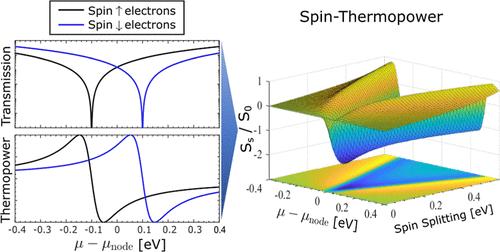
The researchers utilized a schematic of the benzenedithiol (BDT) single-molecule junction, as shown in Figure 3, to test their theoretical predictions. In this configuration, electron waves flow around the benzene ring and interfere destructively. With an applied magnetic field, the Bergfield team demonstrates that heat can be efficiently converted into a spin-voltage. This work provides valuable insights into the mechanisms driving spin-based energy transport and lays the foundation for future quantum information technologies.
The generation of spin-voltage is a critical component of spintronics, as it enables the control of spin-based devices. The researchers’ discovery has the potential to revolutionize the field of spintronics and enable the development of more efficient and powerful quantum devices. As Dr. Bergfield noted, “By leveraging the wave-like nature of electrons, we’ve shown that quantum ‘weirdness’ can lead to entirely new ways of harnessing waste heat for advanced technologies.”
Spintronics and Quantum Computing
The field of spintronics has the potential to revolutionize the field of quantum computing. Spin-based devices could drastically reduce energy loss and heat generation compared to traditional electronics, making them ideal for use in quantum computers. The researchers’ discovery has the potential to enable the development of more efficient and powerful quantum devices, which could have a significant impact on the field of quantum computing.
Quantum computing is a rapidly evolving field that has the potential to solve complex problems that are currently unsolvable with traditional computers. However, the development of quantum computers is hindered by the need for more efficient and powerful devices. The researchers’ discovery has the potential to address this challenge and enable the development of more advanced quantum computers.
The use of spintronics in quantum computing also has the potential to enable secure communication. Spin-based devices could be used to create secure communication channels that are resistant to eavesdropping and tampering. This could have a significant impact on the field of secure communication, enabling the creation of secure communication networks that are essential for many applications.
Energy Recovery and Future Applications
The researchers’ discovery has the potential to enable the development of more efficient energy recovery systems. Spin-based devices could be used to harness waste heat and convert it into usable energy, reducing energy loss and increasing efficiency. This could have a significant impact on the field of energy recovery, enabling the creation of more efficient and sustainable energy systems.
The discovery also has the potential to enable the development of more advanced quantum devices, including quantum sensors and quantum simulators. These devices could be used to study complex phenomena and make new discoveries in fields such as materials science and chemistry.
As Dr. Bergfield noted, “Modeling how spin and charge flow in molecule-based devices requires tackling the quantum many-body problem. This involves predicting the behavior of approximately 10²³ interacting electrons—roughly as many as there are stars in the universe.” The researchers’ discovery has the potential to address this challenge and enable the development of more advanced quantum devices.
Conclusion
The researchers’ discovery has the potential to revolutionize the field of spintronics. It could enable the development of more efficient and powerful quantum devices. Quantum interference is used to generate a spin-voltage. This is a critical component of spintronics. It enables the control of spin-based devices. The discovery could solve some of the most pressing energy challenges of our time. These include the need for more efficient energy recovery systems. They also encompass the demand for secure communication networks.
The research received gracious funding from the National Science Foundation (Grant DMR-1809024). It marks a critical step toward scalable quantum devices for energy-efficient applications. Undergraduate researcher Runa Bennett noted her excitement. She said, “It’s exciting to see how quantum mechanics, something so fundamental, can have such practical applications.” The discovery could lead to innovations in quantum computing. It can also advance secure communication and energy recovery. This enables the creation of more efficient and sustainable energy systems.
The future of spintronics and quantum innovation is promising, with many potential applications and discoveries waiting to be made. As Dr. Bergfield noted, “By leveraging the wave-like nature of electrons, we’ve shown that quantum ‘weirdness’ can lead to new methods.” These methods harness waste heat for advanced technologies. The researchers’ discovery is an important step toward realizing the potential of spintronics and quantum innovation. It enables the creation of more efficient and powerful devices. These devices can address some of the most pressing challenges of our time.
External Link: Click Here For More