


Oussama Korichi and colleagues at Tampere University have created a key advance in integrated photonics. Their research introduces a compact, monolithic multi-plane light conversion (MPLC) architecture fabricated directly within fused silica glass using laser writing. This new approach overcomes limitations of existing technologies by enabling efficient, full vectorial control of light structures within a volume of just a few cubic millimeters. The ability to perform complex beam-splitting, mode conversions, and polarization control, including the manipulation of optical Skyrmions, opens up possibilities for advanced optical networks and miniaturised devices for optical communications at telecom wavelengths.
High-efficiency multi-plane light conversion within monolithic fused silica glass
Transmission efficiencies of approximately 89 per cent per modulation plane at 808nm, and 94 per cent at 1550nm, represent a substantial improvement over previous laser-written geometric-phase elements. Earlier devices typically relied on single-plane modulation or only a few cascaded planes, resulting in significant signal loss due to the cumulative effect of imperfections at each interface. This performance threshold allows for the creation of fully volumetric multi-plane light conversion (MPLC) architectures, previously limited by cumulative loss when stacking multiple bulky optical components. The significance of achieving such high efficiencies lies in the potential to create complex optical systems without sacrificing signal integrity, a crucial factor for applications requiring precise control of light.
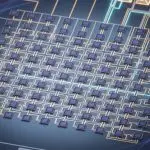
The new monolithic device, fabricated directly within fused silica glass, contains up to 30 modulation planes within a volume of just 0.7mm x 0.7mm x 10mm; each plane comprises between 200×200 and 500×500 pixels controlling light polarization. Complex beam-splitting and the transformation of light’s polarization are now possible, even manipulating the topology of optical skyrmions, twisted wave patterns with potential applications in data storage and advanced imaging. A 15-mode spatial mode sorter and a 12-mode polarization and spatial mode sorter were also successfully implemented, showcasing potential for miniaturised optical networks capable of handling multiple data streams simultaneously. These sorters are vital for increasing the capacity and efficiency of optical communication systems by allowing for the separation and routing of different spatial and polarization modes of light.
This compact device, measuring a few cubic millimeters, contains between 10 and 30 layers, each approximately 0.7mm by 0.7mm in area, with pixels ranging from 2 to 8 micrometers in size. The devices utilise Type II nanogratings, chosen for their ability to create effective half-waveplates with only two or three layers, offering advantages over bulkier optical components and more complex nanofabrication techniques. Half-waveplates alter the polarization of light by 90 degrees, and the use of Type II nanogratings allows for this to be achieved with minimal material thickness and complexity. This approach enables complex manipulation of light within a tiny volume, paving the way for miniaturised optical networks and integrated photonics, potentially revolutionising fields like telecommunications, sensing, and quantum computing.
Fabrication of compact multi-plane light conversion devices via laser-induced birefringence in
Direct laser writing within fused silica glass proved central to fabricating this new device. The technique exploits the material’s birefringence, where light bends differently depending on its polarization, much like its behaviour when passing through a crystal. By carefully controlling ultrashort laser pulses, typically in the femtosecond regime, nanoscale modifications were induced, creating layers of patterned birefringence within the glass. These layers act as spatially-varying half-waveplates, subtly altering the light’s polarization. The precise control over laser parameters, such as pulse duration, energy, and scanning speed, is crucial for creating nanogratings with the desired properties. This process allows for precise control over the light’s properties across multiple internal layers, akin to a sculptor gradually forming a statue. Stacking these modifications, a process called multi-plane light conversion, enabled complex manipulation of light within a tiny volume, offering a pathway towards fully integrated photonics.
Laser-written nanogratings enable compact multi-plane light manipulation in glass
The demand for manipulating light’s properties, its polarization, phase, and amplitude, is growing rapidly across diverse fields, from fundamental optics research to advanced applications such as microscopy, optical trapping, and quantum information processing. Researchers are actively seeking efficient ways to control multiple light modes simultaneously, and multi-plane light conversion offers a promising route. However, current methods often rely on bulky optical components, limited scalar control (affecting only the intensity of light, not its polarization or phase), or complex nanofabrication, hindering widespread adoption. Traditional optical elements, like lenses and prisms, are often large and require precise alignment, making miniaturisation difficult.
Fabricating complex optical components remains challenging and expensive, limiting practical implementation of multi-plane light conversion. This new work addresses these limitations by demonstrating a compact and efficient method for manipulating light using laser writing in glass. Volumetric engineering creates nanogratings, tiny structures with dimensions on the nanometre scale, within the glass, controlling the light’s properties without bulky optics or intricate fabrication. These nanogratings are formed by inducing a periodic change in the refractive index of the glass, effectively creating a diffraction grating that modifies the polarization of light. This advance establishes full vectorial control of light within a compact, glass-based device, meaning that both the amplitude and polarization of light can be precisely controlled.
The multi-plane light conversion (MPLC) architecture manipulates light’s properties across multiple internal layers. A miniaturised multiplexer operating at telecom wavelengths (around 1550nm) confirms the potential for optical communications, overcoming limitations of previous bulky or scalar-only systems. This is particularly important for increasing the bandwidth and capacity of fibre optic networks. Further work will likely explore integrating multiple devices into complex optical circuits and fully characterising wavelength-dependent performance, potentially leading to the development of highly integrated photonic chips for a wide range of applications. Investigating the long-term stability and scalability of the fabrication process will also be crucial for translating this technology into commercially viable products.
The researchers successfully created a compact device for manipulating light using laser writing within fused silica glass. This new method overcomes limitations of previous optical components by enabling full control over the amplitude and polarization of light in a device measuring only a few cubic millimetres. The architecture uses nanogratings to modify light’s properties, demonstrating multi-mode transformations and complex beam-splitting for both scalar and vectorial light. This advance offers potential for integrated multimode optical networks and, as demonstrated by a miniaturised multiplexer, may benefit optical communications.
👉 More information
🗞 Volumetric Processing of Structured Light Integrated in Glass
🧠 ArXiv: https://arxiv.org/abs/2604.18885



See today’s quantum computing news on Quantum Zeitgeist for the latest breakthroughs in qubits, hardware, algorithms, and industry deals.



