

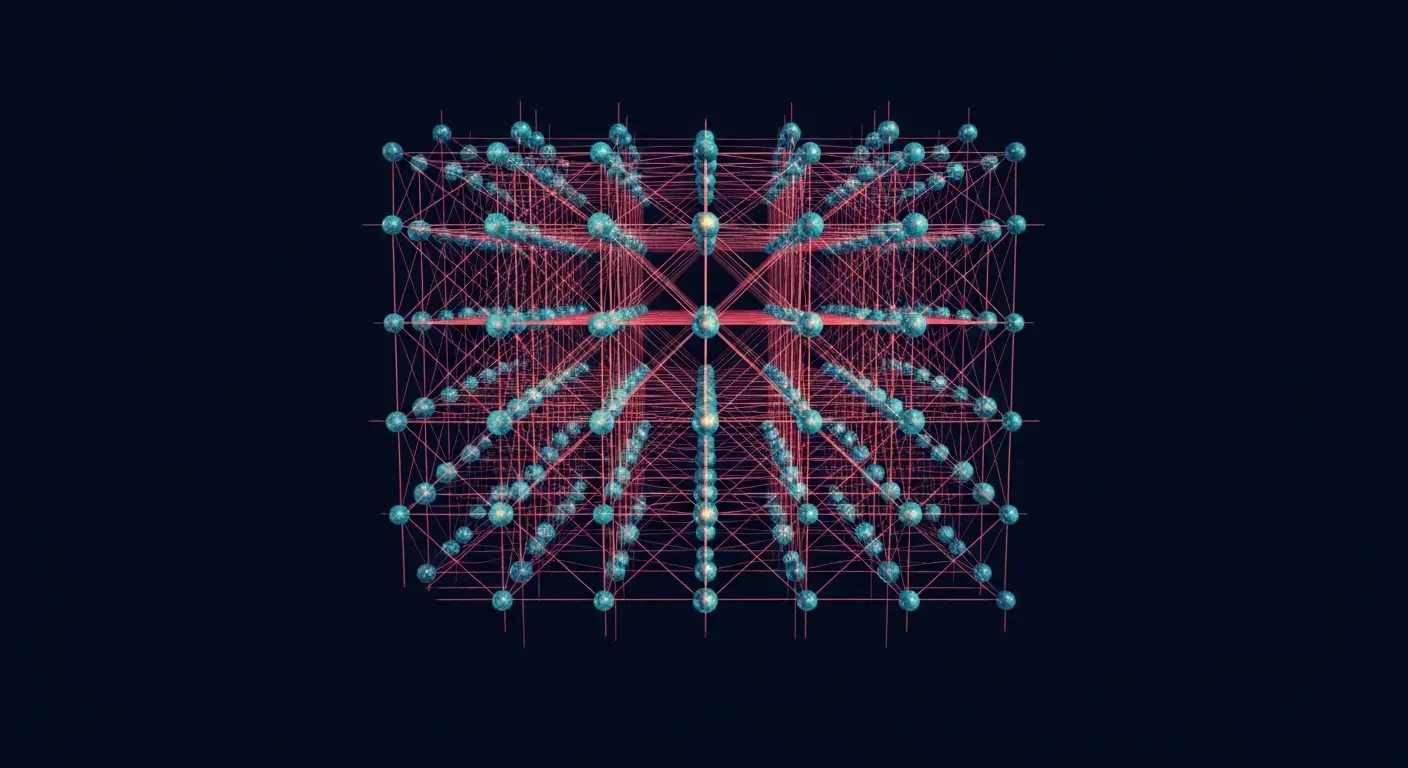
Tom Ben-Ami at Max-Planck-Institut f¨ur Physik komplexer Systeme in collaboration with University of Augsburg and colleagues have engineered ‘many-body cages’ within Floquet circuits, a recently discovered route to unusual behaviour in quantum materials. The research details a general construction for these circuits and a strategy to structure these cages, showcasing the approach with the quantum hard disk model potentially realisable in Rydberg atom arrays. The resulting Floquet many-body cages exhibit topological properties and unique ‘time crystalline’ order, offering a new set of tools for manipulating nonequilibrium behaviour in a broad range of driven quantum systems.
Engineered many-body localisation drives transition to discrete time-crystal phase
After 104 periods of pulsed driving, a many-body caged spin glass, previously exhibiting fractal-like properties, transitioned to a spatiotemporally ordered discrete time crystal. This transformation resulted from engineering techniques allowing precise control over quantum interference and the creation of π-quasienergy modes within the system. Floquet circuits, repeating sequences of pulses, constructed ‘many-body cages’ to actively build ‘many-body cages’ which localise quantum particles and prevent typical energy distribution; this contrasts with relying on pre-existing configurations or disorder.
The emergence of a spatiotemporally ordered discrete time crystal occurred from a many-body caged spin glass following 104 periods of pulsed driving. Precise control of quantum interference and the generation of π-quasienergy modes underpin this, essential for establishing the time crystalline order; these modes represent a unique form of energy distribution. Floquet circuits, repeating sequences of pulses, employed to construct ‘many-body cages’ which actively localise quantum particles, differing from systems reliant on inherent disorder or pre-existing configurations. Applying this scheme to a quantum hard-disk model, a system potentially built using Rydberg atom arrays, confirmed the possibility of engineering nonequilibrium behaviour; the model’s constraints create sparsely connected state graphs ideal for supporting these cages.
Constructing and Characterising Many-Body Cages Using Palindromic Floquet Drives
Floquet circuits, a repeating sequence of pulses applied to a quantum system, proved central to this investigation. These circuits carefully constructed ‘many-body cages’, a configuration where quantum particles become trapped in a collective state, restricting their movement. Actively building these cages within the quantum system through precise control of the driving pulses, rather than finding pre-existing ones, was key; a general method for designing circuits capable of hosting these cages was identified.
A quantum hard disk model, a system realisable in Rydberg atom arrays, utilised to demonstrate these principles. The experiments involved a square lattice with durations τV and τH governing bosonic hopping; a palindromic drive, combining horizontal and vertical pulses, employed to create the many-body cages. Analysis of the quasienergy spectrum revealed zero-modes and π-quasienergy modes, confirming the emergence of time crystalline spatiotemporal order within the system; the lattice size was L=6 with N=15 sites. This approach offered greater control over cage construction than seeking pre-existing configurations.
Engineered quantum cages offer active control over exotic matter states
‘Many-body cages’ can now be engineered within quantum circuits, creating a new pathway to control exotic states of matter and potentially advance quantum technologies. This approach differs from previous methods reliant on inherent disorder or pre-existing configurations, instead actively building these cages through precisely timed pulses of energy. However, the current demonstration remains within the confines of a specific ‘quantum hard-disk’ model, raising questions about how easily these principles translate to more complex and realistic quantum systems.
A fundamentally new method for controlling quantum systems has been established, despite the initial tests being performed on a simplified ‘quantum hard-disk’ model. Creating these ‘many-body cages’, isolated spaces within a quantum circuit, offers a route to engineer exotic states of matter not reliant on chance or pre-set conditions. This active construction of quantum environments promises advances beyond current limitations, potentially unlocking more stable and complex quantum technologies as the technique expands to encompass more realistic scenarios.
A new technique to actively build ‘many-body cages’ within quantum circuits has been demonstrated, isolating quantum states and enabling control over exotic matter. These engineered cages, tested using a simplified model, offer a pathway beyond relying on random quantum behaviour. Engineered many-body cages offer a novel method for controlling quantum systems, differing from approaches reliant on inherent disorder. This demonstrates the active construction of these cages within Floquet quantum circuits, a repeating sequence of pulses, enabling the creation of unique, stable quantum states. Specifically, a discrete time crystal, a phase of matter exhibiting repeating patterns over time, was successfully built using a quantum hard-disk model potentially realisable with Rydberg atom arrays. The resulting spatiotemporal order, achieved through π-quasienergy modes, now prompts investigation into whether this technique can generate more complex, structured eigenstates within the vast Hilbert space of many-body systems.
A new technique for building ‘many-body cages’ within quantum circuits has been demonstrated. These engineered cages isolate quantum states, offering a route to control matter without relying on inherent disorder or pre-existing configurations. The research successfully created a discrete time crystal using a ‘quantum hard-disk’ model, potentially realisable with Rydberg atom arrays, and exhibiting π-quasienergy modes. The authors suggest this method could be extended to more general quantum circuits, providing a new tool to engineer behaviour in driven systems.
👉 More information
🗞 Floquet Many-Body Cages
🧠 ArXiv: https://arxiv.org/abs/2604.13027

See today’s quantum computing news on Quantum Zeitgeist for the latest breakthroughs in qubits, hardware, algorithms, and industry deals.



