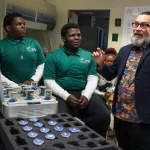
Norbert Holtkamp is defining a focused strategy for Fermilab, prioritizing the laboratory’s core scientific mission approximately 100 days after officially assuming the role of director on January 12, 2026. The experienced leader, who previously managed large-scale projects including ITER, the International Thermonuclear Experimental Reactor in France, is aligning Fermilab with ambitious national research goals. Holtkamp, photographed inside the Industrial Center Building at Fermilab, explained his motivation: “I wanted to be Fermilab director because of ‘the challenge.’” He emphasizes that Fermilab, and the entire DOE national lab system, exists “to ask the difficult questions: the key questions that the nation needs to answer in science and technology.” His initial moves include prioritizing delivery of the Deep Underground Neutrino Experiment at the Long-Baseline Neutrino Facility by 2031, support for the High-Luminosity Large Hadron Collider, and technological innovation.
Norbert Holtkamp’s Strategic Vision for Fermilab’s Future
Norbert Holtkamp’s arrival at Fermilab is marked by a decisive push for focused scientific objectives, a strategy underscored by his extensive experience managing complex international projects. This experience with large-scale, multi-billion dollar endeavors suggests a pragmatic approach to resource allocation and project management at Fermilab. Holtkamp’s initial 100 days have been dedicated to defining a clear direction for the lab, one that directly addresses the core mission established by the U.S. Department of Energy. He articulated his motivation for taking the position, stating he was drawn by “the challenge,” clarifying that it wasn’t the managerial aspects, but rather the pursuit of fundamental scientific questions that appealed to him. A recent photograph shows Holtkamp with staff inside the Industrial Center Building (ICB).
Holtkamp has stressed that these initiatives must be executed safely, with quality, and on schedule, in that order. “Focus is the key to success for organizations facing daunting projects,” he asserted, indicating his confidence in establishing a streamlined workflow. Delivering a leading neutrino program is a top priority for Fermilab and central to maintaining U.S. leadership in neutrino science. DUNE is an international flagship experiment hosted by the Long-Baseline Neutrino Facility and designed to unlock the mysteries of neutrinos. The Long-Baseline Neutrino Facility for DUNE comprises two particle detectors: a smaller detector at Fermilab in Illinois, and a much larger detector a mile below Earth’s surface at the Sanford Underground Research Facility in South Dakota. The LBNF/DUNE-US project recently achieved a critical milestone with the approval of its performance baseline and the commencement of construction, signaling readiness for execution. Steve Brice, head of the Fermilab DUNE Coordination Office, expressed gratitude for Holtkamp’s direction, stating, “We are extremely grateful for Norbert’s direction and focus. I think it will greatly benefit the DUNE at LBNF effort and enable us to achieve and execute at the highest level.”
DUNE at LBNF: Delivering the Leading Neutrino Program
Norbert Holtkamp’s arrival at Fermilab on January 12, 2026, signaled a renewed emphasis on strategic prioritization for the nation’s premier particle physics laboratory, building on decades of ambitious scientific endeavors. Holtkamp, bringing over 20 years of experience managing complex projects at institutions like SLAC, Oak Ridge, and the ITER fusion reactor in France, immediately focused on defining a clear direction for Fermilab’s future. DUNE, an international collaboration hosted by the Long-Baseline Neutrino Facility at Fermilab, aims to unravel the mysteries of neutrinos, elusive subatomic particles potentially holding the key to understanding the matter-antimatter imbalance in the universe. The facility comprises two advanced detectors: one at Fermilab in Illinois and a much larger one located a mile underground at the Sanford Underground Research Facility in South Dakota.
Together with PIP-II, a new particle accelerator, DUNE is poised to define the next generation of discovery, not only addressing fundamental physics but also driving technological advancements. Currently, the collaboration is preparing to install 6,000 tons of steel components for the DUNE detector’s cryostats, entering the project’s final installation phase. In 2026, work includes installing cryogenic distribution piping and preparing for the arrival of the first beamline component, a radio-frequency quadrupole.
In just 100 days, Norbert Holtkamp has set a compelling direction for Fermilab – one grounded in focus, execution and growth.
PIP-II Advances Neutrino Beam Creation for 2026 Goals
Norbert Holtkamp, recently appointed director of Fermilab, is rapidly reshaping the laboratory’s priorities, with a keen focus on delivering ambitious scientific goals. Stepping into his role on January 12, 2026, Holtkamp’s initial 100 days have centered on establishing a clear strategic direction, evidenced by a photo credit from inside the Industrial Center Building and a commitment to safe, quality execution. A central component of this renewed focus is the PIP-II project, a major upgrade to Fermilab’s accelerator complex designed to create the world’s most intense neutrino beam. In 2026, the PIP-II team is concentrating on the “warm front end,” the initial stage where negatively charged hydrogen ions are generated to fuel the accelerator and ultimately produce the neutrino stream. Installation of piping for the cryogenic distribution system is underway, and the first section of the beamline, a radio-frequency quadrupole, is slated for placement within the PIP-II tunnel in the coming weeks.
The three priorities from the director provide focus on all critical aspects of day-to-day work in the HL-LHC AUP.
Giorgio Apollinari, project director of the HL-LHC Accelerator Upgrade Project
Fermilab’s Role in the High-Luminosity LHC Upgrade
Holtkamp, bringing over two decades of experience managing complex scientific endeavors at institutions including ITER in France, identified delivering on three core objectives as central to Fermilab’s future; supporting the HL-LHC upgrade and the CMS experiment represents a significant component of this vision. This isn’t merely about maintaining participation, but ensuring the United States fully benefits from its investment in global particle physics. Fermilab’s role in the HL-LHC upgrade extends beyond simply providing components; the laboratory is a key integrator of U.S. contributions, delivering magnets, detector systems, and crucial computing infrastructure. Already, five cryoassemblies containing niobium-tin magnets have been shipped for use in the collider, designed to focus the beam at interaction points and dramatically increase collision rates.
Fermilab is committed to delivering five additional assemblies by mid-2027, a testament to the collaborative effort involving Lawrence Berkeley National Laboratory, Brookhaven National Laboratory, and Fermilab itself. “The three priorities from the director provide focus on all critical aspects of day-to-day work in the HL-LHC AUP,” said Giorgio Apollinari, project director of the HL-LHC Accelerator Upgrade Project, highlighting the impact of this focused approach. Beyond the HL-LHC, Holtkamp has also prioritized the Deep Underground Neutrino Experiment (DUNE) at the Long-Baseline Neutrino Facility, aiming for completion by 2031. In the last 100 days, the LBNF/DUNE-US project team hosted several successful “critical decision” reviews required by the Department of Energy, including the essential CD-2/3 review that approved the project’s performance baseline and start of construction. This successful review signals that the project is fully planned and ready for execution.
The three priorities from the director provide focus on all critical aspects of day-to-day work in the HL-LHC AUP.
Giorgio Apollinari, project director of the HL-LHC Accelerator Upgrade Project
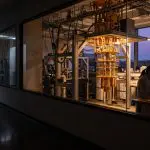
Norbert Holtkamp’s arrival at Fermilab challenges a common assumption about leadership in large science projects; it isn’t the management itself that presents the greatest hurdle, but rather the pursuit of genuinely challenging scientific questions. This background informs his current focus: streamlining Fermilab’s objectives to maximize impact and leadership in neutrino science. Crucially, Holtkamp’s vision extends beyond established particle physics, emphasizing technological innovation in areas like quantum science, artificial intelligence, and detector technologies.
As a community, we need to make sure we ask these questions broadly, define their priorities and then think about the instruments needed to answer them. That has been the fabric of the national labs from their inception.
Norbert Holtkamp, director of Fermilab



See today’s quantum computing news on Quantum Zeitgeist for the latest breakthroughs in qubits, hardware, algorithms, and industry deals.