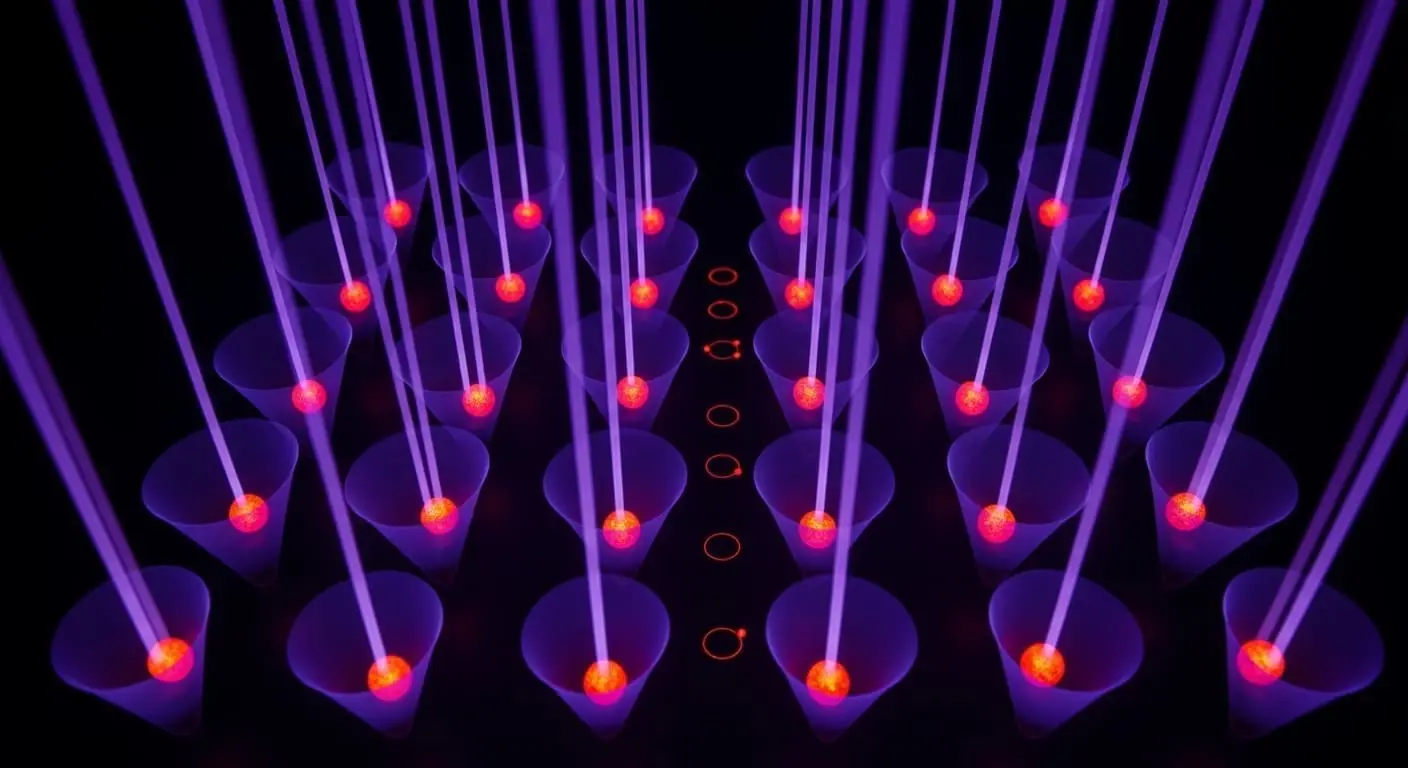
A thorough investigation into light emission from collections of atoms reveals the conditions under which an ensemble of independent two-level atoms produces thermal light, a fundamental characteristic described by the Gaussian Moment Theorem. Manuel Bojer of theQuantum Optics and Quantum Information, and colleagues clarify the relationship between atom number, coherent and incoherent light emission, and the purity of atomic states. The findings offer key insight into the generation of thermal light from non-interacting emitters.
Gaussian Moment Theorem verified for atomic ensembles exceeding ten atoms
Thermal light emission from cold atomic ensembles has now been measured with a previously unattainable precision. The findings establish conditions where the Gaussian Moment Theorem holds true for atom numbers exceeding M=10, a sharp improvement over prior methods limited to qualitative assessments. This breakthrough allows definitive determination of when an ensemble of motionless two-level atoms will exhibit the predictable statistical behaviour of thermal light, which is important for applications in quantum technologies and precision measurement. Traditionally, verifying the Gaussian Moment Theorem required simplifying assumptions about the atomic system, often limiting the analysis to qualitative agreement. The theorem itself states that for a thermal light source, all moments of the light field are determined by the first moment, implying a specific Gaussian distribution of photon number fluctuations. This work moves beyond such approximations by providing quantitative criteria for its validity, specifically relating to the number of atoms involved and the characteristics of their emission. This breakthrough allows for the definitive determination of when an ensemble of motionless two-level atoms will exhibit the predictable statistical behaviour of thermal light. The theorem itself states that for a thermal light source, all moments of the light field are determined by the first moment, implying a specific Gaussian distribution of photon number fluctuations.
Analysis of leading-order corrections revealed how finite-size effects and spin coherence influence deviations from purely thermal behaviour, offering insights into the limits of this approximation. The team derived two specific conditions relating atom number to the ratio of coherent to incoherent light emission necessary for thermal statistics to emerge, validating these across various atomic system examples. These conditions are crucial because they define the boundaries within which the simplified thermal model remains accurate. Coherent light emission arises from the collective, in-phase oscillation of atoms, while incoherent emission stems from spontaneous decay and random phase relationships. The ratio between these two dictates the overall statistical properties of the emitted light. For instance, a higher proportion of coherent emission introduces correlations between photons, moving the system away from the purely random behaviour characteristic of thermal light. The researchers meticulously examined how these ratios, in conjunction with the atom number, impact the higher-order moments of the light field, providing a rigorous test of the Gaussian Moment Theorem. While these results pinpoint the parameters for predictable thermal emission, they do not yet address the significant challenges of maintaining coherence in larger, more complex systems required for practical quantum devices. Atomic interactions, deliberately excluded from the model to simplify calculations, will inevitably alter these findings, introducing a tension between theoretical purity and practical application. Further research will need to address how these interactions affect the observed behaviour and explore methods for mitigating their influence. Specifically, dipole-dipole interactions between atoms can induce correlations, shifting the light statistics away from the ideal thermal profile. Understanding and controlling these interactions is paramount for scaling up these systems for quantum information processing.
Predictable thermal light emission from isolated atoms informs future quantum device development
Scientists have refined our understanding of light emission, identifying precise conditions for achieving thermal light, a predictable form of illumination important for advancing quantum technologies. A baseline of predictable thermal light emission from simplified models remains a key step towards building more complex and realistic quantum devices. Accurate accounting for, and eventual control of, the effects of atomic interactions in future experiments is now possible thanks to this understanding. Thermal light, while seemingly simple, serves as a crucial benchmark for evaluating the performance of more sophisticated light sources used in quantum communication and computation. Any deviation from thermal behaviour indicates the presence of non-classical correlations, which are essential for achieving quantum advantages.
The Gaussian Moment Theorem defines specific conditions for generating light with predictable statistical properties from collections of motionless two-level atoms. Scientists pinpointed relationships between the number of atoms and the balance of coherent and incoherent light emission through its application. Establishing these criteria advances understanding beyond qualitative observations, offering a precise benchmark for evaluating light emission in more complex atomic systems, and providing a foundation for future investigations into the impact of atomic interactions. The methodology involved detailed calculations of the light field’s statistical moments, specifically the second-order correlation function g(2), which quantifies the degree of photon bunching. By comparing these calculated moments with the predictions of the Gaussian Moment Theorem, the researchers could determine the conditions under which thermal behaviour emerges. The analysis considered both pure and mixed states of the atoms, allowing for a comprehensive assessment of the theorem’s validity under different conditions. Real-world atomic ensembles are never truly motionless or independent, so this work, focused on perfectly isolated atoms, skirts a significant challenge. Despite acknowledging that real atoms are never perfectly isolated, these findings establish a foundation for understanding light emission, as interactions between them will alter these results. The assumption of motionless atoms simplifies the theoretical model, eliminating the complexities of Doppler broadening and motional effects. However, this simplification allows for a clearer understanding of the fundamental principles governing thermal light emission. Future work will undoubtedly need to incorporate these effects to accurately model real-world systems. Furthermore, the assumption of independent atoms neglects the crucial role of collective effects, such as Dicke superradiance, which can significantly alter the light statistics. Investigating the interplay between these collective effects and the Gaussian Moment Theorem represents a promising avenue for future research, potentially leading to the development of novel quantum light sources with enhanced properties.
The research demonstrated that an ensemble of two-level atoms emits thermal light when specific conditions relating to atom number and coherent to incoherent light emission are met. This is important because it provides a precise understanding of how light is generated by these atoms, moving beyond simple observation to quantifiable criteria. The researchers calculated statistical moments of the light field to verify the Gaussian Moment Theorem, considering both pure and mixed atomic states. They note that future work should address the complexities of atomic motion and interactions to model more realistic systems.
👉 More information
🗞 Deviations from thermal light statistics in ensembles of independent two-level emitters
🧠 ArXiv: https://arxiv.org/abs/2604.05823



See today’s quantum computing news on Quantum Zeitgeist for the latest breakthroughs in qubits, hardware, algorithms, and industry deals.