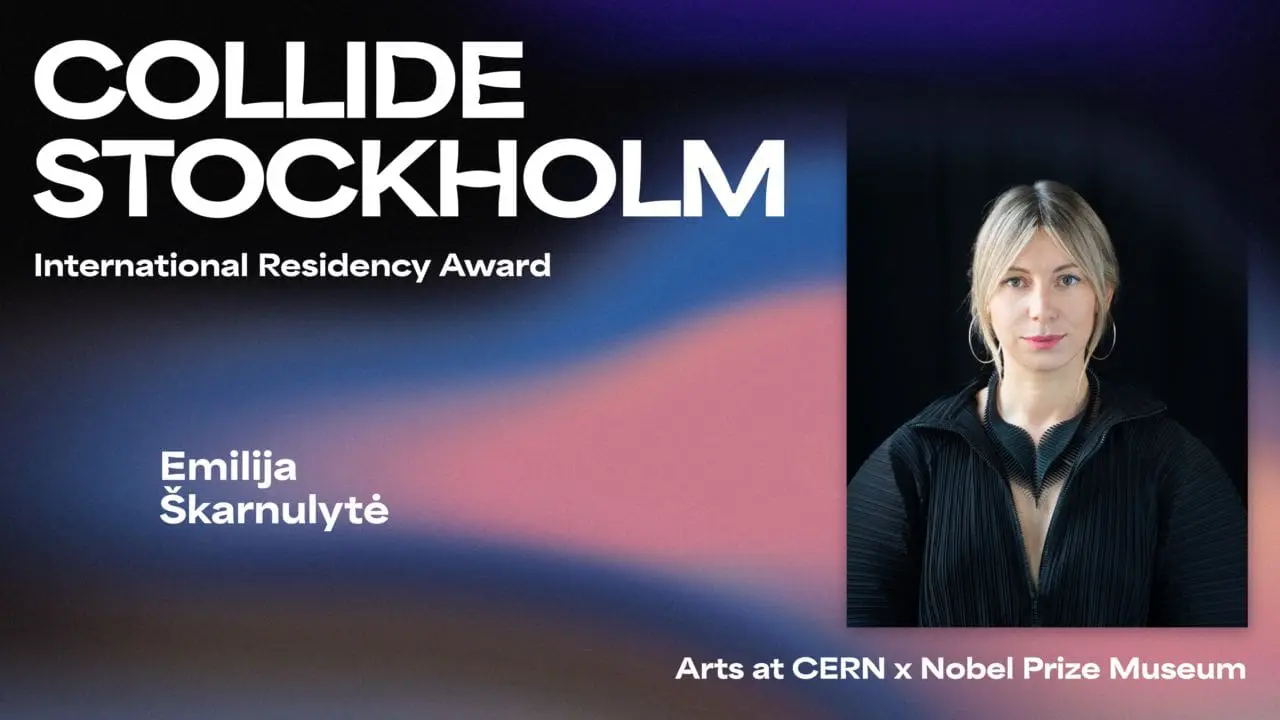
Lithuanian artist Emilija Škarnulytė will spend two months exploring particle physics and the history of scientific discovery after being selected for the Arts at CERN’s international residency, Collide Stockholm. The program, a collaboration between CERN and the Nobel Prize Museum, attracted 908 applications from artists in 89 countries. Škarnulytė’s project, titled “Memory of the Unseen,” will begin at CERN, exploring the limits of detection within the laboratory’s infrastructure before continuing at the Nobel Prize Museum to examine how scientific narratives become part of collective memory. “Arts at CERN was delighted by the number and breadth of the proposals,” said Giulia Bini, Head of Arts at CERN. “We look forward to welcoming Emilija Škarnulytė to CERN and developing this new edition of Collide with the Nobel Prize Museum.”
Collide Stockholm: 2026 Artist-in-Residence Awarded to Emilija Škarnulytė
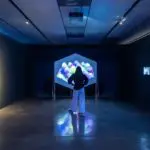
The Collide Stockholm artist-in-residency program received applications from artists in 89 countries, demonstrating global interest in collaborations between art and fundamental science; a total of 908 artists submitted proposals for the program’s latest cycle. Škarnulytė’s artistic practice centers on the spaces where the visible and invisible converge, examining the relationship between humans and the post-human, and the interplay of present and deep time. At CERN, she will investigate event reconstruction, decay signatures, and detector sensitivity, exploring what she describes as “thresholds” within the laboratory’s complex systems. She intends to blend 3D scans, visual sequences, and sound to capture “fragile spaces where the invisible becomes briefly perceptible,” specifically within detector caverns, tunnels, and data-processing systems. Following her time at CERN, Škarnulytė will research the Nobel Prize Museum’s role in shaping the cultural understanding of scientific discovery and collective memory.
The selection jury, chaired by Bini and including representatives from the Nobel Prize Museum and CERN’s scientific community, also awarded Honorary Mentions to artists Morehshin Allahyari and Wendi Yan, recognizing the quality of the submissions. Clara Åhlvik, Director of Exhibition at the Nobel Prize Museum, expressed excitement about collaborating with Škarnulytė in her exploration of the museum’s history and preserved narratives.
Allahyari & Yan Receive Honorary Mentions for Technological Explorations
Now in its second year, the Arts at CERN residency program continues to attract a diverse pool of applicants; the recent open call garnered 908 submissions from artists representing 89 countries, demonstrating growing international interest in the intersection of art and fundamental physics. This dual-location structure, initiated in 2025, is designed to foster reflection on the cultural impact of scientific advancement and technological innovation, providing artists with access to both research facilities and an institution dedicated to celebrating human achievement. Allahyari’s project distinguished itself through its innovative approach to reconfiguring computational machines, drawing inspiration from automata developed during the Islamic Golden Era; the committee lauded her work for its imaginative potential and aesthetic vision in revisiting histories of technological innovation and mechanical intelligence.
Similarly, Wendi Yan’s transdisciplinary project, which explores transcultural narratives within science and technology, impressed the jury with its use of worldbuilding and gaming as tools for historical inquiry and knowledge creation, bridging research with emerging digital aesthetics. The Honorary Mentions acknowledge the merit of Allahyari and Yan’s concepts, even within a competitive field.
We look forward to welcoming Emilija Škarnulytė to CERN and to developing this new edition of Collide with the Nobel Prize Museum with a view to providing a fertile ground to reflect on our respective quests for knowledge by fostering artistic visions as a means of inquiry.
Giulia Bini, Head of Arts at CERN

See today’s quantum computing news on Quantum Zeitgeist for the latest breakthroughs in qubits, hardware, algorithms, and industry deals.