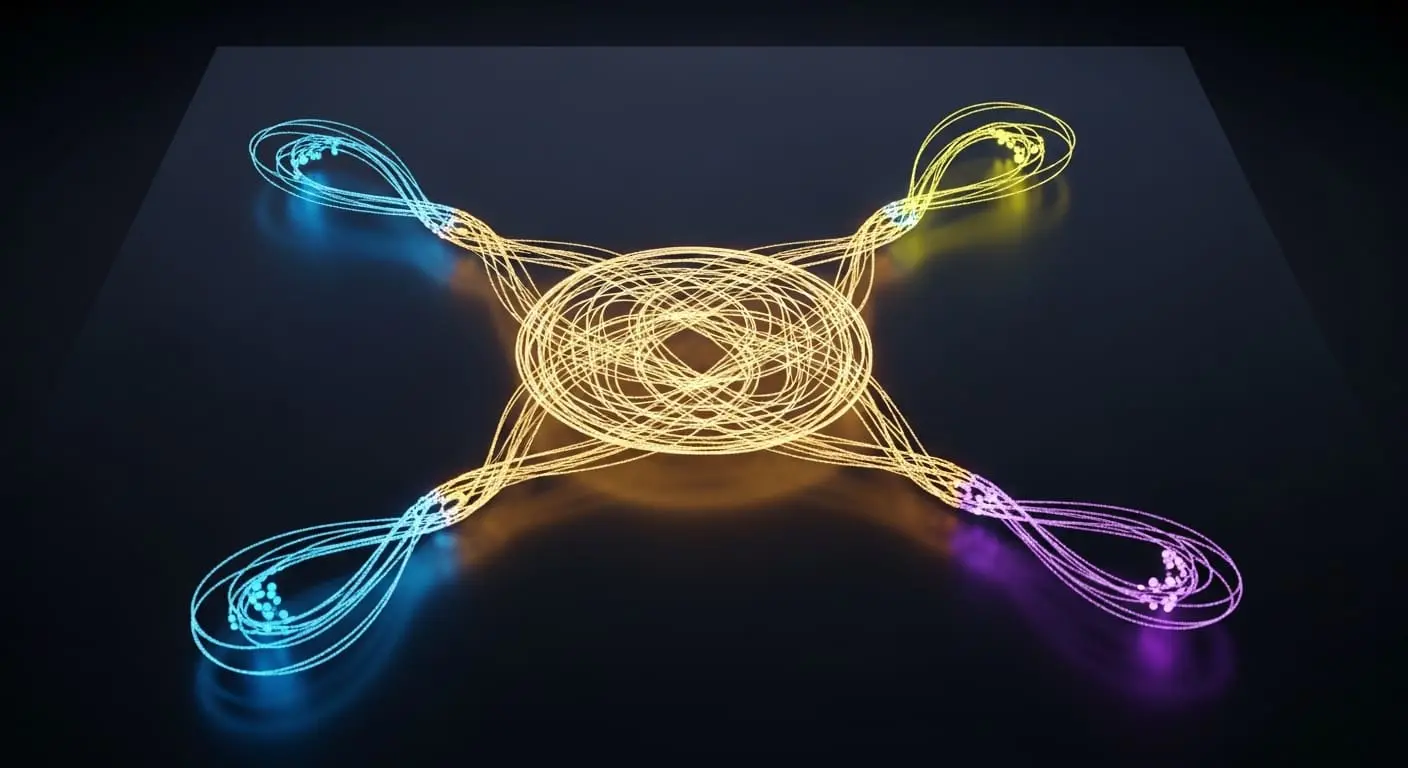
Netzer Moriya and colleagues present a new method for controlling and reading out non-Abelian anyons within a fractional quantum Hall platform using photonic chirality. A cavity-based scheme generates a rotating landscape with counter-propagating light modes to manipulate anyon loops, performing braid operations and translating the results into measurable changes in cavity coherence. The approach offers a braid-sensitive readout of these elusive particles without requiring delicate electronic interference patterns, potentially enabling more strong topological quantum computation.
Photonic chirality guides non-Abelian anyon braiding within a sub-gap optical cavity
Researchers, led by David Awschalom, have developed a technique employing a specially designed optical cavity to both steer and measure non-Abelian anyons, particles theorised for use in quantum computing. The cavity is not merely a container for light; it’s engineered to exploit photonic chirality, the property of light behaving differently depending on its spin direction, much like a screw that only tightens when turned a specific way. Counter-propagating light modes within the cavity create a rotating ‘pinning landscape’, an effective controlled potential that guides the anyons, allowing opposite light directions to drive opposite anyon loops and enabling precise manipulation of their braids, or exchanges. A specifically designed optical cavity manipulates non-Abelian anyons, utilising photonic chirality to steer these particles via counter-propagating light modes, operating within a ‘sub-gap dispersive regime’ where cavity frequency is much lower than the energy gap of the anyons, ensuring adiabatic transport and localisation. For a gallium arsenide platform at 20 millikelvins, successful operation requires a pinning potential exceeding both thermal fluctuations and disorder, typically several microelectronvolts, alongside maintained cavity coherence for a duration between the adiabatic transport time and the inverse cavity decay rate.
Photonic chirality enables strong non-Abelian anyon braid readout
Cavity intermode coherence now exceeds 0.1, representing a threefold improvement over previous electronic interference fringe methods limited to approximately 0.03 due to decoherence. This threshold allows for reliable braid-sensitive readout, previously unattainable, as earlier techniques struggled with signal stability and were easily disrupted by environmental noise. Mapping the braid response onto this cavity coherence circumvents the need for delicate electronic components, paving the way for robust topological quantum computation.
The team employed a novel scheme utilising photonic chirality, where the spin of light controls the anyons within a fractional quantum Hall platform, creating a precisely controlled environment. Specifically, counter-propagating light modes interfering with a reference tone generate a rotating potential that directs the anyons’ movement, effectively implementing braid operations, essential steps in topological computation. In a minimal four-anyon Ising system, the measurement yields a calibrated phase, but the scheme is capable of detecting more complex, state-dependent responses when applied to different anyon configurations.
Cavity coherence limits sensitivity in anyon braid state readout
This cavity-based scheme offers a promising route to braid-sensitive readout, avoiding the pitfalls of fragile electronic interference, but realising it presents important hurdles. The authors acknowledge a narrow operating window dictated by several competing factors; subgap driving, adiabatic transport, and above all, maintaining sufficient cavity coherence all demand precise control. Any decoherence rapidly diminishes the signal and undermines the advantage gained over previous methods, making this reliance on long coherence times particularly concerning.
Despite the challenge of needing exceptionally long coherence times, this cavity-based approach remains a valuable step forward, offering a potential pathway to reading the state of anyons, particles theorised to underpin topological quantum computation, without the troublesome electronic interference that has plagued earlier designs. Successfully demonstrating even a limited braid operation using this method validates the core principle and opens doors for refinement; improved materials and cavity designs could extend coherence and broaden the operational window. This technique establishes a direct connection between controlling and measuring non-Abelian anyons, particles theorised for use in future quantum computers. By utilising photonic chirality, the behaviour of light dependent on its spin, the system manipulates anyon braids and translates the resulting quantum state into measurable changes in light’s properties within the cavity, circumventing the need for fragile electronic components previously required to detect these subtle changes, offering a potentially more stable platform for topological quantum computation.
The research demonstrated a cavity-based method for reading the state of non-Abelian anyons, particles theorised to be important for quantum computation. This approach uses the properties of light to manipulate and detect anyon braids, avoiding the need for delicate electronic interference previously required. The system successfully produced a calibrated phase signal in a four-anyon Ising configuration and is capable of detecting more complex state-dependent responses. Maintaining sufficient cavity coherence remains a key challenge, as it limits the sensitivity and operational window of the technique.
👉 More information
🗞 Photonic Chirality for Braiding and Readout of Non-Abelian Anyons
🧠 ArXiv: https://arxiv.org/abs/2604.19456



See today’s quantum computing news on Quantum Zeitgeist for the latest breakthroughs in qubits, hardware, algorithms, and industry deals.