

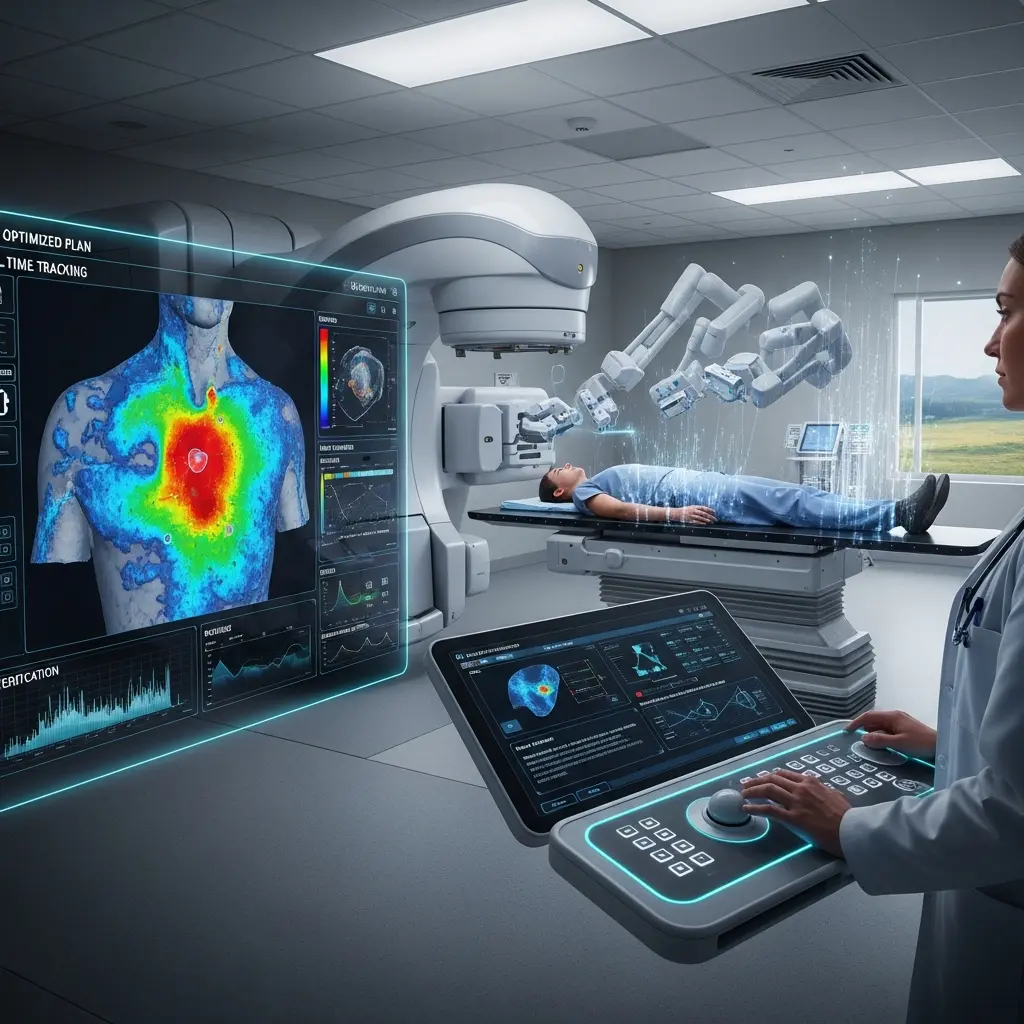
Proton therapy represents a significant advancement in cancer treatment, delivering highly targeted radiation with minimal damage to surrounding tissues, but creating effective treatment plans remains a complex undertaking. Yuzhen Ding, Hongying Feng, and Martin Bues from the Mayo Clinic, alongside colleagues including Tianming Liu from the University of Georgia and Thomas J. Whitaker from the University of Texas MD Anderson Cancer Center, comprehensively review how artificial intelligence is poised to transform this process. Their work examines recent advances in applying AI to critical aspects of proton therapy planning, from reconstructing medical images and accurately registering patient anatomy, to optimising treatment delivery and assessing plan quality. The team demonstrates that AI algorithms successfully automate time-consuming tasks, enhance image accuracy, and accelerate the creation of personalised treatment plans, ultimately promising to improve efficiency and consistency in proton therapy for cancer patients.
AI Advances in Radiation Oncology Imaging
Artificial Intelligence (AI) is transforming radiation oncology, spanning image analysis, treatment planning, adaptive radiotherapy, and clinical decision support. AI improves efficiency and consistency through automated delineation of organs-at-risk and target volumes in medical images, and predicts treatment response, prognosis, and biomarkers through radiomics, the extraction of quantitative features from medical images. Furthermore, AI combines information from different imaging modalities, such as CT and MRI, for more accurate diagnosis and treatment planning. AI plays a crucial role in adaptive radiotherapy and motion management, predicting anatomical changes during treatment due to factors like weight loss or tumor regression, enabling adaptive treatment planning.
AI refines deformable image registration, accurately aligning images acquired at different time points, and predicts respiratory motion during treatment, allowing for more accurate targeting and dose delivery, particularly in lung and liver cancers. AI-driven methods now predict cine images of abdominal motion, enhancing precision. Large Language Models (LLMs), like GPT, are being evaluated for their ability to answer complex questions in radiation oncology physics, assist with documentation, and potentially support clinical decision-making. Researchers are benchmarking and fine-tuning LLMs for specific tasks, utilizing them to analyze clinical messages, improving communication and efficiency. Vision-language models, leveraging pre-trained models used in computer vision and natural language processing, are being explored for various biomedical tasks. This rapidly evolving research landscape focuses on translating AI innovations into clinical practice to improve patient care and outcomes.
AI Advances in Proton Therapy Planning
Artificial intelligence is increasingly valuable in improving proton therapy treatment planning, a process challenged by anatomical changes and uncertainties. Researchers systematically examined recent studies focusing on applications of AI across several key areas, including image reconstruction, image registration, dose calculation, plan optimization, and quality assessment. A central focus involved analyzing how AI techniques enhance computed tomography (CT) imaging, a crucial component of proton therapy. Scientists investigated methods to improve CT reconstruction, recognizing its importance in providing detailed anatomical information and converting Hounsfield Unit values into relative stopping power maps essential for accurate dose calculations.
The team assessed how AI can refine the quality of these reconstructed images, ultimately improving the precision of proton beam range and dose distribution predictions. Furthermore, the study explored the application of AI to deformable image registration, accurately aligning images acquired at different time points to account for anatomical changes. The research highlights that AI-driven approaches support more personalized and adaptive planning, potentially leading to improved clinical outcomes and reduced toxicity. By systematically reviewing the current state of the field, the study identifies key methodological limitations and emerging research directions, paving the way for the broader clinical adoption of AI-assisted proton therapy treatment planning.
AI Enhances Proton Therapy Treatment Planning
Artificial intelligence (AI) is improving proton therapy treatment planning, a process challenged by anatomical changes and uncertainties. AI-based methods are now capable of generating synthetic CT (sCT) images from lower-dose inputs, such as cone-beam CT, effectively addressing limitations of conventional imaging modalities like long acquisition times and radiation dose concerns. The study highlights AI’s ability to improve image quality through techniques like denoising and artifact correction, crucial for accurate treatment planning. Furthermore, AI facilitates deformable image registration, enabling precise alignment of images acquired at different time points to account for anatomical changes during treatment.
AI-driven dose calculation methods are accelerating Monte Carlo simulations, a computationally intensive process, and enabling faster, more accurate predictions of proton beam range and dose distributions. These methods reduce manual workload and computational burden, potentially enabling more adaptive and patient-specific proton therapy. Researchers are also leveraging AI for automated contouring of tumors and organs at risk, improving efficiency and standardization within the treatment planning workflow. AI is emerging as a key enabler of efficient, consistent, and patient-specific proton therapy treatment planning, paving the way for improved clinical outcomes and reduced treatment times.
AI Streamlines Proton Therapy Treatment Planning
Recent research demonstrates that artificial intelligence is becoming increasingly valuable in improving the efficiency and precision of proton therapy treatment planning. Studies show AI methods successfully automate several key processes, including image reconstruction, contouring of anatomical structures, and the prediction of radiation dose distributions. These advancements reduce the substantial manual workload typically required, and also accelerate computationally intensive tasks like robust plan optimization, ultimately supporting more personalized and adaptive treatment strategies for patients. Data scarcity and ensuring the generalizability of AI models across diverse patient populations remain key challenges. Successful translation of these techniques into routine clinical practice also depends on robust validation and seamless integration into existing clinical workflows. Future research should focus on addressing these issues to fully realize the potential of AI in enhancing the delivery of proton therapy and improving patient outcomes.
🗞 AI in Proton Therapy Treatment Planning: A Review
🧠 ArXiv: https://arxiv.org/abs/2510.19213




See today’s quantum computing news on Quantum Zeitgeist for the latest breakthroughs in qubits, hardware, algorithms, and industry deals.



