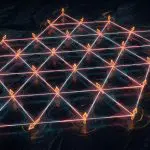
Quantum Art has achieved a greater than 100-fold performance improvement in simulating electromagnetic wave propagation compared to leading superconducting quantum computing platforms, demonstrating a substantial advance in quantum computing capabilities. The company’s algorithms can model waves across areas spanning tens of cubic kilometers at centimeter-level resolution, a feat requiring approximately 10¹⁸ sampling points, a scale previously impractical for even the most powerful classical supercomputers. This advance relies on Quantum Art’s multi-qubit gate capabilities, allowing for efficient solutions to the partial differential equations that underpin models across fields from communications to aerospace. “When attempting to model complex wave behavior at this scale and centimeter-level resolution, classical systems impose trade-offs that limit either accuracy or coverage,” says Roee Ozeri, Chief Scientific Officer at Quantum Art. “The quantum algorithms we developed preserve high precision at scales that were previously impractical.”
Quantum Art Architecture Enables Large-Scale PDE Solutions
This advancement addresses a critical limitation in fields reliant on accurate wave modeling, such as wireless communication and defense systems, where detailed simulations are essential for reliable performance. Classical systems struggle with such large datasets, necessitating compromises between accuracy, coverage, and computational resources. Quantum Art’s approach bypasses these constraints by efficiently representing vast grids with 60 qubits. The core of this capability lies in Quantum Art’s multi-qubit gate capabilities, which allow for the efficient solution of partial differential equations (PDEs) fundamental to wave propagation modeling and numerous other scientific disciplines. This compression of data into fewer computational steps reduces the complexity of quantum circuits, enabling advanced algorithms to function effectively on near-term quantum systems, suggesting a pathway to practical quantum advantage even before the advent of significantly larger qubit counts. The ability to accurately simulate such expansive areas promises to refine wireless coverage planning and bolster the dependability of crucial communication networks.
The company’s multi-qubit gate capabilities are central to this success, allowing for the compression of complex operations and a reduction in quantum circuit depth, enabling efficient execution even with a relatively modest 60 qubits. This is particularly significant because it suggests a pathway toward practical quantum advantage without requiring the massive qubit counts often anticipated.
When attempting to model complex wave behavior at this scale and centimeter-level resolution, classical systems impose trade-offs that limit either accuracy or coverage. The quantum algorithms we developed preserve high precision at scales that were previously impractical, and this advantage is expected to grow as quantum hardware continues to advance.
Roee Ozeri, Chief Scientific Officer at Quantum Art



See today’s quantum computing news on Quantum Zeitgeist for the latest breakthroughs in qubits, hardware, algorithms, and industry deals.