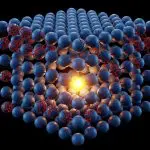
Researchers have discovered that intentionally misaligned layers in atomically thin materials can dramatically alter how they interact with light, published this month in PNAS under the title “Moiré excitons in generalized Wigner crystals.” The work, led by Zhenglu Li, assistant professor in the Mork Family Department of Chemical Engineering and Materials Science at USC Viterbi, reveals a direct connection between electron organization and a material’s optical response, opening possibilities for advanced technologies. Like velvet changing properties when ruffled, these materials form a moiré superlattice only when two layers are overlaid at an acute angle; “the pattern actively reshapes how electrons behave and that’s what makes these moiré materials so remarkable,” Li explains. This ability to engineer electron behavior, rather than solely relying on chemical composition, could guide the design of future quantum and optoelectronic materials for sensing, energy conversion, and quantum information science.
Moiré Superlattices Reshape Electron Behavior
This isn’t merely a visual phenomenon akin to the patterns seen in fabrics, but a key to engineering materials with tailored optical and quantum characteristics. Li’s recent publication in PNAS, titled “Moiré excitons in generalized Wigner crystals,” details how electron organization directly dictates a material’s response to light, and importantly, this organization can be intentionally manipulated. The resulting moiré superlattice isn’t always present; “the pattern only emerges when two layers are slightly misaligned,” Li clarifies, emphasizing the precision required to unlock these effects. This misalignment flattens energy bands, slowing electrons and amplifying their interactions, leading to unusual properties. The team’s computational approach, grounded in many-body quantum mechanics, moves beyond treating electrons as independent particles, instead accounting for their collective influence. This allows for the prediction of complex phenomena, starting from the fundamental laws of quantum mechanics, without relying on experimental adjustments.
Within these moiré superlattices, electrons self-organize into generalized Wigner crystals, forming an internal structure dictated by electron arrangement, not just atomic positioning. “In most semiconductors, light creates excitons – pairs of an excited electron and the ‘hole’ it leaves behind – and this is largely understood from the material’s band structure,” said Li, highlighting the novelty of their findings.
First-Principles Calculations Resolve Excited State Structure
Beyond simply observing the visual effects of moiré patterns, researchers are now leveraging computational methods to understand how these nanoscale textures influence a material’s response to light. The team’s large-scale calculations directly resolved the internal structure of excitations within these materials for the first time, revealing that when light creates excitons, electron-hole pairs, they remain tightly linked, moving in concert with the underlying Wigner crystal. This understanding is crucial because, as Li notes, excited states, conditions driven by light, heat, or electric fields, are central to a material’s functionality in optical devices, yet notoriously difficult to calculate due to the complex interplay of interacting particles.
In fact, the pattern actively reshapes how electrons behave and that’s what makes these moiré materials so remarkable.