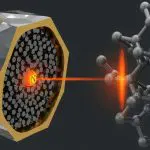
A thorough investigation by Khalid N. Anindya and Hong Guo at McGill University reveals control over fractionalised quantum states within organic spin chains. Anindya and colleagues show how the termination parity of these chains dictates the behaviour of emergent boundary modes, effectively quenching or releasing a spin-½ degree of freedom. The discovery offers a new design principle for manipulating and coupling fractional boundary modes, potentially advancing the development of quantum technologies based on organic materials.
Termination parity controls fractional modes at magnetic material interfaces
Splitting between boundary modes now reaches 0.3J, a threefold increase over previous observations of isolated fractional modes. This represents a significant advancement in the field of condensed matter physics, where manipulating and understanding fractionalised excitations remains a central challenge. Previous attempts to observe and control these interfacial states were hampered by their inherent fragility and extreme sensitivity to environmental noise, leading to broad, unresolved features in experimental spectra. However, this research demonstrates a remarkably stable and controllable system, achieved through the precise engineering of organic spin chains. This advancement stems from the precise manipulation of ‘termination parity’ at the junction of two distinct spin systems, a dimerized spin-1/2 chain and an effective Haldane spin-1 chain, all within a single organic material. The Haldane phase, characterised by a lack of long-range magnetic order despite strong interactions, provides a unique platform for hosting these fractionalised excitations. The dimerized spin-1/2 chain, conversely, exhibits well-defined local magnetic moments, creating a contrasting environment at the interface.
The interfacial fractional mode can be either suppressed through local fusion or released as an uncompensated spin-1/2-like degree of freedom, depending on the chain’s termination. Manipulating how spin chains connect, specifically their ‘termination parity’, allows control over fractional boundary modes at the interface between different magnetic materials. These fractional modes, representing incomplete quantum excitations, arise due to the topological properties of the spin system and are not simply a consequence of broken symmetry. They are either suppressed by fusing the chains locally, effectively ‘completing’ the spin degrees of freedom, or released as distinct spin-1/2-like entities depending on the termination configuration. Calculations reveal that two such internal boundary modes within an embedded Haldane domain exhibit splitting with an exponentially decaying characteristic, confirming termination parity as a key principle for designing and coupling these fractional modes. The observed exponential decay in the splitting suggests a short-range interaction between the boundary modes, confined to the immediate vicinity of the interface. Local dI/dV spectroscopy, a technique measuring changes in current and voltage at the nanoscale, could distinguish between active and quenched junctions through the presence or absence of a zero-bias feature, offering a direct experimental signature of this controlled fractionalization. The zero-bias feature would correspond to the tunnelling of electrons through the uncompensated spin-1/2 state, while its absence would indicate a quenched, fully paired state.
Engineered quantum states offer precise control of fractionalised properties at organic interfaces
Controlling quantum behaviour at material boundaries promises advances in spintronics and quantum information science, yet reliably isolating and manipulating these delicate states has proven remarkably difficult. The ability to engineer and control these boundary modes is crucial for developing novel quantum devices, such as quantum bits (qubits) and quantum interconnects. Previously, interfacial states were prone to disruption from even minor environmental disturbances, but this work reveals a stable, controllable system within a specific organic material. The choice of an organic material is significant, as these materials offer advantages in terms of tunability and ease of fabrication, potentially enabling the creation of complex quantum circuits. While termination-controlled fractionalization was successfully demonstrated, it remains an open question whether these findings extend beyond this single platform. Investigating the generality of this principle across different material systems, including inorganic semiconductors and magnetic heterostructures, is a crucial next step.
Nevertheless, demonstrating stable control within a single organic material does not diminish the significance of this achievement. “Fractionalized” quantum states were successfully engineered, splitting a single quantum property into separate, controllable parts at material boundaries. This precise manipulation of quantum behaviour represents a vital step towards building more complex quantum systems. The ability to disentangle and control these fractionalized degrees of freedom opens up possibilities for encoding and processing quantum information in a robust and scalable manner. A stable, controllable quantum behaviour was achieved within an organic material by splitting a quantum property into separate parts at material boundaries. This decoupling of quantum properties allows for independent manipulation and control, potentially leading to enhanced functionality in quantum devices.
This precise manipulation, termed termination-controlled fractionalization, relies on controlling the material’s edge; altering its ‘termination parity’ releases or quenches a fractional quantum state. The underlying physics involves the interplay between the different spin systems at the interface, leading to the formation of localized boundary modes. The research reveals control over the behaviour of fractional quantum states at the junction of two distinct magnetic systems within a single organic material. By manipulating the ‘termination parity’, effectively the way the spin chains connect, a fractional spin-1/2-like degree of freedom can be either suppressed or released. Establishing termination parity as a design principle allows for the engineering and coupling of these boundary modes, offering a pathway to tailor quantum behaviour. The ability to couple these boundary modes is particularly important, as it allows for the creation of more complex quantum networks and the transmission of quantum information over longer distances. Further investigation will focus on understanding how these controlled boundary modes interact within more complex, multi-dimensional structures and whether this principle extends to other material platforms. Exploring the potential for creating arrays of these controlled boundary modes and integrating them into functional devices represents a promising avenue for future research, potentially leading to breakthroughs in quantum technologies.
The research demonstrated control over fractional quantum states within an organic material by manipulating its boundaries. This is significant because decoupling quantum properties enables their independent control and potentially enhances functionality in quantum devices. Researchers achieved a stable quantum behaviour by splitting a quantum property into separate parts, controlled by a principle called ‘termination parity’. The authors intend to investigate how these controlled boundary modes interact in more complex structures, furthering understanding of this phenomenon.
👉 More information
🗞 Termination-Controlled Fractionalization and Hybridization at Topological Interfaces in Organic Spin Chains
🧠 ArXiv: https://arxiv.org/abs/2604.19498