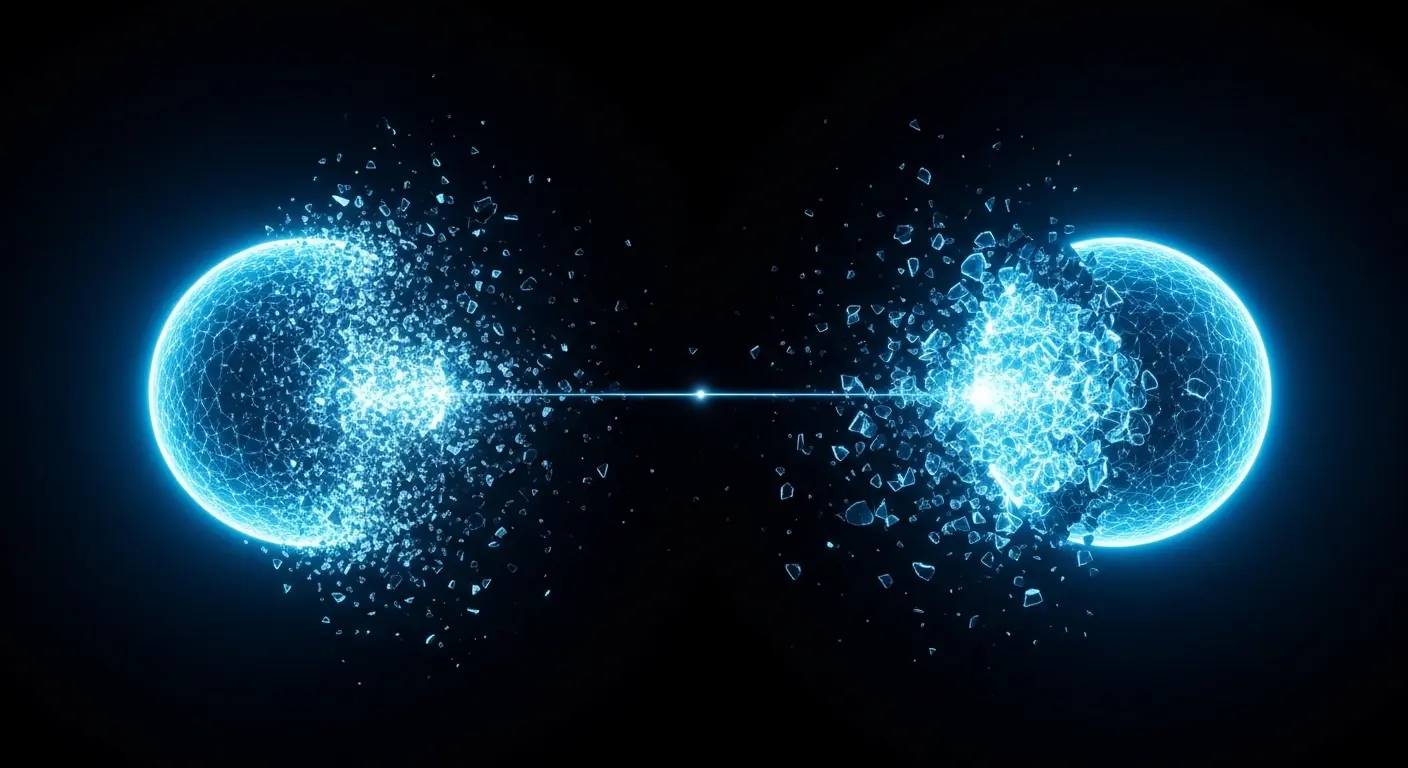
Monika Rani and colleagues at Indian Institute of Technology Jodhpur show that quantum state transfer functions using butterfly graphs and discrete-time quantum walks to build scalable quantum networks. High-fidelity state transfer occurs across various butterfly graph structures, expanding the range of networks capable of supporting this key quantum communication method. This collaboration between Indian Institute of Technology Jodhpur and National Institute of Technology Agartala further assesses the resilience of this transfer against both unital and non-unital noise, including random telegraph noise, modified Ornstein-Uhlenbeck noise, and non-Markovian amplitude damping noise, thereby advancing theoretical knowledge of quantum transport phenomena and the impact of system-environment interactions.
High-fidelity quantum state transfer surpasses 99.8% using discrete-time walks on butterfly networks
A fidelity of quantum state transfer improved from 83.2% to over 99.8% across butterfly graphs, a threshold previously unattainable with more conventional network topologies. This significant enhancement in fidelity is crucial because quantum communication relies on the accurate transmission of quantum bits, or qubits. Any deviation from the original quantum state introduces errors, limiting the distance and reliability of communication. Achieving a fidelity exceeding 99.8% demonstrates a substantial reduction in these errors, bringing practical quantum communication closer to realisation. The research expands the families of networks capable of supporting high-fidelity transfer, a key requirement for scalable quantum communication, which necessitates the ability to connect numerous qubits to form a functional quantum internet. The discrete-time quantum walk, a method of propagating quantum information, offers advantages over continuous-time approaches due to its inherent controllability and ease of implementation in discrete computational frameworks. This method involves evolving the quantum state in discrete time steps, allowing for precise manipulation and analysis of the transfer process. Analysis also demonstrates durability against complex, non-Markovian noise, environmental disturbances that ‘remember’ past interactions, including random telegraph noise and modified Ornstein-Uhlenbeck noise, offering insights into real-world quantum system behaviour.
Butterfly graphs, constructed from simpler path graphs, offer predictable performance and scalability, vital for building robust quantum networks. Path graphs, consisting of nodes connected linearly, serve as the fundamental building blocks. Butterfly graphs are created by iteratively connecting these path graphs in a specific pattern, resulting in a hierarchical structure. This hierarchical structure provides a predictable and scalable architecture, essential for accommodating a growing number of qubits in a quantum network. The research extends theoretical understanding of quantum transport phenomena and system-environment interactions, revealing the transfer remained durable across multiple iterations of the butterfly graph construction, extending the range of network topologies suitable for reliable quantum communication. The ability to maintain high fidelity across multiple iterations of the graph construction is particularly important for building large-scale networks, as it ensures that the quantum state can be transferred across increasingly complex topologies without significant degradation. Maintaining this high fidelity proved possible even when simulating complex ‘non-Markovian’ noise, representing realistic environmental disturbances that retain memory of past interactions, including random telegraph noise and modified Ornstein-Uhlenbeck noise. Random telegraph noise, characterised by random fluctuations in the system’s properties, and modified Ornstein-Uhlenbeck noise, a correlated noise process, are common sources of decoherence in quantum systems. These graphs are built from simpler ‘path graphs’, providing a predictable and scalable structure. However, current results are based on simulations and do not yet demonstrate sustained fidelity in fabricated quantum devices, representing a significant hurdle to practical implementation. Translating these simulations into physical devices requires overcoming challenges related to qubit fabrication, control, and coherence maintenance.
Realistic noise simulations validate butterfly graph potential for scalable quantum communication
Building strong quantum communication networks demands more than identifying topologies that can support perfect state transfer; it requires overcoming the insidious effects of environmental ‘memory’. Quantum systems are inherently susceptible to decoherence, the loss of quantum information due to interactions with the environment. Markovian noise, a common simplification in quantum models, assumes that the environment has no memory of past interactions. However, real-world environments often exhibit non-Markovian behaviour, where past interactions influence the present state of the system. This ‘memory effect’ can significantly degrade the performance of quantum communication protocols. The simulations conducted by Rani and colleagues specifically addressed this challenge by incorporating non-Markovian noise models, providing a more realistic assessment of the butterfly graph’s performance. While high-fidelity transfer across butterfly graphs was successfully demonstrated even with realistic noise, the simulations had a limitation in scope. Specifically, the team focused on unital and non-unital noise models, but the behaviour of these networks under other, potentially more damaging, forms of environmental disturbance remains an open question. Unital noise affects all quantum states equally, while non-unital noise introduces state-dependent errors. Investigating the impact of other noise types, such as coloured noise or frequency-dependent noise, could further refine our understanding of the butterfly graph’s robustness. Durable quantum state transfer, the reliable transmission of quantum information, nevertheless represents a major step forward.
Butterfly graphs are now established as viable structures for scalable quantum communication networks, extending the range of designs capable of reliably transmitting quantum information. The ability to reliably transfer quantum states is fundamental to many quantum communication protocols, including quantum key distribution, quantum teleportation, and distributed quantum computing. Discrete-time quantum walks allow precise control over the process, unlike more complex continuous models. Continuous-time quantum walks, while theoretically interesting, are often more difficult to implement experimentally due to the need for precise control over time-dependent Hamiltonians. Discrete-time walks, on the other hand, can be implemented using a sequence of discrete unitary operations, simplifying the experimental requirements. Assessing performance under realistic environmental disturbances, termed non-Markovian noise, which retain a ‘memory’ of past interactions and can disrupt quantum coherence, was a key focus of this work. The preservation of quantum coherence, the superposition of quantum states, is essential for maintaining the integrity of quantum information. Non-Markovian noise can lead to decoherence by introducing correlations between the system and the environment. This moves the field beyond ideal conditions and towards practical quantum communication systems. The development of practical quantum communication systems requires addressing the challenges posed by real-world environments and developing robust protocols that can tolerate noise and imperfections.
The research demonstrated that quantum state transfer functions effectively across butterfly graphs, adding to the existing designs suitable for scalable quantum networks. This is important because reliable quantum state transfer is a core requirement for secure quantum communication and distributed quantum computing. Researchers investigated how different types of environmental noise, including non-Markovian effects, impact this transfer, revealing the robustness of these graph structures. The study contributes to a theoretical understanding of quantum transport and moves the field closer to practical quantum communication systems.
👉 More information
🗞 Quantum state transfer on a scalable network under unital and non-unital noise
🧠 ArXiv: https://arxiv.org/abs/2604.11620
See today’s quantum computing news on Quantum Zeitgeist for the latest breakthroughs in qubits, hardware, algorithms, and industry deals.