

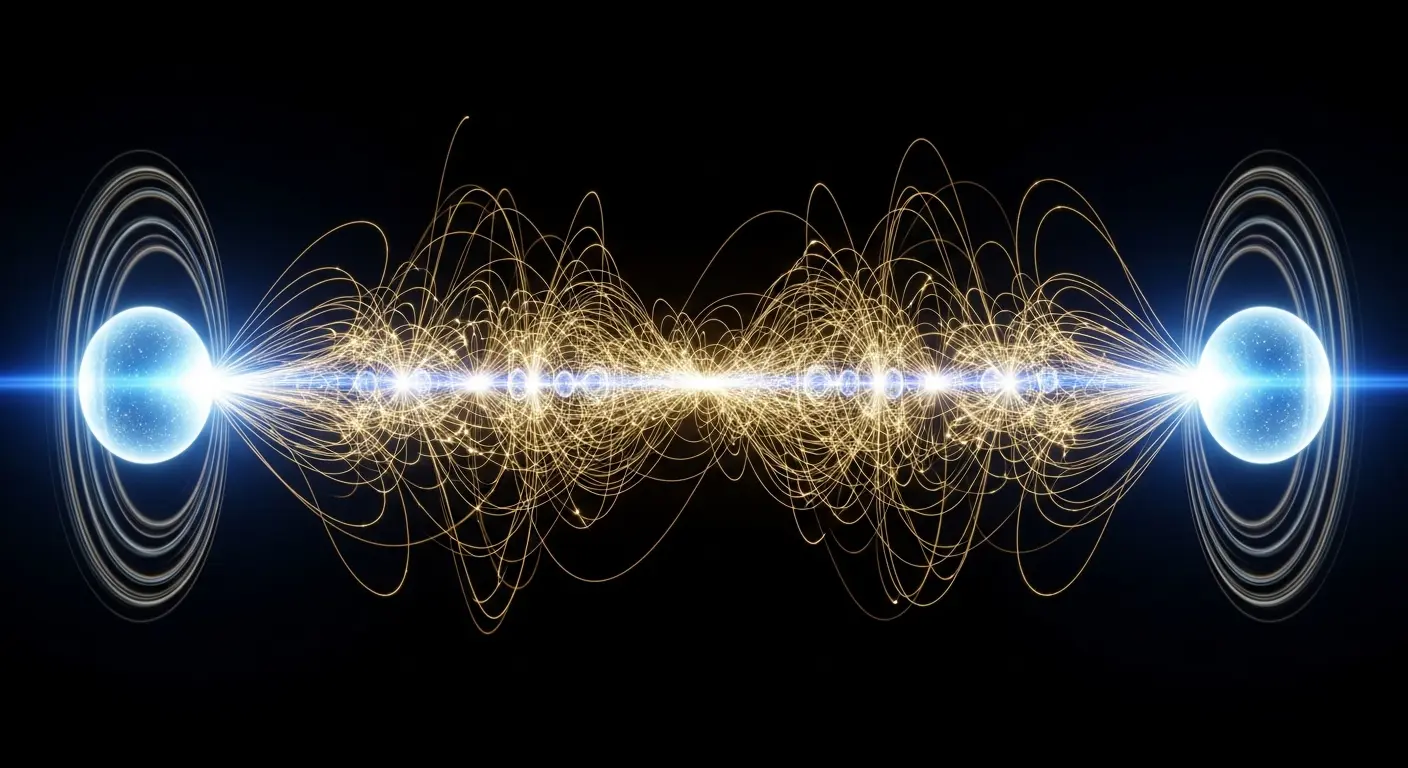
Utilising three-state, or three-level, qutrit systems, a method has been devised to concentrate high-dimensional entangled states with unknown parameters. Previously, entanglement concentration protocols largely focused on two-level qubit systems, but Si-Qi Du of the University of Science and Technology of China and Tianjin Normal University and colleagues have now distilled a maximally entangled two-qutrit Bell state from less-entangled states. This was achieved through cross-Kerr nonlinearities, X-quadrature homodyne measurements, and single-partite projection measurements performed solely at Bob’s site.
A new method to improve connections between quantum particles known as qutrits has been engineered; these can store more information than conventional quantum bits, or qubits. This technique concentrates entanglement, strengthening the quantum signal and protecting it from disruption during communication. By extending entanglement concentration beyond simple two-level systems, this development supports the creation of more effective and dependable quantum networks.
Entanglement in qutrits, quantum particles capable of storing more information than traditional qubits, has been successfully concentrated, representing a breakthrough in quantum communication. These qutrits function like a three-position switch, offering greater potential states compared to the simple on/off nature of qubits. This new technique strengthens quantum signals, protecting them from disruption during transmission. Key to this is the extension of entanglement concentration beyond the previously limited realm of two-level systems, paving the way for more strong quantum networks. The process relies on subtly influencing particle interactions without direct contact, akin to the influence of magnets at a distance, using what are known as cross-Kerr nonlinearities. Precise measurements of light’s properties, similar to carefully analysing a wave’s amplitude and phase, via X-quadrature homodyne measurements, are also integral to the process.
High-dimensional entanglement concentration exceeds qubit limitations using a simplified protocol
Entanglement in two qutrits has been concentrated from partially entangled states with a success probability six times greater than previously achievable with two-level qubit systems. This surpasses limitations inherent in earlier entanglement concentration protocols, which struggled to effectively distill high-dimensional states. Utilising cross-Kerr nonlinearities, X-quadrature homodyne measurements, and single-qutrit projection measurements performed solely at one location simplifies experimental setups and reduces potential errors.
Experiments were conducted with two identical copies of the entangled states required for the process. Scaling this technique to accommodate larger systems and maintaining coherence in practical environments presents a significant challenge. Performing all measurements at Bob’s site differs from earlier protocols that needed distributed measurements, and the generation of partially entangled qubit states expands the potential applications beyond simply concentrating entanglement.
The method concentrates entanglement and generates partially entangled qubit states as a useful by-product for other quantum information tasks, increasing the technique’s flexibility. A challenge remains in scaling this technique to larger systems while preserving coherence in real-world conditions. This development expands the potential applications beyond simple entanglement concentration. Further work will focus on addressing the challenges of scaling and coherence in realistic environments, investigating the limits of this approach with increased system complexity and noise. The protocol’s simplicity offers a pathway towards more robust and efficient quantum communication systems.
Distilling entanglement in high-dimensional qutrits advances strong quantum communication networks
Concentrating entanglement is vital for building practical quantum networks and more powerful computers. The new protocol successfully distills a highly entangled state from weaker signals, a key step towards reliable long-distance quantum communication. While a high success rate is desirable, the efficiency of the concentration process itself is crucial, as the resource cost of distillation must be considered alongside its benefits. This development extends entanglement concentration beyond simple two-level qubit systems to more complex high-dimensional systems, qutrits.
High-dimensional quantum systems offer larger information capacity, stronger durability, and higher efficiency compared to qubit systems. During quantum communication, channel noise during transmission or storage inevitably causes maximally entangled states to become mixed or less-entangled. A method has been proposed to concentrate nonlocal high-dimensional generalised Bell states with unknown parameters. Following cross-Kerr nonlinearities and X-quadrature homodyne measurements, alongside single-partite projection measurements performed only at Bob’s location, a two-qutrit maximally entangled Bell state can be distilled. Previous entanglement concentration protocols primarily focused on two-level qubit systems, but the resulting partially entangled qubit states are useful resources for quantum information processing. Linear optical elements complete single-qutrit projection measurement, key to this protocol with unknown parameters, and linear optical high-dimensional protocols with known parameters are also designed.
The researchers successfully distilled a maximally entangled two-qutrit Bell state from weaker, partially entangled signals. This achievement extends entanglement concentration protocols beyond simpler qubit systems to utilise more complex high-dimensional qutrits, offering increased information capacity and resilience. The protocol relies on cross-Kerr nonlinearities, homodyne measurements, and single-partite projection measurements performed at a single location. The resulting partially entangled states also represent a valuable resource for various quantum information processing tasks, and the simplicity of the method suggests a pathway towards more robust quantum communication systems.
👉 More information
🗞 Entanglement concentration of high-dimensional unknown partially entangled state
🧠 ArXiv: https://arxiv.org/abs/2604.12338

See today’s quantum computing news on Quantum Zeitgeist for the latest breakthroughs in qubits, hardware, algorithms, and industry deals.



