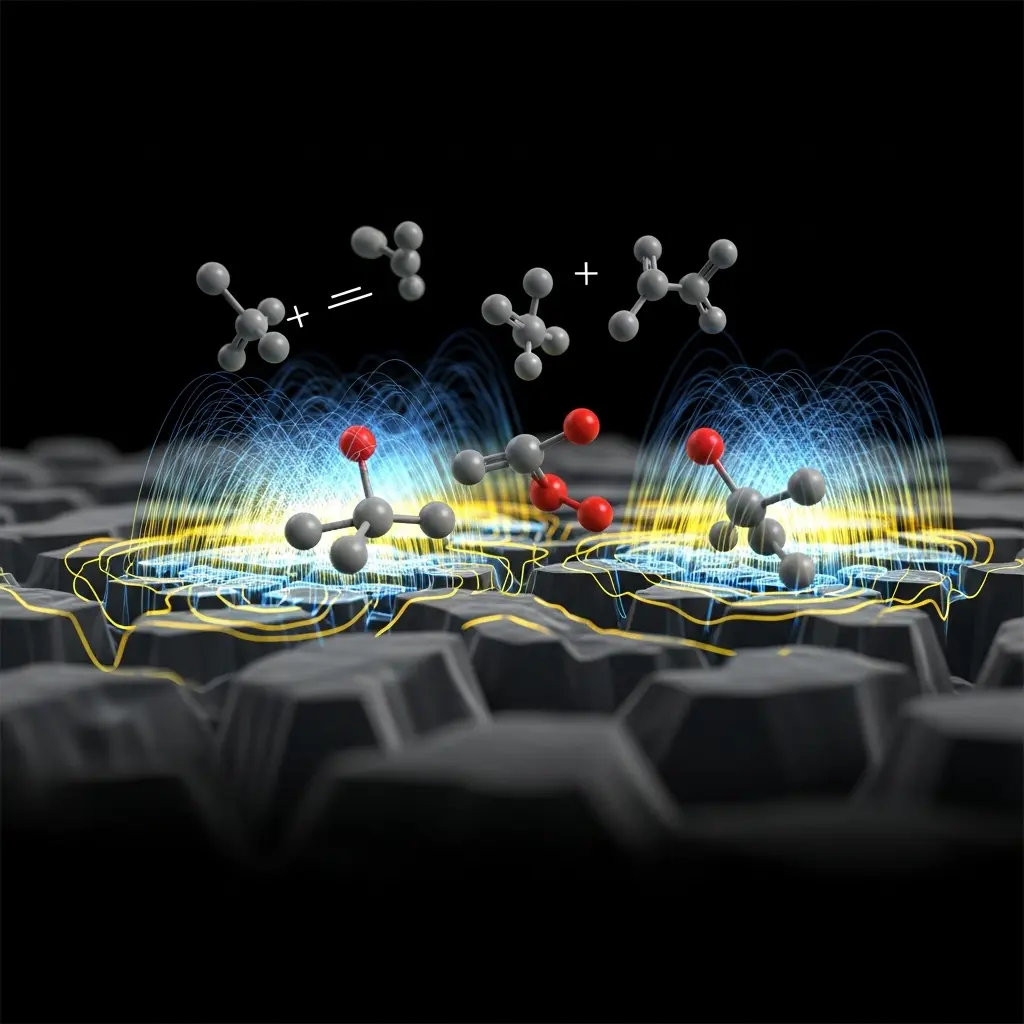
Scientists are continually striving to improve the accuracy of computational models used to understand and design catalysts. Benjamin X. Shi from the Initiative for Computational Catalysis, Flatiron Institute, and Timothy C. Berkelbach from the Department of Chemistry, Columbia University, present a new framework for developing density functionals specifically tailored for modelling catalysis on metal surfaces. Their work addresses a long-standing challenge in the field, achieving ‘transition-metal chemical accuracy’ in predicting catalytic properties, a level of reliability comparable to experimental results. By introducing two novel, computationally practical density functionals, and building upon recent advances in non-self-consistent methods, the researchers demonstrate a significant leap in predictive power across a broad range of adsorption reactions and barrier heights. This collaborative effort establishes a clear pathway towards more accurate and sophisticated computational tools for heterogeneous catalysis and related areas of chemistry.
A predictive error of just 13 kilojoules per mole, the threshold for reliable chemical modelling, is now attainable for metal-based catalytic reactions. This level of precision promises to accelerate the design of better catalysts for industries ranging from pharmaceuticals to sustainable energy, moving the field beyond guesswork and towards rational, predictive design.
Scientists have long sought to accurately model catalytic reactions on transition metal surfaces using density functional theory (DFT). These simulations, predicting properties like adsorption energy and reaction barriers, are becoming increasingly important for the rational design of new catalysts. Achieving reliable results with DFT, however, hinges on the accuracy of the density functional approximations (DFAs) employed, and attaining “transition-metal chemical accuracy” , an error margin of 13 kJ/mol, remains a persistent challenge.
Researchers have now developed a new framework for designing DFAs specifically tailored to study molecules adsorbed on transition metals, building upon recent advances in non-self-consistent approaches. The team proposes two novel functionals within this framework, demonstrating a significant leap in predictive power. Across a diverse set of 39 adsorption reactions, these functionals consistently achieve transition-metal chemical accuracy, while also delivering reliable results for 17 barrier heights.
Beyond improving numerical precision, these non-self-consistent DFAs correct qualitative failures that have long plagued existing self-consistent methods. Current DFAs incorrectly predict the preferred adsorption site of carbon monoxide on platinum and graphene on nickel, a problem now addressed by this new approach. These functionals are computationally efficient and readily compatible with existing DFT codes, with accompanying scripts and workflows available to the research community.
The team constructed a hybrid functional and a double-hybrid extension, starting with a self-consistent calculation using the BEEF-vdW DFA, a dispersion-corrected GGA already known for surface science. Both were refined through empirical tuning against a curated dataset of adsorption energies. The true strength of this work lies in its transferability; the resulting functionals accurately predict the properties of systems used for tuning and demonstrate qualitative and quantitative accuracy across a wider range of molecule-surface phenomena.
Improved Accuracy in Adsorption Energetics Using the dhBEEF-vdW Functional
Considering qualitative improvements, the study highlights the ability of these new non-self-consistent DFAs to address longstanding challenges in density functional theory. For instance, conventional DFAs incorrectly predicted the preferred adsorption site of carbon monoxide (CO) on platinum (Pt), favouring a hollow site instead of the experimentally observed top site.
Development and validation of novel density functionals for transition metal adsorption energies
Density functional theory (DFT) calculations commenced with the construction of two new functionals designed to improve the accuracy of modelling molecular adsorption on transition metals. These functionals, built upon recent advances in non-self-consistent DFAs, were developed by systematically adjusting parameters to optimise performance across a broad range of catalytic systems.
Initial stages involved defining a training set comprising 39 distinct adsorption reactions on various transition-metal surfaces, alongside 17 reaction barrier heights. The functionals were then tested against this dataset to assess their ability to predict adsorption energies with ‘transition-metal chemical accuracy’, specifically an error margin of 13 kJ/mol.
Calculations were performed using the VASP (Vienna Ab initio Simulation Package) code, employing plane-wave basis sets and pseudopotentials to simplify core electrons. Surface slabs were modelled with multiple layers of atoms to accurately represent the bulk material, and a vacuum layer was included to prevent interactions between periodic images. A key aspect of this work was the focus on non-self-consistent DFAs, which calculate the exchange-correlation energy in a single pass, avoiding the self-consistent field (SCF) cycle and offering a substantial reduction in computational cost.
Careful consideration was given to ensuring the transferability of these functionals, meaning their ability to accurately predict properties across different materials and systems. For comparison, calculations were also performed using established self-consistent DFAs, including the HSE06 hybrid functional and semilocal functionals like GGAs and meta-GGAs. Scripts and workflows were made publicly available to allow other researchers to easily implement and test these new functionals within their own DFT calculations.
Refining density functionals for accurate prediction of surface catalysis
Scientists developing computational tools for materials design face a longstanding challenge: achieving reliable predictions of catalytic activity. Density functional theory offers a promising route to rationally design better catalysts, yet its accuracy has been limited by approximations in how electron interactions are modelled. For years, researchers have strived for ‘transition-metal chemical accuracy’, around 13 kJ/mol, but consistently reaching this benchmark has proved elusive.
A new framework offers a potential step forward, presenting density functionals specifically tailored for modelling molecules adsorbed onto metal surfaces. Unlike previous attempts relying on complex, computationally expensive methods, this approach focuses on non-self-consistent functionals, delivering improved accuracy with a manageable computational cost.
Calculations involving exact exchange and random phase approximation remain surprisingly efficient within this new system. The relative expense, exceeding that of simpler methods by a factor of 15 to 60, suggests careful consideration will be needed when applying it to larger, more complex systems. However, the significance extends beyond mere numerical improvements.
Current density functionals often fail to accurately describe simple scenarios, such as carbon monoxide binding to platinum or graphene on nickel, highlighting fundamental flaws in their underlying assumptions. By addressing these qualitative failures, this work suggests a deeper, more physically sound description of metal-molecule interactions. Once further refined, these functionals could accelerate the discovery of improved catalysts for a range of industrial processes, from reducing harmful emissions to optimising energy storage.
This framework isn’t simply about these two new functionals; it’s about a new strategy for functional design. Beyond heterogeneous catalysis, the principles established here could be extended to other areas of computational chemistry and materials science, potentially unlocking more accurate predictions for a wider range of systems. Questions remain regarding the transferability of these functionals to different metal systems and reaction conditions, and the impact of dispersion corrections on overall accuracy needs careful assessment.
🗞 Practical and improved density functionals for computational catalysis on metal surfaces
🧠 ArXiv: https://arxiv.org/abs/2602.14962




See today’s quantum computing news on Quantum Zeitgeist for the latest breakthroughs in qubits, hardware, algorithms, and industry deals.