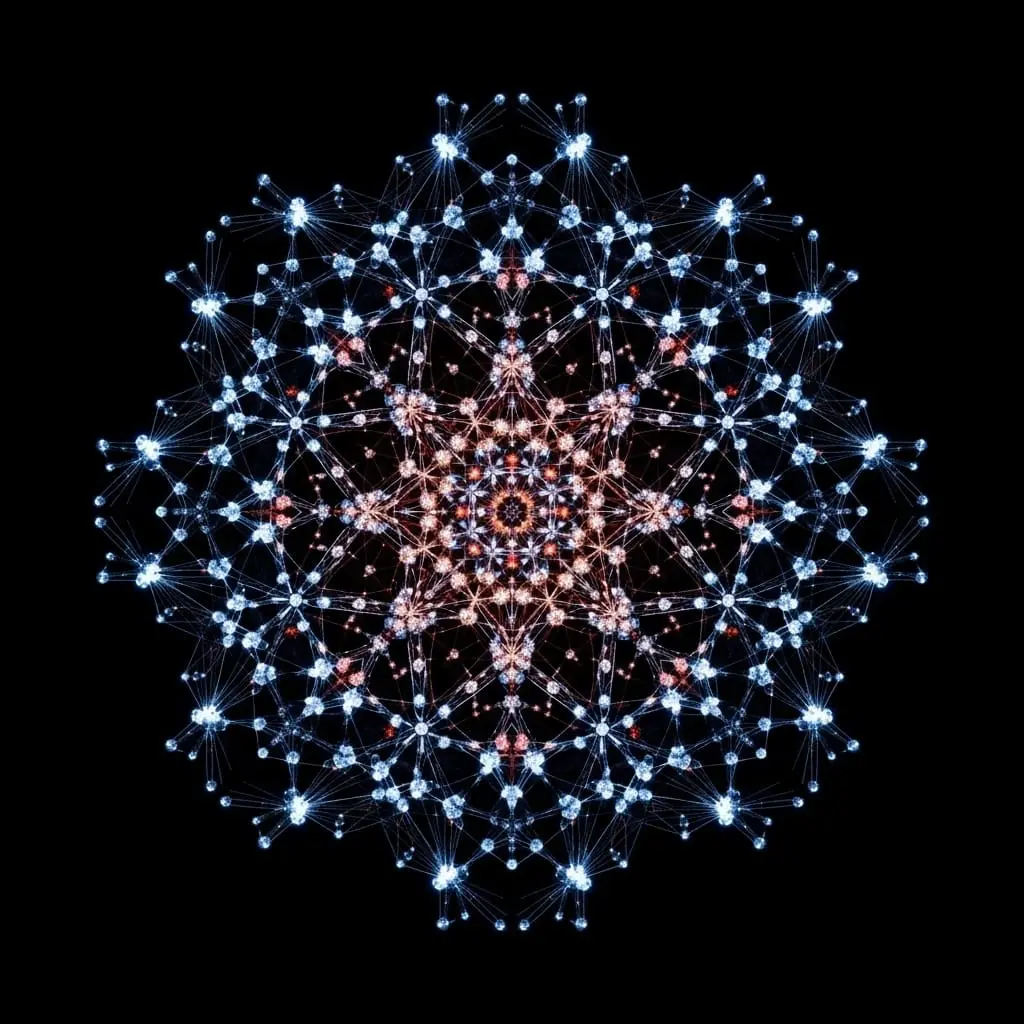
Scientists are increasingly interested in understanding how aperiodicity arises in quantum systems, and new research published in this area details the emergent aperiodicity observed in Bose-Bose mixtures subjected to spin-dependent periodic potentials. Abid Ali from First Affiliated Hospital of Xi’an Jiaotong University, Pei Zhang and Yong-Chang Zhang from MOE Key Laboratory for Nonequilibrium Synthesis and Modulation of Condensed Matter, and Shaanxi Key Laboratory of Quantum Information and Quantum Optoelectronic Devices, School of Physics, Xi’an Jiaotong University, working with Hiroki Saito from Department of Engineering Science, University of Electro-Communications, demonstrate that quasicrystalline order can arise in binary condensates even without explicitly aperiodic lattices. This collaborative work reveals that population balance is a key ingredient for stabilising these quasicrystals, offering a novel pathway to control and observe these exotic states of matter and potentially informing future developments in quantum materials and technologies.
Scientists have uncovered a novel pathway to create quasicrystalline structures within binary Bose-Einstein condensates, potentially revolutionising materials science and quantum technologies. This work demonstrates the spontaneous emergence of order without relying on explicitly aperiodic lattices, a significant advancement in the field of quantum materials.
Unveiling Eightfold Symmetry in Atomic Condensates
Identifying Eightfold Symmetry in Condensed Matter
The research details how carefully balanced interactions between two types of atoms, confined within spin-dependent optical lattices, give rise to strikingly patterned states of matter. Specifically, the emergence of eightfold rotational symmetry is the most striking quantitative result, signifying the formation of a quasicrystalline structure, a pattern not typically found in conventional crystals.
This discovery challenges conventional understanding of symmetry in condensed matter physics, offering a new route to engineer materials with tailored properties. Quasicrystals, possessing order but lacking the repeating translational symmetry of traditional crystals, have long fascinated physicists due to their unique characteristics and potential applications.
Unlike previous experimental realizations of quasicrystals in ultracold atoms which relied on externally imposed aperiodic potentials, this study reveals a self-organising process driven by the interactions between the atoms themselves. The study focuses on repulsive binary Bose-Einstein condensates, superfluids formed from atoms cooled to extremely low temperatures, confined within twisted, spin-dependent periodic optical lattices.
Transitioning Order Through Controlled Atomic Coupling
Transitioning Order Through Manipulated Atomic Coupling
By manipulating the interactions between the two atomic species, researchers observed a transition from a simple fourfold symmetry, dictated by the lattice geometry, to a more complex eightfold symmetry indicative of quasicrystalline order. Increasing the coupling strength between the components induced additional momentum peaks, combining with the lattice structure to produce the observed aperiodic patterns.
Real-time simulations confirm the dynamic stability of these
Confirming Stability and Population Balance Dynamics
Real-time simulations confirm the dynamic stability of these aperiodic structures, demonstrating their potential for experimental observation and manipulation. At intermediate interactions, global phase separation suppresses the quasicrystalline state, but stronger coupling restores the eightfold symmetry through a process of local phase separation. This intricate interplay between interaction scales and confinement allows for the creation of long-lived metastable phases exhibiting unique density modulations and a crossover from lattice-dominated to interaction-driven quasicrystalline order.
Population Balance Role in Stabilizing Quasicrystalline Phases
The research highlights the crucial role of population balance between the two atomic species in stabilising the quasicrystalline phase. Repulsive binary Bose-Einstein condensates were studied within twisted, spin-dependent periodic optical lattices to investigate ground-state and low-lying metastable phases. Balanced mixtures of these condensates were subjected to weak intercomponent interactions, establishing a fourfold momentum-space symmetry dictated by the lattice geometry.
To induce more complex behaviour, the coupling strength was systematically increased, prompting the emergence of additional momentum peaks. These peaks combined with the lattice-induced structure, allowing for detailed analysis of the resulting momentum distributions. The experimental setup employed component-dependent periodic potentials generated using laser beams with carefully selected wave numbers and polarizations, chosen to preserve translational symmetry while introducing complexity through the interplay of intra- and intercomponent interactions.
Specifically, the study focused on the competition between intra-component interactions, denoted as g11 and g22, and the intercomponent interaction, g12, as a driver for quasicrystalline formation. Investigations extended to imbalanced mixtures, where partially miscible density clusters were formed at intermediate coupling strengths. By varying the population balance between the two condensate species, the researchers explored the conditions necessary for stabilising quasicrystals.
The use of real-time simulations was crucial for verifying the dynamic stability of these structures, demonstrating that the observed patterns were not merely static arrangements but sustained quantum states. The emergence of eightfold rotational symmetry defines a key characteristic of the observed quasicrystalline order within binary Bose-Einstein condensates.
This striking symmetry arises from the interplay between lattice geometry and intercomponent interactions. Increasing coupling strength in balanced mixtures induces additional momentum peaks which, combined with the lattice structure, generate this eightfold pattern. A secondary ring of dominant momentum peaks then appears at smaller wave vectors, indicating longer-wavelength density modulations and a transition from lattice-dominated to interaction-driven quasicrystalline order.
Imbalanced mixtures exhibit eightfold-symmetric aperiodic patterns only at
Imbalanced mixtures exhibit eightfold-symmetric aperiodic patterns only at intermediate coupling, forming partially miscible density clusters. Beyond this point, stronger interactions drive complete global phase separation, effectively destroying the quasicrystalline order. This sensitivity to mixture balance highlights population control as a crucial factor in stabilising these quantum quasicrystals.
The research demonstrates that quasicrystalline order can emerge spontaneously in binary condensates, driven by atomic interactions rather than imposed external potentials. Scientists have long sought to exert increasingly precise control over the arrangement of matter, not just to create new materials but to explore fundamental states of being beyond the predictable order of conventional crystals.
The difficulty lies in balancing competing forces; conventional crystals favour arrangements that minimise energy through repetition, but true quasicrystals demand a delicate interplay between order and disorder. Achieving this in a dynamic system like a Bose-Einstein condensate, where atoms are constantly moving and interacting, is a significant challenge.
This research sidesteps the need for pre-designed aperiodic lattices, instead relying on the careful manipulation of interactions between two different types of atom to self-assemble these complex patterns. The implications extend beyond fundamental physics, as quasicrystals possess unusual properties, such as strength, reflectivity, and thermal conductivity, that could be harnessed in advanced materials.
While scaling up from laboratory demonstrations to practical applications remains a considerable hurdle, this work offers a new route to designing materials with tailored, non-repeating structures. However, the stability of these quasicrystalline phases is currently limited, and the precise conditions required for their formation are narrow. Future research will need to address these limitations, exploring how to broaden the parameter space and enhance the longevity of these aperiodic structures.
🗞 Emergent aperiodicity in Bose-Bose mixtures induced by spin-dependent periodic potentials
🧠 ArXiv: https://arxiv.org/abs/2602.13129