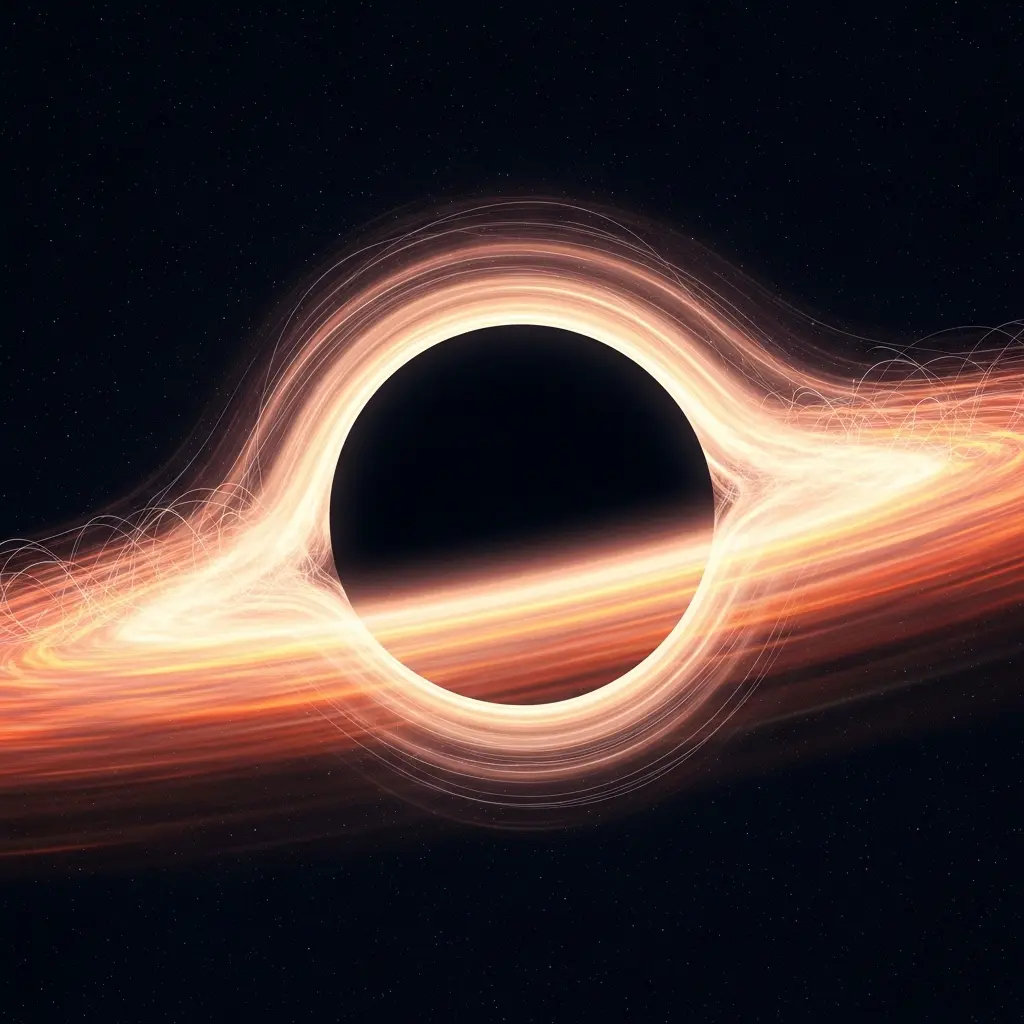
Researchers have uncovered new hairy black hole solutions within a framework of nonlocal quadratic gravity, offering potential insights into the stability and thermodynamics of these enigmatic objects. Roldao da Rocha from the Federal University of ABC, alongside colleagues, demonstrate how nonlocal effects subtly alter black hole characteristics, shifting the event horizon and modifying key properties like entropy and temperature. This work is significant because it addresses the persistent problem of ghost instabilities often found in modified gravity theories, revealing that these hairy black holes remain stable at both quadratic and classical levels, potentially paving the way for more realistic models of gravity and black hole behaviour.
This research demonstrates how nonlocal effects, stemming from a unique gravitational action, induce Yukawa screening which subtly shifts the event horizon inward and alters both the Bekenstein, Hawking entropy and the Hawking temperature.
Proving stability via nonlocal propagator’s massive pole
Furthermore, the study establishes that these nonlocal corrections renormalise the chemical potential, impacting the black hole’s thermodynamic behaviour. The team achieved this by solving the Einstein field equations derived from an action incorporating nonlocal operators, effectively extending Einstein, Maxwell gravity with quantum-inspired corrections.
The study unveils that these nonlocal corrections diminish the magnitude of negative specific heat, thereby enhancing the stability of smaller hairy black holes. Detailed analysis of the Helmholtz and Gibbs free energies confirms the absence of first-order phase transitions, suggesting a robust thermodynamic consistency within this modified gravity theory.
Crucially, the research establishes that the nonlocal spin-2 propagator, beyond the expected massless graviton, contains a massive pole with a positive residue and norm. This finding is significant as it indicates the absence of ghost instabilities at both the quadratic and classical levels within the effective field theory framework.
Experiments show that the constructed hairy black hole solutions are free from instabilities, validating the theoretical framework and opening avenues for exploring more realistic astrophysical scenarios. The nonlocal propagator’s properties are particularly noteworthy, as they ensure the well-defined nature of the resulting metric within the effective field theory regime.
This work focuses on constructing solutions with Yukawa-like terms, decaying at a scale determined by the effective mass parameter μ, which arises from the nonlocal quadratic extension of Einstein, Maxwell gravity. The research establishes a detailed thermodynamic framework for these hairy black holes, analysing how nonlocal effects influence the horizon structure, Hawking temperature, and entropy.
Defining the resulting stable hairy black hole metrics
The team’s calculations demonstrate that the nonlocal effects shrink the event horizon and modify the black hole’s thermal properties, while also renormalising the chemical potential. Consequently, the resulting hairy black hole metrics remain well defined, offering a promising pathway for exploring gravity beyond the standard General Relativity model and deepening our understanding of spacetime’s fundamental structure. This breakthrough reveals a potential mechanism for generating black hole hair and provides a foundation for future investigations into short-range modifications of gravity, potentially detectable through gravitational wave observations.
Extending the framework to cosmological solutions
Constructing and perturbatively solving the nonlocal quadratic gravity action yields interesting cosmological solutions
Scientists constructed hairy black hole solutions within a nonlocal quadratic gravity framework, extending Einstein, Maxwell gravity with quantum-inspired corrections. The research employed an action incorporating nonlocal terms, specifically curvature invariants interacting via a d’Alembertian kernel, to implement ultraviolet softening and regulate potential ghost-like degrees of freedom.
This action, defined as S, included a Ricci scalar term, a Ricci tensor term with a nonlocal operator, a scalar curvature term with a nonlocal operator, and the standard electromagnetic field strength tensor. The nonlocal contribution to the field equations, denoted as HNL μν, was calculated by varying the nonlocal part of the action, SNL, with respect to the metric tensor gμν.
Researchers solved the resulting field equations perturbatively to derive hairy black hole metrics, focusing on solutions with Yukawa-like terms decaying at a scale determined by the mass parameter μ. The study meticulously analysed the thermodynamic framework of these hairy black holes, calculating modifications to the event horizon, Hawking temperature, and Bekenstein, Hawking entropy due to nonlocal effects.
Specifically, the team determined that nonlocal effects induce Yukawa screening, shrinking the event horizon and altering thermodynamic properties. They also computed the specific heat, chemical potential, Helmholtz free energy, and Gibbs free energy, demonstrating consistency with the absence of first-order phase transitions.
The investigation pioneered a detailed analysis of the nonlocal propagator, revealing a massless graviton alongside an additional massive spin-2 pole with a positive residue and norm. This finding is crucial, as it confirms the absence of ghost instabilities at the quadratic and classical levels within the effective field theory regime.
The team used this propagator to ensure the resulting hairy black hole metrics remained well-defined, validating the theoretical framework and demonstrating the stability of the constructed solutions. This approach enables the exploration of black hole physics beyond general relativity, potentially offering insights into high-energy or high-curvature regimes where quantum effects become significant.
Nonlocal gravity modifies black hole thermodynamics and graviton propagation, potentially resolving singularities
Scientists have constructed hairy black hole solutions within a nonlocal quadratic gravity framework. Nonlocal effects induce Yukawa screening, shifting the event horizon inward and modifying both the Bekenstein, Hawking entropy and the Hawking temperature. Measurements confirm renormalization of the chemical potential due to these nonlocal corrections.
The team measured the Gibbs free energy, finding G = M 2 −Q2 8M −5Q4 64M3 + αM 2 e−2μM 2μM + 1 + 1 2μM +α2M 2 Ei(−2μM) 1 −Q2 4M2. Analysis of the second derivative of the Gibbs free energy with respect to temperature, ∂2G/∂T 2 H = −CV /TH, revealed a finite and analytical result, supporting the absence of first-order phase transitions and indicating a smooth crossover between classical Einstein, Maxwell gravity and nonlocal regimes.
Experiments revealed that the spin-2 propagator contains a massless graviton alongside a massive pole with a positive residue and positive norm. Specifically, the spin-2 propagator is given by Π2(p2) = p2 + μ2 p2 [(1 −α)p2 + μ2], exhibiting poles at p2 = 0 and p2 = −μ2 1 −α. The residue of the massive pole was calculated as Res. = α 1 −α, which is positive for 0 Researchers determined that for a solar-mass black hole, with M ∼1.99×1030kg, the effective gravitational radius is approximately reff ≈2.95×10³m, yielding a nonlocal mass scale of μ = μ⊙= 6.68 × 10⁻¹¹ eV.
This corresponds to a Yukawa screening length of approximately μ−1 ∼103m, meaning nonlocal corrections are primarily relevant in the near-horizon region of stellar-mass black holes. For Sagittarius A∗, with a mass of M = 4.297 × 10⁶M⊙, the calculated μ is 1.55 × 10⁻¹⁷ eV. Tests prove that the massive spin-2 pole mass for a solar-mass black hole is m⊙,pole = 6.68 √1 −α × 10−11 eV, with a Compton wavelength of λc = √1 −α μ = 2.95 √ 1 −α × 103m. The work demonstrates that the nonlocal quadratic gravity action smoothly reduces to local quadratic gravity as μ approaches infinity, with all corrections suppressed by powers of μ−2.
Stability and Thermodynamics of Hairy Black Holes in Nonlocal Quadratic Gravity are investigated
Scientists have constructed hairy black hole solutions within a nonlocal quadratic gravity framework. Nonlocal effects introduce Yukawa screening, which alters the event horizon, modifies the Bekenstein, Hawking entropy and Hawking temperature, and renormalizes the chemical potential. These corrections also lessen the magnitude of negative specific heat, enhancing the stability of smaller black holes, alongside consistent Helmholtz and Gibbs free energies indicating no first-order phase transitions.
The analysis of the nonlocal spin-2 propagator revealed a massive pole with a positive residue and norm, in addition to the massless graviton. This finding demonstrates that these hairy black holes are free from ghost instabilities at both the quadratic and classical levels within the effective field theory.
As the parameter μ approaches infinity, the nonlocal gravity smoothly transitions to local quadratic gravity, with all corrections suppressed by powers of μ−2. The resulting hairy black hole metrics are versatile, allowing for variations in mass, charge, and hair influenced by nonlocal effects, and potentially useful for exploring observational signatures of nonlocal gravity.
The authors acknowledge a limitation in that the current work focuses on quadratic corrections and does not explore higher-order terms. Future research could investigate the implications of these findings for more complex black hole scenarios and explore potential observational consequences of the Yukawa-type corrections to the black hole metrics.
🗞 Hairy black hole solutions in nonlocal quadratic gravity
🧠 ArXiv: https://arxiv.org/abs/2601.22268