

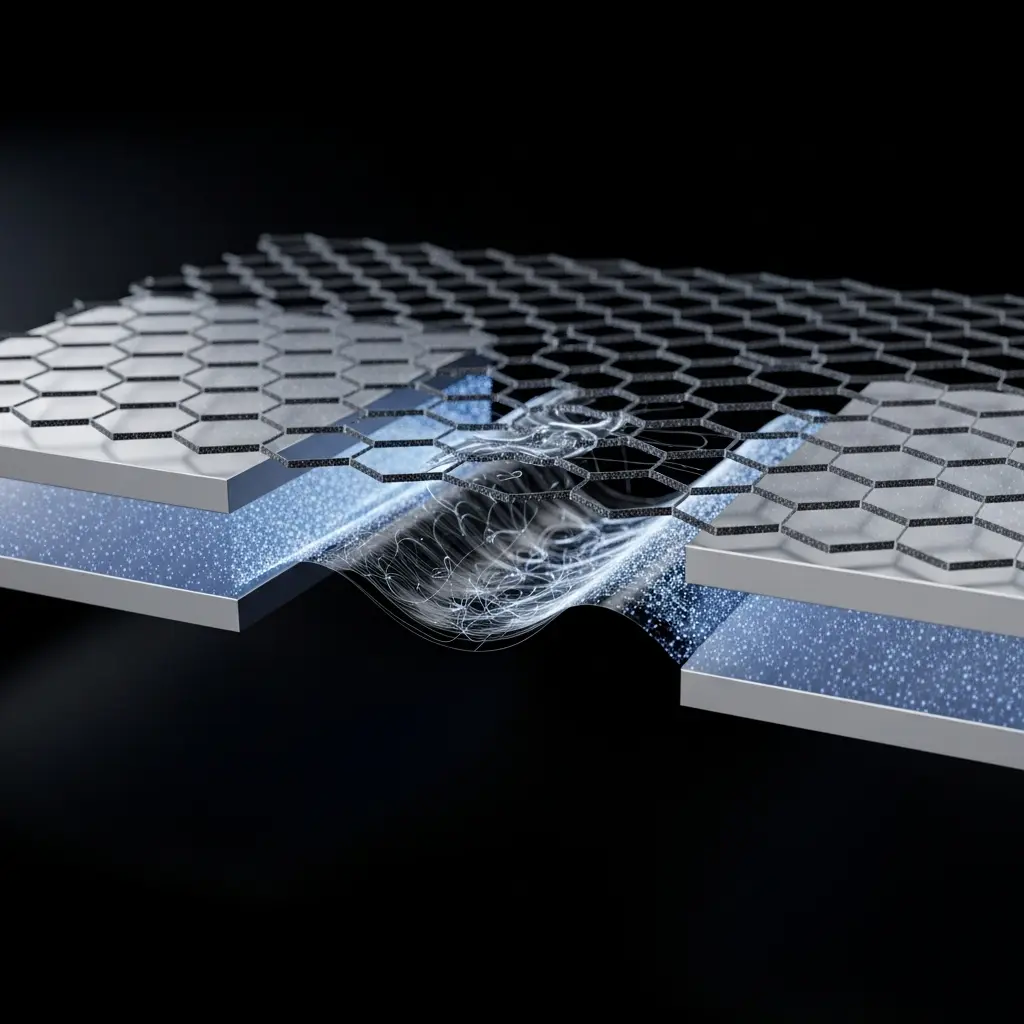
Researchers are increasingly exploring the potential of graphene in quantum technologies, and a new study details a promising step forward in engineering motional quanta using graphene Josephson junctions. Zhen-Yang Peng from Shanghai Jiao Tong University, alongside Mehdi Abdi, and colleagues demonstrate a hybrid device where graphene membrane vibrations couple to superconducting circuits, enabling strong and tunable interactions even at the quantum level. This innovative approach utilises flexural mode-controlled Cooper pair tunneling to efficiently implement parametric processes, potentially leading to the rapid generation of non-classical mechanical states and dramatically improved sensing capabilities. Their work signifies a crucial advancement, paving the way for utilising graphene’s mechanical properties for information processing within nanoscale circuit structures.
Their work signifies a crucial advancement, paving the way for utilising graphene’s mechanical properties for information processing within nanoscale circuit structures.
Graphene Josephson junctions control motional quanta
Scientists have unveiled a novel hybrid quantum device integrating graphene Josephson junctions with superconducting circuits, demonstrating a pathway to engineer motional quanta with unprecedented control. The team achieved a significant breakthrough by demonstrating the possibility of parametrically cooling the motional modes of the graphene membrane close to its ground state, paving the way for advanced quantum control techniques. Researchers meticulously designed a hybrid nanomechanical scheme based on graphene Josephson junctions, focusing on the zero-point fluctuations of the graphene’s motional degrees of freedom. Numerical analysis confirms the efficacy of this coupling in facilitating parametric cooling, a process crucial for reducing thermal noise and enhancing Quantum coherence.
This precise control over the graphene’s vibrational state is a key innovation, allowing for the creation of well-defined quantum mechanical states. The study further investigates the potential of this hybrid device for generating non-classical mechanical states, specifically cat states, and for critically enhanced quantum sensing. Experiments show that the engineered coupling enables the fast generation of mechanical cat states, superposition states of the mechanical oscillator, which are essential resources for quantum information processing. Furthermore, the research reveals that operating the system near a critical point significantly enhances the quantum Fisher information of the vibrational mode, leading to improved precision in frequency estimation.
This criticality-enhanced sensing capability promises substantial advancements in quantum metrology and precision measurements. The Hamiltonian of the system, incorporating both circuit and vibrational degrees of freedom, was derived, revealing a coupling term proportional to the square of both the creation and annihilation operators for both the circuit and vibrational modes. By neglecting higher-order terms, the team simplified the Hamiltonian, allowing for a clear understanding of the dominant interactions and facilitating numerical simulations. The research establishes a foundation for future explorations into complex quantum phenomena and the development of advanced quantum technologies, opening exciting avenues for manipulating and sensing at the nanoscale.
Graphene Josephson Junctions Control Mechanical Quantum States with
This work pioneers the use of graphene’s flexural modes to control Cooper pair tunneling, establishing a strong and tunable interaction even at zero-point fluctuations. To define the Josephson energy within the short-junction regime, the team calculated HGJJ = −∆0 ∑∞ n=0 √ 1 −τn sin2 φ/2, where ∆0 represents the superconductor excitation gap, φ is the superconducting phase, and τn denotes the transmission probability for each Andreev mode excited in the graphene. Crucially, the chemical potential μ, experimentally tunable, governs τn. Given that ∆0/Ec ≫1, the dynamics of Andreev bound modes are dominated by the Josephson potential energy, allowing researchers to neglect the influence of offset charge ng.
This simplification led to an anharmonic oscillator Hamiltonian, H0 = 4Ecn2 + 1 2 EJφ2 −ηφ4, where EJ = ∆0 ∑ n τn/4 and η = 1 24∆0 ∑ n (4τn −3τ 2 n)/16. Experiments employed creation and annihilation operators to express the Hamiltonian as H0 = ωra†a − η(a + a†)4, with resonance frequency ωr= √ 8Ec EJ and nonlinearity factor η=2Ecη/ EJ. Recognizing that graphene junctions vibrate, the study accounted for zero-point fluctuations, acknowledging that surface tension is influenced by these fluctuations and alters junction length. Consequently, the Hamiltonian H0(z) was expanded as a series of z, revealing the coupling between graphene’s vibrational degrees of freedom and the superconducting circuit.
The team simplified graphene membrane vibrations as flexural harmonic oscillations, focusing on the fundamental mode with profile ζ(x)=z cos (πx/L0), where L0 is the equilibrium junction length. The total bent junction length, L(z)=2L0E(−z2π2/L2 0)/π, facilitated the calculation of first and second-order perturbation terms, ultimately yielding the hybrid system Hamiltonian: H′ = ωra†a − η(a + a†)4 + ωb†b + G2(a + a†)2(b + b†)2. The coupling rate, G2 = π2∆0 32L0 √ 2Ec EJ ∞ ∑ n=0 ∂τn ∂L z2 zpf, was shown to be controllable by tuning the charging energy Ec and transmission probability τn, offering promising applications in quantum dynamics and non-classical state generation. To achieve quantum control, the team engineered parametric cooling via coherent drive Hdri = A(aeiωDt + H. c. ), moving to a rotating frame and applying a displacement transformation to reveal an effective parametric interaction for vibrational mode cooling.
Graphene vibrations enhance quantum criticality and QFI
The team measured a critical enhancement in quantum Fisher information (QFI) in the steady state, demonstrating a significant improvement over fully-connected models where quartic anharmonic terms resist quantum criticality. Specifically, the value of ξ, representing nonlinearity, was found to be consistently positive, modifying the critical point such that Λc(ξ0) Λc(ξ=0). Results demonstrate that the suppression of scaling ζ for finite ξ leads to a shorter optimal time, t∗, for dynamical QFI measurements. Measurements confirm a substantial enhancement of steady-state QFI due to negative anharmonicity, a key difference from previous models.
The research team computed the l1 norm of coherence, Cl1, to quantitatively prove that quantum coherence is the dominant resource for QFI enhancement, observing rapid growth of Cl1 as the system approached the critical point, a direct correlation visually confirmed in Fig0.4(d). This nonlinear contribution generates a superposition of squeezed number states, further increasing coherence within the system. Further investigations at finite temperatures revealed a surprising result: thermal fluctuations can actually enhance sensitivity. The team calculated the steady-state QFI for finite temperatures, obtaining the equation Fω,ss = (∂ω∆)2(∂∆ n)2 n( n + 1) + 4Λ2 ∆4 2(2 n + 1)2 2 n2 + 2 n + 1, where the first term represents the conventional thermal equilibrium contribution and the second highlights the influence of squeezing.
Data shows that in the low-temperature limit, Fω,ss(T→0) = 8Λ2/∆4, while at high temperatures, Fω,ss(T→∞) ≈(ω2 + 16Λ2)/∆4. Tests prove that the steady-state QFI for a squeezed thermal state scales as Fω,ss∝∆−4, irrespective of the temperature regime, surpassing the scaling observed in Gibbs states. The researchers observed that the coherence of the system at its steady-state, Css l1, increases with temperature, mixing more squeezed Fock states and enhancing quantum coherence, as illustrated in Fig0.5(b).
Graphene Junctions Enhance Quantum Sensing and Control
Scientists have developed a hybrid quantum device utilising graphene Josephson junctions to couple vibrational and superconducting circuits. By implementing a parametric process, researchers demonstrate efficient control over these interactions, opening avenues for advanced technological applications. They observed that the enhancement of quantum Fisher information with temperature is linked to the coherence of the system at steady-state, with squeezed thermal states exhibiting greater coherence than standard thermal states. Acknowledging certain limitations, the authors note the complexity of accurately modelling all parameters within the graphene Josephson junction. Future research directions include further exploration of mechanical quantum information processing and optimisation of the device for specific sensing applications. This work establishes a promising platform for manipulating mechanical quantum states and improving the precision of quantum sensing, though further refinement is needed to fully realise its potential.
👉 More information
🗞 Graphene Josephson Junctions for Engineering Motional Quanta
🧠 ArXiv: https://arxiv.org/abs/2601.19324



See today’s quantum computing news on Quantum Zeitgeist for the latest breakthroughs in qubits, hardware, algorithms, and industry deals.



