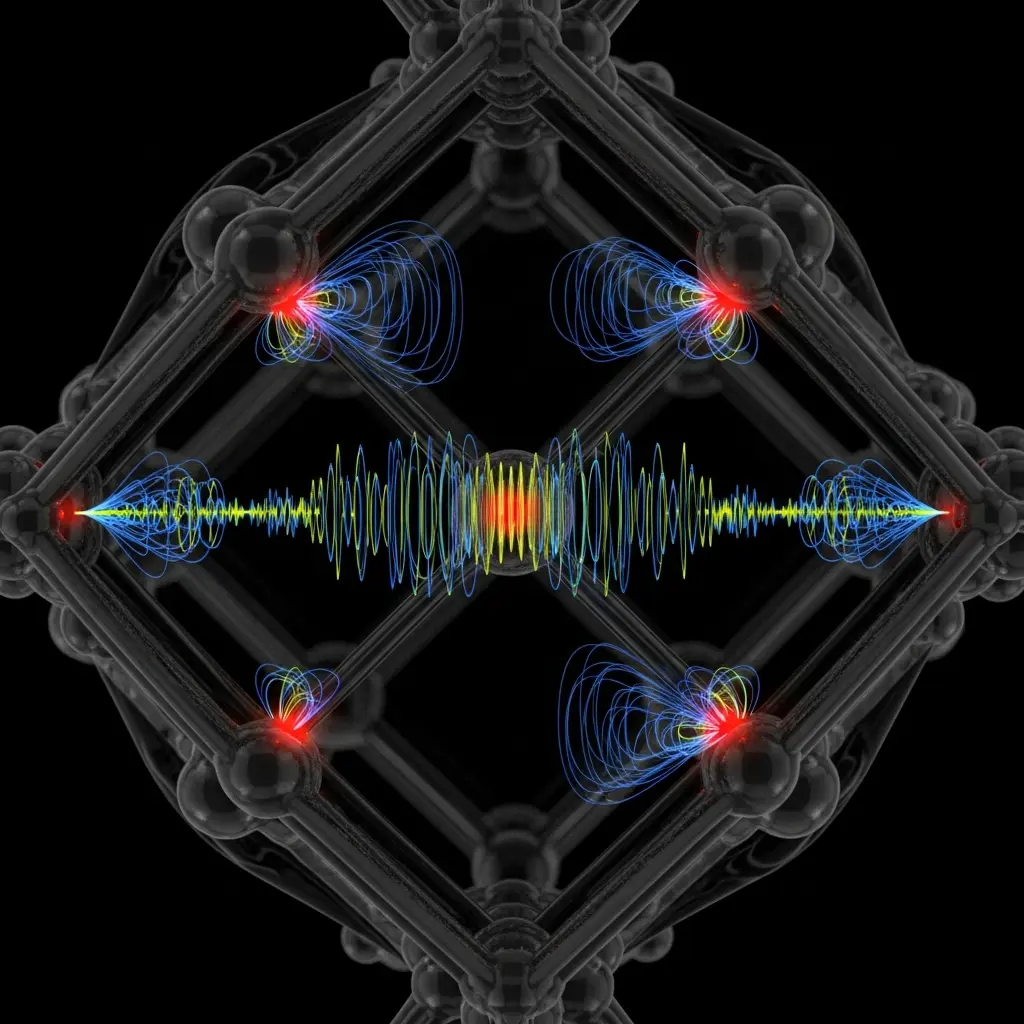
Scientists are developing innovative methods to sense electric and magnetic fields with unprecedented precision, crucial for advancing nanometer-scale devices. Daisuke Sato, Junjie Guo, and Takuto Ichikawa, all from the Department of Applied Physics at the University of Tsukuba, alongside Dwi Prananto et al, have engineered an ultrafast diamond nonlinear photonic sensor to assess surface electric fields. This research breaks the spatial limitations of conventional pump-probe techniques by utilising nitrogen-vacancy centres in a diamond nanotip, enabling monitoring of local electric field dynamics at nanometer-femtosecond resolutions.Their nanoscopic technique promises new avenues for sensing and understanding advanced nanomaterials, potentially revolutionising fields from materials science to electronics.
This nanoscopic technique promises to unlock new possibilities for characterizing advanced nanomaterials and quantum devices. The study reveals a novel approach to electro-optic (EO) sensing, leveraging the nonlinear optical phenomenon where a material’s optical properties are modified by an electric field. While traditional EO sensors rely on materials like ferroelectrics and are limited by the diffraction of light, this research utilizes diamond color centers to achieve substantially improved spatial resolution.
Color centers in diamond, specifically the nitrogen-vacancy (NV) center, are attractive for sensing applications due to their unique quantum states, although conventional implementations require metallic contacts for microwave introduction. By employing diamond crystals with NV centers, the researchers circumvented the need for external microwaves and exploited the non-zero second-order nonlinear susceptibility induced by NV defects, enabling the Pockels effect, a key component of their sensor. Experiments demonstrate that the 1.56 eV photons used do not directly interact with the NV spin states, ensuring a non-resonant transition and focusing solely on the electric field modulation. The team developed an ultra-precise spatio-temporal sensing technique with resolutions of ≤500nm and ≤100 fs by combining an optical pump-probe technique with scanning probe microscopy (SPM) technology. Introducing NV defects at a shallow depth (40nm) from the diamond surface created a highly surface-sensitive SPM probe, capable of detecting electric fields as a function of time delay. This innovative design allows for the excitation of the sample with short light pulses and subsequent sensing of electric fields through the Pockels effect within the diamond nanoprobes.
Diamond NV probe fabrication and characterisation are crucial
The optical system was constructed around the microscope, utilizing a concave mirror to inject excitation pulse light at a 45-degree oblique angle, while a reflective long-focus objective lens focused probe light from the back of the tip, further details are available in supplementary notes. A reflective (Schwarzschild) type objective lens was selected to minimize dispersion from the Ti:sapphire pulse laser, which delivered pulses ≤10 fs in length with wavelengths spanning 660 to 940nm (1.88 to 1.32 eV). The AFM system then focused the probe beam on the back of the cantilever, specifically targeting the diamond NV tip for precise measurements. Researchers first evaluated the sensor’s sensitivity using n-type semiconducting GaAs as a test sample, leveraging its approximately 1.5 eV band-gap energy at room temperature.
Due to high surface state density, the Fermi level was pinned mid-gap, causing band bending and a static electric field perpendicular to the surface, this enabled electro-optic measurements with the NV tip. Using this approach, the team obtained ∆E ≈− 3.1×10⁶V m-1 from experimental data (ΔR#$ R% ⁄ = 2.2 × 10), aligning with values obtained using similar techniques on n-GaAs. Even when measuring under the NV tip, a positive EO signal with an approximately 0.5ps relaxation time was observed, despite a reduction in signal amplitude to ≈1/42 of the macroscopic case, confirming nanoscale sensing capabilities.Analysis of the relaxation time and signal amplitude suggested a probing area diameter of approximately 800nm, consistent with observations from imaging, and indicated stronger carrier scattering and diffusion in the surface region.
Nanoscale Electric Field Mapping with Diamond NV Centres
The research team successfully integrated light and materials technology to create a novel sensing technique for nanometer-scale devices, achieving resolutions of ≤500nm and ≤100 fs. Using equation (1), scientists obtained ∆E ≈− 3.1×10⁶V m-1 from the maximum experimental EO response value (ΔR#$ R% ⁄ = 2.2 × 10), aligning with values obtained using similar techniques. Furthermore, measurements conducted with the NV tip showed a positive EO signal with ≈0.5ps relaxation time, albeit with an amplitude reduced to ≈1/42 of the macroscopic case. This confirms the possibility of sensing through the diamond NV tip, and allows estimation of the NV probe diameter to be ≈800nm, consistent with observations. The halving of the relaxation time constant suggests stronger carrier scattering and diffusion in the surface region, potentially due to surface defects or 2D conduction.
👉 More information
🗞 An ultrafast diamond nonlinear photonic sensor
🧠 ArXiv: https://arxiv.org/abs/2601.15562