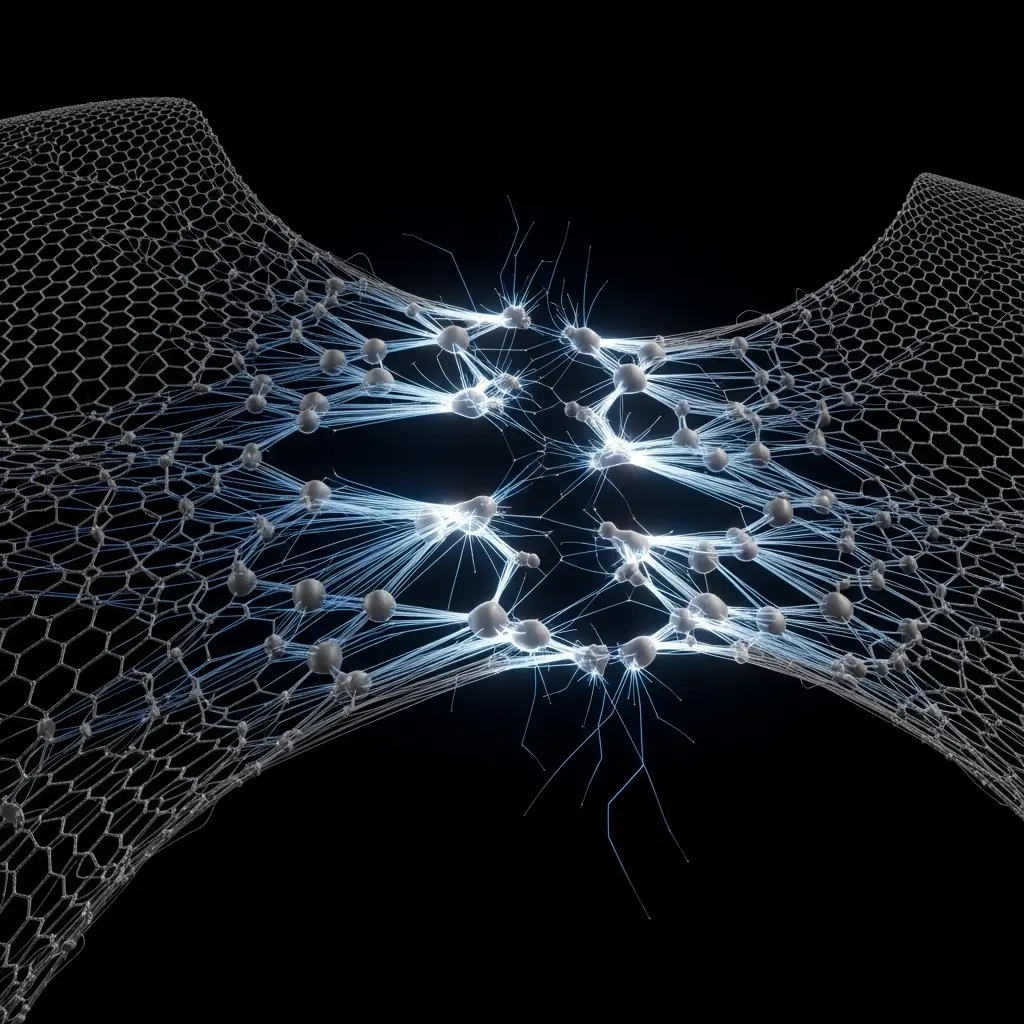
Understanding the mechanical properties of two-dimensional carbon nanostructures is crucial for developing advanced materials, and recent research from Xiangyang Wang, Huibo Qi, Biao Xu, and Shichao Dai of Ludong University, along with Jiqiang Li, presents a new approach to modelling these materials under stress. The team developed a multiscale modelling technique that bridges the gap between atomic-level detail and the behaviour of the material as a continuous sheet, allowing them to accurately predict how these structures deform and fracture. This method reveals that the presence and arrangement of strong, sp3 bonds between layers dramatically influences a material’s strength, and the simulations demonstrate that strategic placement of these bonds can significantly enhance tensile strength, potentially leading to the design of stronger, more resilient nanomaterials. The results show that certain structures exhibit mechanical properties comparable to diamond, offering promising avenues for materials science innovation.
This research introduces a multiscale auxiliary nodes (MAN) method, rooted in atomic structures and potentials, to simulate two-dimensional carbon nanotubes. The method constructs two virtual continuum sheets with high-order continuity, enabling a smooth transition between atomic and continuum scales. The moving least squares (MLS) approximation transforms atomic displacements into nodal displacements, converting atomic potential energy into strain energy within the continuum model. By iteratively solving nonlinear stiffness equations, scientists determine the equilibrium configuration of the system under specified loading conditions, achieving accurate and efficient simulations of nanotube behaviour.
Multiscale Modelling of Carbon Nanostructure Deformation
Scientists developed a multiscale auxiliary nodes (MAN) method to investigate the nonlinear deformation and fracture behaviour of two-dimensional carbon nanostructures, including bilayer graphene, diamane, and transitional forms. This innovative approach bridges the gap between atomic-level detail and continuum modelling, enabling accurate simulations of these complex materials. The method constructs virtual continuum sheets based on atomic structures and potentials, transforming atomic displacements into nodal displacements within the continuum model. Through iterative solutions, the system reaches equilibrium under specified loading conditions, accurately predicting nonlinear behaviour.
The study solved nonlinear stiffness equations iteratively to determine the equilibrium configuration of the system under various loading conditions. A key feature of the MAN method is its flexibility in node density and arrangement, which facilitates a smooth cross-scale transition and enhances computational efficiency. Numerical simulations using this method accurately predict the mechanical properties of 2D carbon nanostructures. Results demonstrate that diamane exhibits a Young’s modulus and shear modulus closely approaching those of diamond, significantly exceeding the corresponding values for graphene. Furthermore, the quantity and distribution of interlayer sp3 bonds profoundly influence fracture behaviour, with strategic placement of these bonds demonstrably enhancing tensile strength. This research provides a powerful new tool for understanding and designing advanced carbon-based materials with tailored mechanical properties.
Diamane Rigidity Rivals Diamond’s Strength
The team demonstrated that diamane exhibits a Young’s modulus and shear modulus closely approaching those of diamond, and notably exceeding that of graphene. This suggests diamane possesses superior stiffness and strength compared to its more widely studied counterpart. The research highlights the crucial role of interlayer sp3 bonds in influencing fracture behaviour; strategic placement of these bonds effectively enhances the tensile strength of the nanostructures. The MAN method achieves computational efficiency by operating at an order-N complexity, where N represents the number of nodes, significantly outperforming order-N2 methods commonly used in atomistic simulations.
Extensive numerical tests revealed that approximately twelve iteration steps are sufficient to reach a minimal energy state for each load step, demonstrating the method’s rapid convergence. To address potential instability issues arising from material or geometric nonlinearities, the team implemented stiffness matrix modification techniques, ensuring accurate and reliable results even under extreme deformation conditions. The feasibility and effectiveness of the MAN method were thoroughly validated through comprehensive numerical tests, confirming its potential for investigating the large-deformation and fracture behaviour of 2D carbon nanostructures.
Multiscale Modelling Predicts Diamane’s Fracture Resistance
This research presents a multiscale computational method for accurately simulating the mechanical behaviour of two-dimensional carbon nanostructures, including bilayer graphene and diamane, and their transitional forms. By bridging atomic-level details with continuum modelling, the team successfully predicted the large-deformation and fracture characteristics of these materials, demonstrating the method’s ability to capture complex behaviours. Results indicate that diamane exhibits a Young’s modulus and shear modulus approaching those of diamond, significantly exceeding that of single-layer graphene. Crucially, the study reveals a strong correlation between the quantity and arrangement of interlayer sp3 bonds and the fracture resistance of these structures, with strategic placement of these bonds demonstrably enhancing tensile strength.
The team further investigated the influence of varying numbers of interlayer sp3 bonds, finding that increasing their density generally improves fracture strain under both zigzag and armchair tension. Detailed simulations of crack propagation revealed how these bonds affect crack initiation and progression within the material, providing insights into the underlying mechanisms governing fracture. While the method demonstrates high accuracy in simulating these materials, the authors acknowledge that further work is needed to account for the effects of defects and temperature on their mechanical properties. Future research will likely focus on extending this multiscale approach to even more complex nanostructures and exploring its potential for materials design and optimisation.
🗞 A new multiscale modeling approach to unravel the influence of interlayer sp3 bonds on the nonlinear large-deformation and fracture behaviors of 2D carbon nanostructures under tension
🧠 ArXiv: https://arxiv.org/abs/2512.15805




See today’s quantum computing news on Quantum Zeitgeist for the latest breakthroughs in qubits, hardware, algorithms, and industry deals.