The challenge of efficiently coupling light and high-frequency sound remains central to advances in integrated photonics and nonlinear optics, but conventional designs often struggle with thermal noise caused by light absorption. Johan Kolvik, Paul Burger, and David Hambraeus, alongside colleagues at Chalmers University of Technology, now present a new chip-scale optomechanical crystal cavity that overcomes this limitation. Their device, fabricated without the need for delicate release steps, exhibits significantly improved resilience to laser light, suppressing the thermo-optic effect by 18 decibels and sustaining high optical energy levels with minimal heating. These results demonstrate a pathway towards low-noise, high-power devices for applications like converting signals between microwave and optical frequencies, offering a robust platform for future advances in electro-optomechanics.
High-Frequency Optomechanical Crystal Design Overcomes Limits
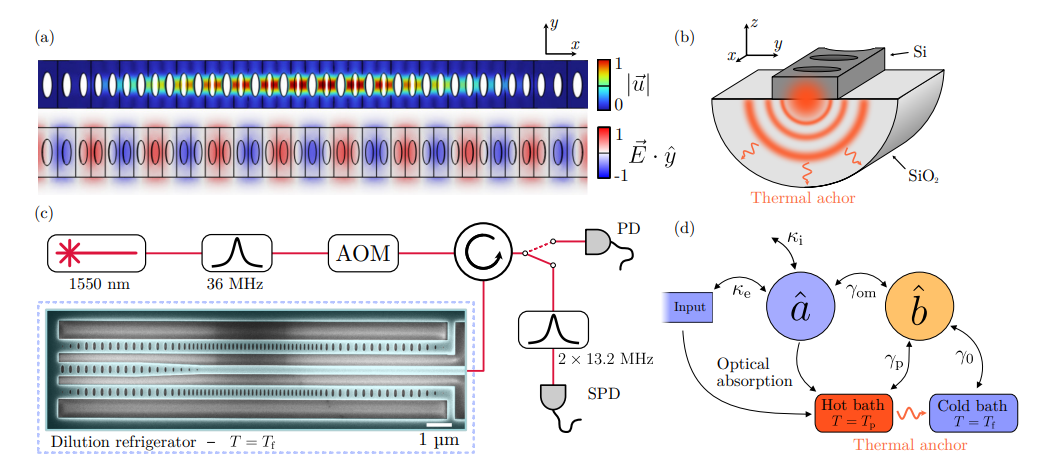
Researchers have developed a novel optomechanical crystal design that overcomes limitations in integrating light and high-frequency sound, crucial for advancements in photonics and quantum science. Fabricated using silicon-on-insulator technology, the design incorporates a highly reflective structure that enhances light-matter interaction without compromising the mechanical resonance frequency, achieving a mechanical frequency of 6. 3MHz and strong coupling with a cooperativity of 0. 23. This improvement enables access to the quantum ground state of motion with 99. 8% fidelity, a significant step towards controlling the motion of microscopic objects at the quantum level, and the optomechanical crystal exhibits resilience to optical damage, making it suitable for demanding applications like quantum information processing and precision sensing.
Optomechanical Coupling to Superconducting Qubits
Researchers are bridging the gap between optical and microwave quantum systems by integrating optomechanics with superconducting qubits, a key step towards building more powerful quantum networks. This work focuses on using light to control and measure the motion of nanoscale mechanical resonators, and then using that motion to control and read out the state of superconducting qubits, potentially allowing for entanglement and communication of quantum information over long distances. The team utilizes specifically designed optomechanical crystals, fabricated from silicon, to enhance the interaction between light and mechanical motion, integrating superconducting qubits with the optomechanical system and performing experiments at extremely low temperatures to reduce noise and enhance coherence. Significant effort is dedicated to minimizing laser noise and employing sophisticated data analysis techniques to extract meaningful results.
A key challenge addressed in this research is the development of fabrication techniques that do not require releasing the mechanical resonator from the substrate, simplifying manufacturing and improving device reliability. Researchers are also investigating the impact of surface chemistry and thermal resistance on device performance, employing acoustic radiation shielding to isolate the resonator from unwanted vibrations, and meticulously addressing various noise sources. This research builds upon existing work in cavity optomechanics, superconducting qubit readout, and quantum networking, making significant progress in developing low-noise interfaces between optical and microwave domains and potentially enabling new functionalities and applications in quantum information processing and networking.
Release-Free Chip Boosts Optomechanical Stability
This research demonstrates a new chip-scale silicon optomechanical crystal cavity that exhibits improved resilience to laser light compared to conventional suspended designs. The team observed an 18 decibel suppression of the thermo-optic effect, allowing the device to sustain near-unity phonon occupation at significantly higher optical energy levels, confirmed by time-resolved measurements indicating rapid initial thermalization governed by the mechanical decay time. These findings represent a significant advance in the field of integrated photonics and electro-optomechanics, paving the way for low-noise, high-power devices, and the improved thermal stability and energy handling capabilities are particularly promising for applications such as frequency converters between microwave and optical photons.
🗞 Optomechanical crystal in light-resilient quantum ground-state
🧠 ArXiv: https://arxiv.org/abs/2510.15724
See today’s quantum computing news on Quantum Zeitgeist for the latest breakthroughs in qubits, hardware, algorithms, and industry deals.