Hexagonal boron nitride (hBN) holds considerable promise as a platform for future solid-state technologies, owing to its ability to host spin defects that can be controlled with light, but identifying the precise atomic structure of these defects remains a significant challenge. Petros-Panagis Filippatos, Tom J. P. Irons, and Katherine Inzani, all from the School of Chemistry at the University of Nottingham, investigate the intrinsic point defects within hBN using advanced computational modelling. Their work demonstrates that the r2SCAN method offers an efficient and accurate approach to predicting the properties of these defects, and importantly, identifies VB-, BN0, Bi+ and Ni+ defects as particularly stable colour centres. These findings are crucial because they pinpoint specific defects emitting light at wavelengths suitable for applications in quantum networks and advanced sensing technologies, paving the way for optimised defect screening and ultimately, more powerful devices.
HBN Defects, Calculations and Computational Approaches
This collection of references represents a comprehensive study of defects within hexagonal boron nitride (hBN), a material increasingly important for quantum technologies and optoelectronic devices. The research focuses on understanding the fundamental properties of imperfections in the hBN structure and how these defects influence the material’s behaviour. A central theme is the use of computational modelling to predict and explain the characteristics of these defects, providing insights crucial for materials design and device development. Researchers systematically identify and characterize intrinsic point defects, such as missing or misplaced atoms, within the hBN lattice.
Understanding these defects is fundamental to controlling the material’s properties and tailoring it for specific applications. The vast majority of studies employ first-principles calculations, a powerful technique using the principles of quantum mechanics to model the behaviour of materials at the atomic level. A key focus is determining the stable charge states of these defects, as electrical charge significantly impacts their optical and spin properties. This is particularly important for applications like single-photon emitters and quantum bits (qubits), where controlling the spin of electrons is essential. Researchers also investigate how defects affect the absorption and emission of light in hBN, crucial for developing efficient optoelectronic devices.
Defect Properties in Hexagonal Boron Nitride Investigated
Scientists investigated intrinsic point defects in hexagonal boron nitride (hBN) using density functional theory (DFT) calculations. This computational approach allows for accurate modelling of both localized and delocalized electronic states, crucial for understanding how defects influence material properties. The team employed the r2SCAN functional within DFT, balancing computational efficiency with accuracy, and incorporated corrections for weak van der Waals interactions between atoms. To ensure reliable results, the hBN unit cell was carefully relaxed, optimizing the atomic positions to minimize energy.
Calculations were performed using a plane wave basis set and a specific k-point grid, converging the total energy to a high degree of accuracy. Structures were optimized until the forces on the atoms were minimal, and a method called ShakeNBreak was used to correctly identify the most stable defect configuration. Defects were modelled within a large supercell, minimizing interactions between periodic images. The study meticulously calculated the energy required to create each defect, known as the formation energy, and the energy levels at which the defect can accept or donate electrons, known as charge transition levels. These calculations considered the chemical environment and accounted for image charge effects. Optical transitions were classified to understand how defects absorb and emit light, and the radiative lifetimes and stability of bound excitons were assessed, critical parameters for potential quantum technology applications.
HBN Defects as Promising Colour Centres
This research presents a detailed computational study of intrinsic point defects in hexagonal boron nitride (hBN), aiming to identify promising “colour centres” for quantum technologies. Colour centres are defects that exhibit optical transitions, making them useful for manipulating and storing quantum information. Scientists used density functional theory with the r2SCAN functional to systematically model the formation energies, electronic spectra, and magnetic properties of various defects. Calculations were performed on a large supercell, employing a specific k-point grid and ensuring convergence to a high degree of accuracy.
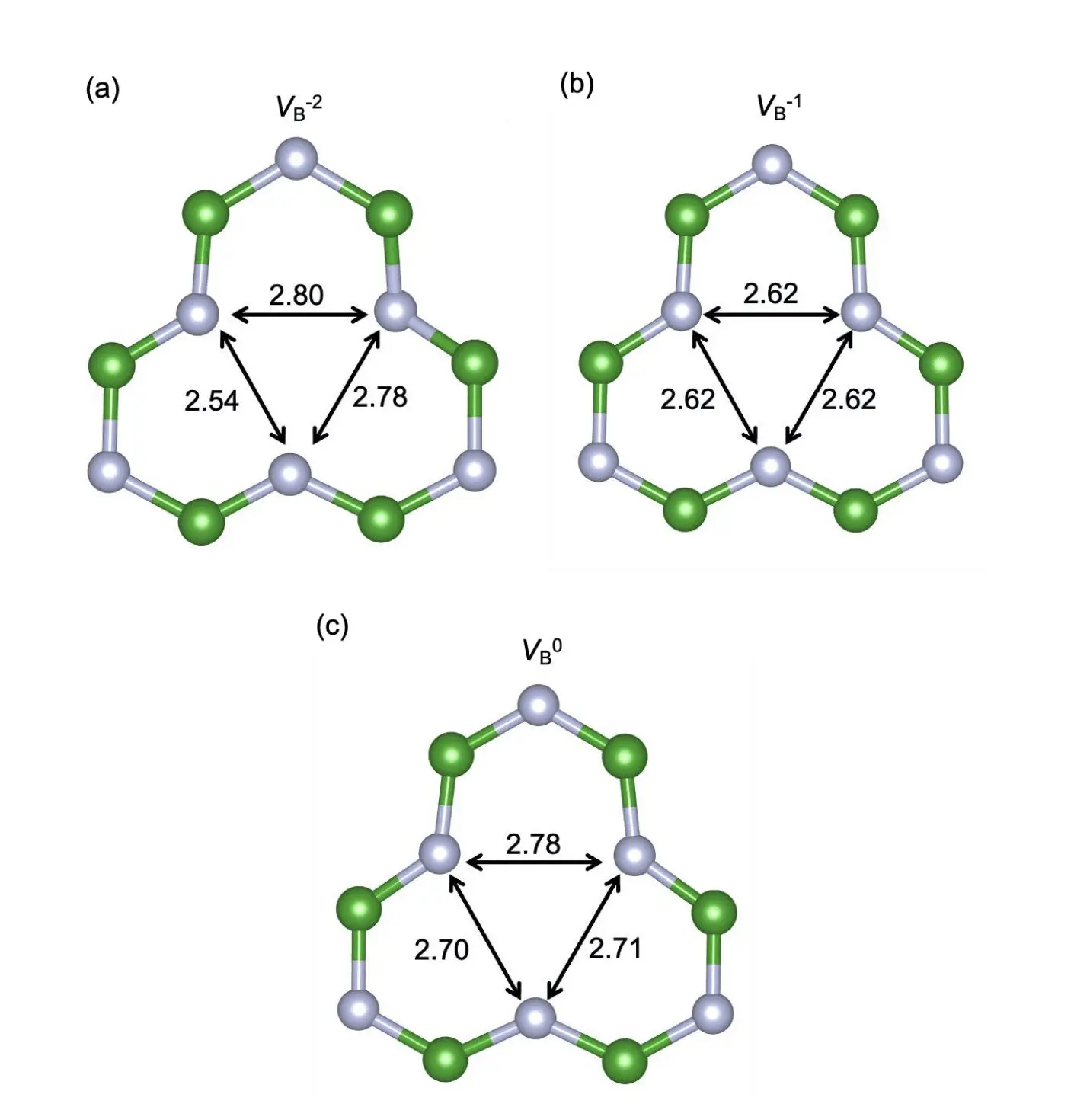
The team carefully optimized the atomic structures, ensuring the forces on the atoms were minimal. Researchers calculated formation energies and charge transition levels for each defect, considering both boron- and nitrogen-rich growth conditions. The r2SCAN functional accurately predicts defect energetics, closely matching higher-level calculations, and provides accurate predictions of zero-phonon line emission, a key parameter for quantum applications. Further analysis focused on optical transitions, finding that r2SCAN effectively captures key properties of the VB-1 triplet state.
Stable Colour Centres in Hexagonal Boron Nitride
This work presents a computational study of intrinsic defects in hexagonal boron nitride (hBN) with the aim of identifying promising candidates for quantum technologies. Researchers employed the r2SCAN functional to model the electronic, optical, and spin properties of these defects, demonstrating that r2SCAN accurately predicts trends in defect formation energies and charge transition levels, making it suitable for efficiently screening a large number of potential defects. These defects possess characteristics relevant for spin qubit implementation, a promising approach to quantum computing. While r2SCAN generally aligns with higher-level calculations, discrepancies suggest that the stability of bound excitons may be underestimated. To further advance these defect systems, the authors recommend future research focus on calculating intersystem crossing rates and spin-phonon interaction strengths to assess spin initialization fidelity and coherence times, crucial parameters for building practical quantum devices based on hBN colour centres.
🗞 Revisiting intrinsic spin defects in hexagonal boron nitride with r2SCAN
🧠 ArXiv: https://arxiv.org/abs/2509.09002




See today’s quantum computing news on Quantum Zeitgeist for the latest breakthroughs in qubits, hardware, algorithms, and industry deals.