Artificial spin ice, arrangements of nanoscale magnets exhibiting fascinating collective behaviour, holds considerable promise for future data storage and processing technologies, but controlling their magnetic configurations remains a significant challenge. Researchers led by D. Pecchio and S. Sahoo, from the Laboratory for Mesoscopic Systems at ETH Zurich, alongside colleagues including O. Chubykalo-Fesenko from the Instituto de Ciencia de Materiales de Madrid, now demonstrate a method to rapidly manipulate these systems using incredibly short bursts of laser light. Their work reveals that femtosecond laser pulses can drive the magnetic relaxation of artificial spin ice within picoseconds, enabling access to low-energy states through the inherent interactions between the nanoscale magnets. This ultrafast control, confirmed by both experimental measurements and detailed simulations, not only advances fundamental understanding of these materials, but also paves the way for developing new, energy-efficient spin-based technologies with unprecedented speed and spatial precision.
It is of great interest to develop methods to rapidly and effectively control the magnetic configurations in artificial spin ices, which are arrangements of dipolar coupled nanomagnets. These systems exhibit a variety of fascinating collective magnetic phenomena, making their control a significant challenge and a valuable pursuit. Achieving this control is not only important for fundamental research into emergent magnetic behaviours, but also opens possibilities for novel technological applications. Therefore, research focuses on developing techniques to precisely engineer and dynamically tune the magnetic landscape within these nanomagnetic arrays.
Frustrated Nanomagnetic Arrays and Emergent Properties
The central theme is the study of Artificial Spin Ice (ASI), nanoscale arrays of magnetic elements designed to mimic the behavior of geometric frustration in natural spin ice materials. The goal is to create materials with emergent magnetic properties, potentially useful for novel computing architectures and data storage. Geometric frustration arises because the arrangement of magnetic elements prevents all magnetic moments from simultaneously minimizing their energy, leading to a disordered ground state and the emergence of magnetic monopoles. Creating these ASI structures requires precise nanofabrication techniques to control the size, shape, and arrangement of the magnetic elements.
Researchers use micromagnetic simulations to model the behavior of the magnetic elements and understand their interactions, calculating energy barriers, relaxation pathways, and dynamic behavior. Advanced techniques, such as simulated annealing, are employed to find the lowest energy states and pathways for magnetization reversal. Machine learning techniques are also applied to analyze complex data and improve simulations. Researchers investigate how to reduce energy barriers to enable faster switching and lower energy consumption, identifying the pathways that magnetization takes as it relaxes to equilibrium.
They are also exploring the creation of three-dimensional ASI structures with more complex magnetic properties. The research highlights the potential of ASI for novel computing architectures, high-density data storage, and artificial neural networks, with applications in spintronics. This interdisciplinary work combines nanofabrication, micromagnetic simulations, advanced computational techniques, and experimental studies, aiming to create new materials and devices with unique magnetic properties for a variety of applications.
Laser Control of Ultrafast Magnetic Relaxation
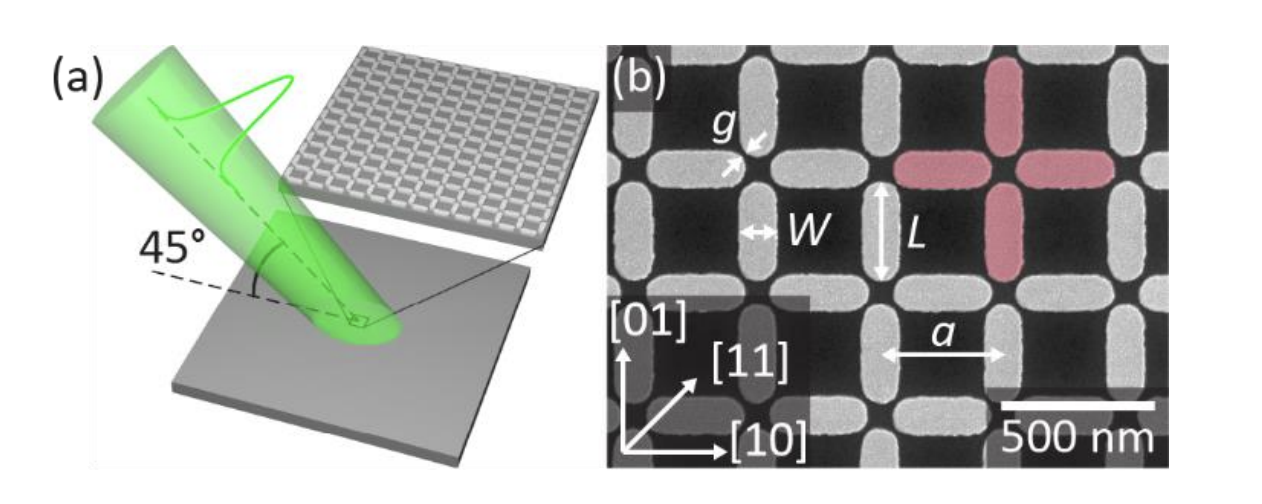
Researchers demonstrate ultrafast control of magnetic relaxation within artificial spin ice, achieving rapid access to low-energy states through femtosecond laser pulses. Experiments reveal that after laser-induced demagnetization, magnetization recovers within picoseconds, initiating a collective magnetic ordering driven by dipolar coupling between nanomagnets. Detailed investigations, combining energy barrier calculations and micromagnetic simulations, elucidate the underlying mechanism: a transient ultrafast demagnetization followed by rapid remagnetization that enables a dipolar-driven collective rearrangement of the nanomagnets. Simulations highlight the critical interplay between initial demagnetization and subsequent partial recovery of magnetization, facilitating collective relaxation into low-energy configurations. A tailored laser annealing protocol further enhances ground-state ordering, consistently achieving over 92% ground-state vertex populations within the artificial spin ice. By exposing the artificial square ice with laser pulses, researchers induced rapid magnetic relaxation without an external magnetic field, delivering an order of magnitude increase in speed compared to existing methods, while simultaneously offering spatial control over the resulting magnetic configuration, opening possibilities for spin-based technologies and memory applications.
Light Controls Ultrafast Magnetic Ordering in Spin Ice
Researchers have demonstrated that femtosecond laser pulses can rapidly control magnetic relaxation in artificial square spin ice, enabling the system to access low-energy states within picoseconds. This control relies on a precise interplay between ultrafast demagnetization and subsequent remagnetization, which allows dipolar interactions to drive collective magnetic ordering and achieve a highly ordered ground state, with over 92% of vertices adopting the lowest-energy configuration. This work highlights the potential of using light to control magnetism in artificial spin ice, offering a promising route towards ultrafast spin-based computing and memory technologies. Future research will likely focus on developing multiscale modeling approaches to fully understand the complex interplay between demagnetization, thermal effects, and dipolar coupling over longer timescales and larger systems, and to explore the applicability of these ultrafast relaxation mechanisms to other artificial spin ice geometries.
🗞 Ultrafast Laser-Induced Magnetic Relaxation in Artificial Spin Ice Driven by Dipolar Interactions
🧠 ArXiv: https://arxiv.org/abs/2508.16231
See today’s quantum computing news on Quantum Zeitgeist for the latest breakthroughs in qubits, hardware, algorithms, and industry deals.