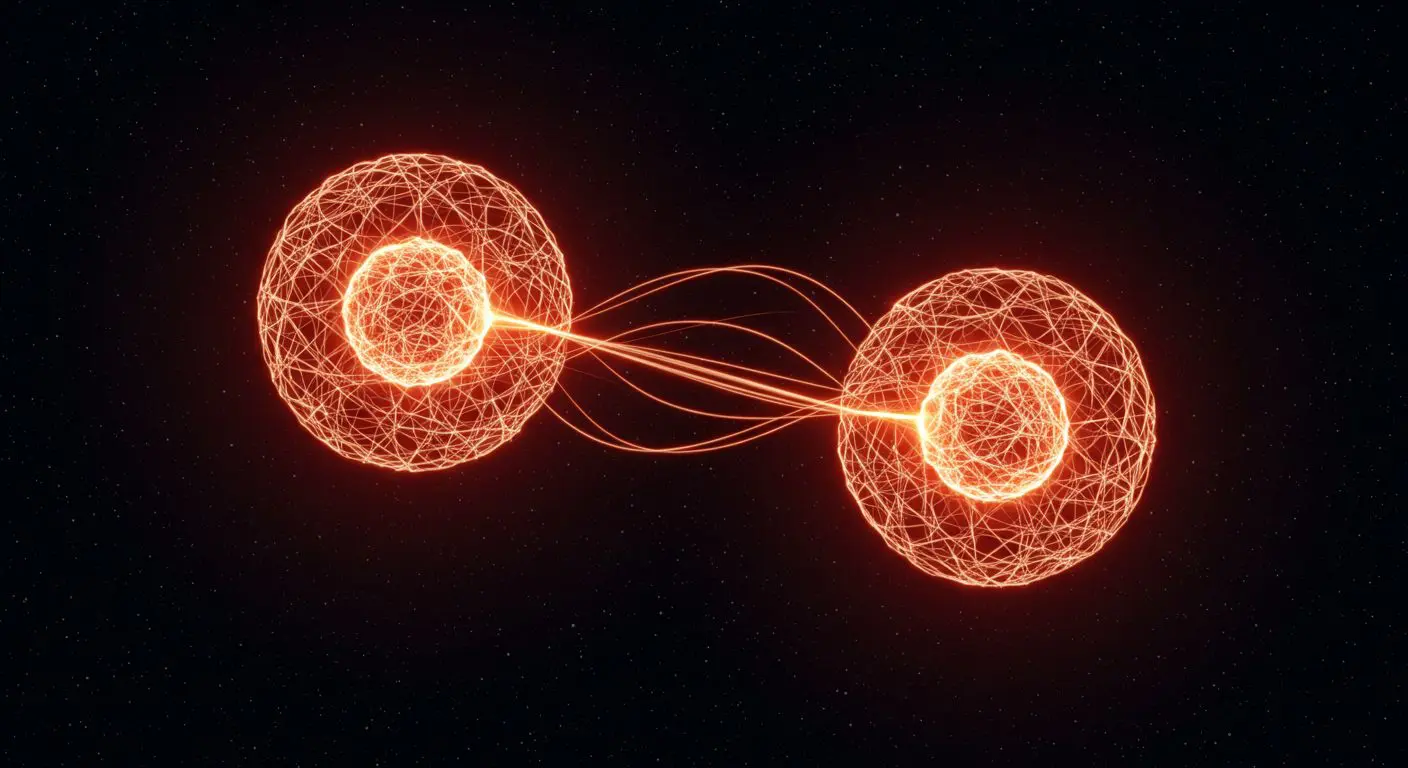
Entangled light, where two photons become linked and share the same fate, holds immense promise for advances in quantum technologies and fundamental physics, and researchers are continually seeking new ways to create and characterise these unusual states. Rounak Chatterjee, Mayuresh Kanagal, and Vikas S Bhat, at the Tata Institute of Fundamental Research, investigate a particularly subtle form of entanglement known as ‘pure’ phase entanglement, where correlations between photons arise solely from the spatial phase of their wavefunctions. This research demonstrates both the theoretical construction and experimental realisation of this state, which uniquely correlates the position of one photon with the momentum of its partner, unlike more common entangled states. By proposing a novel method to certify its properties through one-particle momentum measurement, the team highlights the potential of this pure phase entanglement for applications in precision imaging and other quantum experiments.
This work theoretically and experimentally examines a unique form of phase entanglement known as ‘pure’ phase entanglement, exhibiting the unusual feature that the position of one photon is correlated with the momentum of the other. Unlike typical spatially entangled states, it shows no direct correlation in position or momentum between the two photons, underscoring that all correlations arise purely from the spatial phase of the wavefunction.
Entangled Photons and Spatial Correlation Imaging
This research comprehensively explores quantum imaging, specifically focusing on entangled photon pairs and spatial correlations. Utilizing spontaneous parametric down-conversion, the team builds upon foundational principles of entangled photon generation and manipulation. Researchers have explored how spatial entanglement propagates and evolves, investigating the quality of entanglement during propagation and developing techniques to manipulate these correlations. A significant focus lies on applying these principles to advanced imaging techniques, including quantum holography and ghost imaging, which utilize correlated photons to create images even when one photon doesn’t directly interact with the object.
Furthermore, the research integrates Fourier ptychography, a super-resolution imaging technique, with quantum correlations to enhance resolution and sensitivity. Investigations also extend to phase-contrast imaging, leveraging orbital angular momentum to improve image contrast, and imaging through scattering media, a crucial step towards real-world applications. Recent advancements focus on optimizing entanglement for specific imaging tasks. Researchers are exploring methods to control the degree of entanglement and mitigate wavefront distortion, which can degrade image quality. The use of electron multiplying CCDs allows for the detection of individual photons, crucial for many quantum imaging techniques. Theoretical modeling plays a vital role, with researchers utilizing covariance ellipses and Gaussian models to characterize the spatial properties of entangled photons. Overall, this research demonstrates a clear trajectory towards developing practical quantum imaging systems with the potential to revolutionize fields like microscopy, medical imaging, and remote sensing.
Pure Phase Entanglement Experimentally Demonstrated
Researchers have successfully created and studied ‘pure’ phase entanglement, a phenomenon where two particles are linked through correlations in the spatial phase of their wavefunctions. This differs from typical entanglement where correlations exist in position or momentum, as this new state exhibits correlations solely through phase. The team both theoretically predicted and experimentally demonstrated the existence of this unusual state, opening new avenues for exploring fundamental quantum mechanics. The experiment involved generating pairs of entangled photons and manipulating their properties using lenses.
By precisely controlling the setup, researchers created the ‘pure’ phase entangled state and verified its properties through detailed measurements. A key aspect of the verification process involved demonstrating the absence of any direct correlation in either position or momentum between the photons, confirming that all entanglement arises purely from the phase relationship. This was achieved by analyzing the distribution of photon pairs and showing that they behaved as predicted by the theory. The implications of this research extend to potential applications in advanced imaging techniques and quantum information processing. The unique properties of ‘pure’ phase entanglement could enable the development of novel methods for enhancing image resolution and sensitivity, as well as creating more robust and secure quantum communication protocols. The team demonstrated the ability to measure correlations between position and momentum, paving the way for exploring more complex quantum states and their potential uses.
Spatial Phase Entanglement and Coherence Control
This research establishes a practical method for creating pure phase-entangled states, previously explored only theoretically. This state exhibits a unique characteristic: the position of one photon is correlated with the momentum of its entangled partner, without direct correlation in either position or momentum between the photons themselves. This indicates that all entanglement arises from the spatial phase of the combined quantum system. The findings reveal that by manipulating the parameters of a position measurement, researchers can control the coherence properties of the entangled photon, opening possibilities for applications in various quantum technologies.
Specifically, the researchers highlight potential uses in heralded imaging, where information about one photon’s position can reveal the momentum characteristics of its twin, particularly useful for probing complex or disordered materials. Further applications are envisioned in techniques like Fourier ptychography and phase-contrast microscopy, leveraging the highly correlated phase front of the entangled state. The authors acknowledge limitations related to data processing, noting that finite sampling introduces noise. They employed a method involving excess two-photon correlation to address this, but also point out its limitations when dealing with sparsely distributed densities. Future work could focus on refining these data analysis techniques or exploring alternative methods for mitigating noise in these types of experiments.
🗞 Generation and certification of pure phase entangled light
🧠 ArXiv: https://arxiv.org/abs/2508.11418



See today’s quantum computing news on Quantum Zeitgeist for the latest breakthroughs in qubits, hardware, algorithms, and industry deals.