Schrödinger‘s cat is a thought experiment demonstrating the concept of quantum superposition, where particles can exist simultaneously in multiple states until observed. This paradox challenges classical notions of reality by suggesting that a cat could be alive and dead in a theoretical scenario involving radioactive decay and poison. The experiment highlights the enigmatic nature of quantum mechanics and its departure from everyday experience.
Decoherence theory explains why macroscopic objects like cats do not exhibit such quantum behavior. It posits that interactions with the environment cause loss of coherence, transitioning quantum systems into classical states. This process prevents observable superpositions in large systems, resolving the paradox posed by Schrödinger’s cat. Decoherence involves environmental interactions leading to the collapse of quantum states into classical ones, explaining why everyday objects behave classically.
Modern experiments have extended quantum principles beyond microscopic scales, demonstrating macroscopic superposition. For instance, researchers have placed tiny mechanical oscillators into superposition states by cooling them to their quantum ground state and applying specific forces. These experiments, conducted under highly isolated conditions at ultralow temperatures, challenge classical understanding of physical states and offer insights into potential applications in quantum computing and communication.
Future directions aim to scale up these systems, potentially leading to more complex superpositions and applications. However, challenges remain, including enhancing coherence times and improving control over larger systems. Continued research could unlock new technologies and deepen our understanding of quantum phenomena, bridging the gap between quantum theory and macroscopic reality while highlighting the nonintuitive nature of quantum mechanics.
Quantum Superposition Made Simple
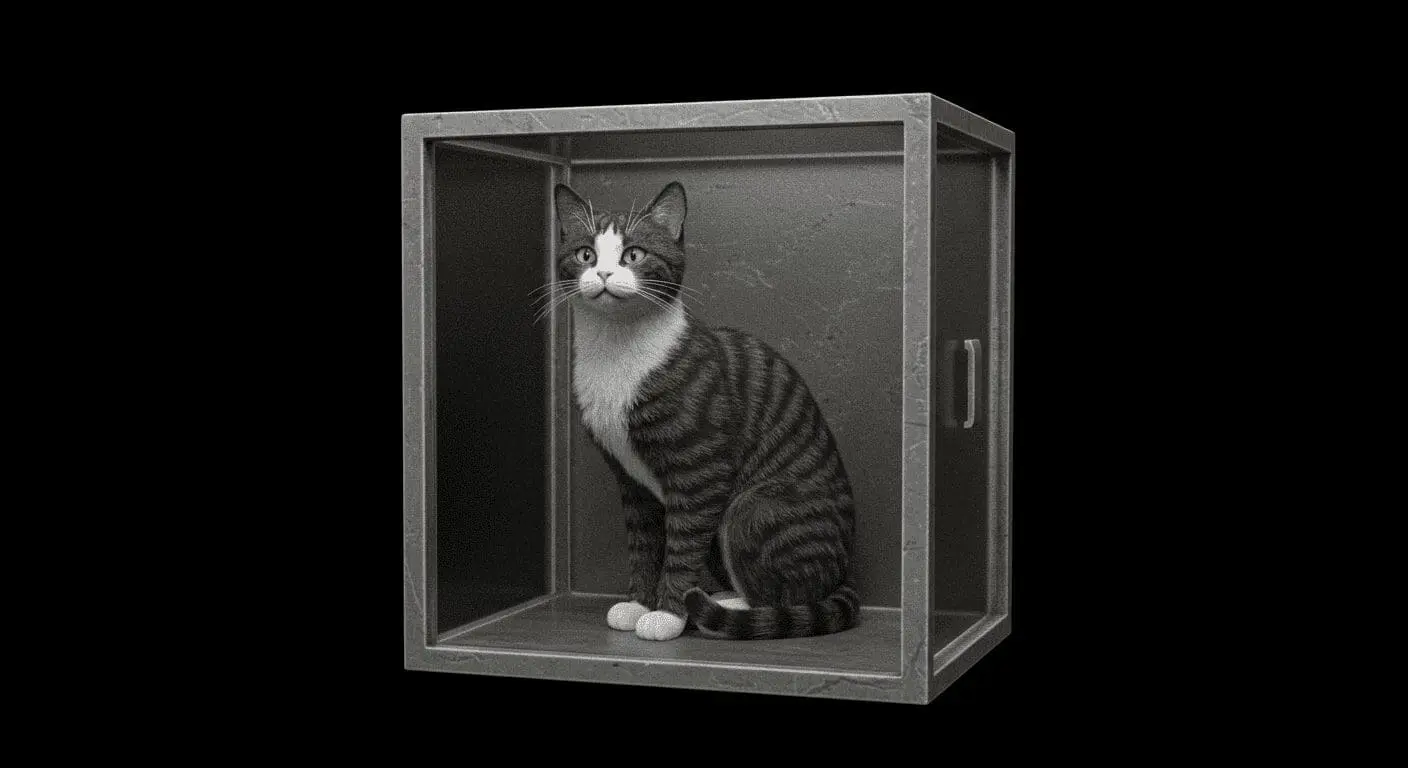
Schrödinger’s Cat is a thought experiment devised by physicist Erwin Schrödinger in 1935 to illustrate the paradoxes inherent in quantum superposition. The experiment involves a hypothetical scenario where a cat is placed inside a sealed box along with a radioactive atom, a Geiger counter, and a vial of poison. If the Geiger counter detects radiation, it triggers the release of poison, killing the cat. According to quantum mechanics, until an observer opens the box, the radioactive atom exists in a superposition of decayed and undecayed states. Consequently, the cat is simultaneously alive and dead, a state known as a quantum superposition.
The thought experiment highlights the counterintuitive nature of quantum mechanics, particularly the principle that particles can exist in multiple states at once until measured. Schrödinger intended this paradox to challenge the Copenhagen interpretation of quantum mechanics, which posits that quantum systems do not have definite properties until they are observed. The cat’s dual state serves as a metaphor for the broader implications of superposition, emphasizing the role of observation in collapsing quantum states into definite outcomes.
While Schrödinger’s Cat is often misunderstood as a literal description of reality, it is instead a tool to provoke critical thinking about the foundations of quantum theory. Physicists have since developed more precise experiments to test superposition, such as those involving photons and electrons. These experiments confirm that quantum systems can indeed exist in multiple states simultaneously, providing empirical evidence for the principles illustrated by Schrödinger’s thought experiment.
The concept of superposition has profound implications for modern technology, particularly in the field of quantum computing. Quantum bits, or qubits, leverage superposition to perform calculations far beyond the capabilities of classical computers. By maintaining multiple states at once, qubits can process vast amounts of information simultaneously, offering revolutionary advancements in fields such as cryptography, optimization, and materials science.
Despite its simplicity, Schrödinger’s Cat remains a cornerstone of quantum mechanics education, illustrating both the elegance and the perplexity of the theory. It underscores the importance of observation in shaping reality at the quantum level and continues to inspire research into the fundamental nature of existence.
Wavefunction Collapse And Measurement
The concept of wavefunction collapse is central to understanding quantum mechanics and its implications for reality. In Schrödinger’s Cat, the act of opening the box and observing the cat forces the system into a single state, either alive or dead. This process raises questions about the nature of measurement and the role of an observer in collapsing the wavefunction. The experiment has become a cornerstone in discussions about quantum interpretations, such as the Many-Worlds Interpretation, which suggests that all possible outcomes occur in separate universes.
Despite its simplicity, Schrödinger’s Cat continues to provoke deep philosophical and scientific debates. It underscores the fundamental tension between the microscopic world governed by quantum mechanics and the macroscopic world described by classical physics. The experiment also serves as a metaphor for the uncertainty principle and the probabilistic nature of quantum states. By challenging our understanding of reality, Schrödinger’s Cat has become an enduring symbol in the history of quantum theory.
The thought experiment remains relevant today as scientists explore alternative interpretations of quantum mechanics and seek to reconcile the paradoxes it presents. It emphasizes the need for a more comprehensive framework that can account for the transition from quantum superpositions to classical reality. Schrödinger’s Cat not only illustrates the peculiarities of quantum mechanics but also inspires ongoing research into the foundational questions of physics.
The Copenhagen Interpretation Debate
The purpose of Schrödinger’s Cat was to critique the Copenhagen Interpretation, highlighting the absurdity of applying quantum superposition to macroscopic objects. Schrödinger intended to show that the interpretation leads to illogical conclusions when extended beyond microscopic particles. This critique challenges the notion that quantum states only collapse upon measurement.
The Copenhagen Interpretation, developed by Niels Bohr and Werner Heisenberg, posits that quantum states remain in superposition until measured. Schrödinger’s Cat underscores the difficulty of imagining macroscopic objects existing in multiple states simultaneously, questioning whether quantum mechanics applies differently at larger scales.
This thought experiment has sparked debates about alternative interpretations of quantum mechanics. Discussions have led to theories such as decoherence and the many-worlds interpretation, which attempt to resolve the paradoxes posed by Schrödinger’s Cat without relying solely on the Copenhagen Interpretation.
The lasting impact of Schrödinger’s Cat lies in its role as a catalyst for exploring the foundations of quantum mechanics. It continues to provoke thought about the nature of reality and the limits of scientific understanding, making it a cornerstone in discussions about quantum theory.
Quantum Decoherence Theory
This experiment highlights the concept of superposition, where particles can exist in multiple states simultaneously, and entanglement, where particles become interconnected regardless of distance. These principles are fundamental to quantum mechanics but challenge classical notions of reality.
Decoherence theory addresses why macroscopic objects like cats do not exhibit such quantum behavior. It explains that interactions with the environment cause loss of coherence, transitioning quantum systems into classical states. This process is rapid for large systems, preventing observable superpositions and resolving the paradox posed by Schrödinger’s Cat.
The mechanisms of decoherence involve environmental interactions leading to loss of coherence. Quantum states lose their phase relationships due to constant exchanges of information with surroundings, effectively collapsing into classical states. This explains why everyday objects behave classically and why quantum phenomena are not observed macroscopically.
In summary, while Schrödinger’s Cat underscores the enigmatic nature of quantum mechanics, decoherence theory provides a framework for understanding how quantum systems transition to classical behavior. It elucidates the role of environmental interactions in preventing macroscopic superpositions, bridging the gap between quantum theory and everyday experience.
Modern Variations And Real-world Tests
Modern variations of Schrödinger’s Cat experiment involve macroscopic systems demonstrating quantum superposition. For instance, researchers have placed a mechanical oscillator, a tiny mirror attached to a spring, into a superposition state. By cooling it to its quantum ground state and applying specific forces, they induced a macroscopic superposition of two vibrational states. This experiment, conducted by O’Connell et al., was published in Nature, showcasing how quantum principles can extend beyond microscopic scales.
Decoherence poses a significant challenge in maintaining these quantum states. Interactions with the environment cause systems to lose their quantum properties, transitioning into classical states. To mitigate this, experiments are conducted at ultra-low temperatures and in highly isolated conditions. Understanding decoherence is crucial for advancing macroscopic quantum systems, as outlined in review articles such as those by Zurek in Physics Today.
Other real-world tests include superconducting circuits and ion traps demonstrating quantum superposition. These systems allow scientists to observe and manipulate quantum states with higher precision. For example, experiments with trapped ions have achieved superpositions of distinct vibrational modes, further validating the principles underlying Schrödinger’s thought experiment.
The implications of these experiments are profound, bridging the gap between quantum theory and macroscopic reality. They challenge our classical understanding of physical states and offer insights into potential applications in quantum computing and communication. As noted by Penrose in “The Emperor’s New Mind,” such experiments highlight the non-intuitive nature of quantum mechanics.
Future directions aim to scale up these systems, potentially leading to more complex superpositions and applications. However, challenges remain, including enhancing coherence times and improving control over larger systems. Continued research could unlock new technologies and deepen our understanding of quantum phenomena.




See today’s quantum computing news on Quantum Zeitgeist for the latest breakthroughs in qubits, hardware, algorithms, and industry deals.