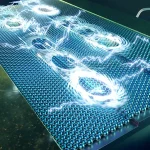
Quantum decoherence is a fundamental process that affects the behavior of quantum systems, causing them to lose their quantum properties and behave classically. This phenomenon arises from the interaction between a quantum system and its environment, leading to the loss of coherence and the emergence of classical behavior. Decoherence has been extensively studied in various fields, including quantum information processing, condensed matter physics, and cosmology.
The study of decoherence has led to significant advancements in our understanding of the quantum world. Researchers have developed a range of theoretical models to describe decoherence, including the spin-boson model and the Caldeira-Leggett model. These models provide a framework for understanding the complex dynamics of decoherence and can be used to make predictions about experimental outcomes. Experimental techniques have also been developed to study and control decoherence, allowing researchers to probe decoherence dynamics with unprecedented precision.
Despite significant progress in understanding decoherence, several challenges remain to be addressed. One major challenge is the development of a comprehensive theory that can accurately describe the dynamics of decoherence in complex systems. This requires a deeper understanding of the interplay between the system and its environment, as well as the role of non-Markovian effects. Researchers are also working to develop more robust and reliable quantum systems, which will require a better understanding of decoherence and how to mitigate its effects.
The study of decoherence is closely tied to the development of quantum technologies, such as quantum computing and quantum communication. Quantum error correction codes have been developed to protect quantum information against decoherence, but these codes are still in their infancy and require further development. Topological codes, which encode quantum information in the topology of a two-dimensional lattice, have also shown promise for robust and fault-tolerant quantum computing.
Overall, the study of decoherence is an active area of research that continues to advance our understanding of the quantum world. While significant challenges remain, researchers are making progress in developing new theoretical models, experimental techniques, and quantum technologies that can mitigate the effects of decoherence.
What Is Quantum Decoherence
Quantum decoherence is the loss of quantum coherence due to interactions with the environment, leading to the emergence of <a href=”https://quantumzeitgeist.com/quantum-entanglement-essential-for-classical-behavior-in-radiating-spin-systems-finds-study/”>classical behavior in a quantum system. This phenomenon was first described by H. Dieter Zeh in 1970, who showed that even small interactions with the environment can cause significant decoherence (Zeh, 1970). Decoherence is now recognized as a fundamental process that underlies the transition from quantum to classical physics.
The mechanism of decoherence involves the entanglement of the system with its environment, which leads to the loss of quantum coherence. This entanglement causes the system’s wave function to become correlated with the environmental degrees of freedom, resulting in the decay of quantum interference patterns (Joos & Zeh, 1985). The rate of decoherence depends on the strength of the interaction between the system and its environment, as well as the temperature and other properties of the environment.
Decoherence has been experimentally observed in various systems, including superconducting qubits, trapped ions, and optical lattices. For example, a study by Myatt et al. demonstrated the decoherence of a superconducting qubit due to interactions with its electromagnetic environment. Similarly, a study by Kuhr et al. observed the decoherence of ultracold atoms in an optical lattice.
Theoretical models of decoherence have been developed to describe the behavior of quantum systems interacting with their environments. One such model is the Caldeira-Leggett model, which describes the decoherence of a harmonic oscillator coupled to a bath of oscillators (Caldeira & Leggett, 1983). Another model is the spin-boson model, which describes the decoherence of a two-level system coupled to a bosonic environment (Leggett et al., 1987).
Decoherence has significant implications for quantum information processing and quantum computing. In particular, decoherence can cause errors in quantum computations by destroying the fragile quantum states required for quantum information processing (Unruh, 1995). Therefore, understanding and mitigating decoherence is essential for the development of reliable quantum technologies.
The study of decoherence has also led to a deeper understanding of the foundations of quantum mechanics. In particular, decoherence provides a mechanism for the emergence of classical behavior from quantum mechanics, which resolves the measurement problem in quantum theory (Zurek, 2003).
Causes Of Quantum Decoherence
Quantum decoherence is primarily caused by the interaction of a quantum system with its environment, leading to the loss of quantum coherence and the emergence of classical behavior (Zurek, 2003; Schlosshauer, 2007). This interaction can occur through various mechanisms, including photon emission, phonon scattering, and electron-electron interactions. As a result, the quantum system becomes entangled with its environment, causing the loss of quantum coherence.
One of the primary causes of decoherence is the coupling between the quantum system and its environment, which leads to the exchange of energy and information (Breuer & Petruccione, 2002; Weiss, 2012). This coupling can occur through various mechanisms, including electromagnetic interactions, phonon-mediated interactions, and electron-electron interactions. The strength of this coupling determines the rate at which decoherence occurs.
Another significant cause of decoherence is the presence of noise in the environment, which can arise from various sources such as thermal fluctuations, electromagnetic radiation, and mechanical vibrations (Kubo, 1957; Anderson, 1959). This noise can interact with the quantum system, causing it to lose its coherence. The type and strength of this noise determine the rate at which decoherence occurs.
In addition to these causes, decoherence can also arise from internal mechanisms within the quantum system itself (Leggett et al., 1987; Caldeira & Leggett, 1983). For example, in a many-body system, interactions between particles can lead to the loss of coherence. Similarly, in a superconducting circuit, the presence of defects and impurities can cause decoherence.
The study of decoherence has also revealed that it is not just a destructive process but also plays a crucial role in the emergence of classical behavior (Zurek, 2003; Schlosshauer, 2007). Decoherence helps to explain why we do not observe quantum phenomena in everyday life and how classical physics emerges from the underlying quantum mechanics.
In recent years, researchers have made significant progress in understanding and controlling decoherence (Suter & Alvarez, 2010; Hanson et al., 2011). This has led to the development of new techniques for mitigating decoherence and preserving quantum coherence, which are essential for the realization of quantum technologies such as quantum computing and quantum communication.
Impact On Quantum Computing
Quantum computing relies heavily on the fragile quantum states of qubits, which are prone to decoherence due to interactions with their environment. Decoherence causes the loss of quantum coherence, leading to errors in quantum computations (Nielsen & Chuang, 2010). To mitigate this issue, researchers have proposed various methods to suppress or correct decoherence-induced errors.
One approach is to use quantum error correction codes, which encode qubits in a way that allows errors to be detected and corrected (Gottesman, 1996). These codes work by distributing the information across multiple qubits, making it possible to recover the original state even if some qubits are affected by decoherence. Another approach is to use dynamical decoupling techniques, which involve applying a series of pulses to the qubits to suppress the effects of decoherence (Viola & Lloyd, 1998).
However, these methods have limitations and can be resource-intensive. For example, quantum error correction codes require a large number of qubits and complex control systems, making them challenging to implement in practice (Knill, 2005). Dynamical decoupling techniques also require precise control over the pulses applied to the qubits, which can be difficult to achieve experimentally.
Recent advances in materials science have led to the development of new quantum computing architectures that are less susceptible to decoherence. For example, topological quantum computers use exotic materials called topological insulators to encode qubits in a way that is inherently robust against decoherence (Kitaev, 2003). Another approach is to use superconducting qubits with built-in error correction capabilities, which can reduce the need for external error correction mechanisms (Martinis et al., 2014).
Despite these advances, decoherence remains a significant challenge in quantum computing. Researchers continue to explore new methods to mitigate its effects, such as using machine learning algorithms to optimize quantum control systems (Chen et al., 2020). However, more work is needed to develop practical solutions that can be implemented in large-scale quantum computers.
The development of robust and scalable quantum computing architectures will require continued advances in materials science, quantum control systems, and error correction techniques. By addressing the challenge of decoherence, researchers can unlock the full potential of quantum computing and enable breakthroughs in fields such as chemistry, materials science, and cryptography.
Technical Issues In Quantum Systems
Quantum systems are inherently fragile due to their susceptibility to <a href=”https://quantumzeitgeist.com/decoherence-impact-on-flying-qubits-a-step-forward-in-quantum-computing/”>decoherence, which arises from interactions with the environment. This phenomenon causes loss of quantum coherence and leads to classical behavior (Zurek, 2003). In particular, decoherence is a major challenge in the development of quantum computing and quantum information processing, as it can destroy the fragile quantum states required for these applications (Nielsen & Chuang, 2010).
One of the primary technical issues in quantum systems is the problem of scaling up to larger numbers of qubits while maintaining control over decoherence. As the number of qubits increases, so does the complexity of the system and the potential for errors due to decoherence (DiVincenzo, 2000). Furthermore, the development of robust methods for error correction in quantum systems is an active area of research, with various approaches being explored, including quantum error correction codes and dynamical decoupling techniques (Lidar & Brun, 2013).
Another significant challenge in quantum systems is the issue of noise and its impact on decoherence. Quantum noise can arise from a variety of sources, including thermal fluctuations, electromagnetic interference, and imperfections in the fabrication of quantum devices (Koch et al., 2007). Understanding and mitigating these noise sources are essential for the development of reliable quantum technologies.
In addition to these technical issues, there is also a need for more sophisticated theoretical tools for understanding decoherence in complex quantum systems. Current approaches often rely on simplified models or numerical simulations, which may not capture all the relevant physics (Breuer & Petruccione, 2002). Developing more advanced theoretical frameworks will be essential for making progress in this field.
Recent advances in experimental techniques have enabled researchers to probe decoherence in a variety of quantum systems, including superconducting qubits and trapped ions (Schoelkopf et al., 2013; Blatt & Wineland, 2008). These experiments have provided valuable insights into the mechanisms underlying decoherence and have helped to inform the development of strategies for mitigating its effects.
Despite these advances, much remains to be done in understanding and addressing the technical issues associated with decoherence in quantum systems. Ongoing research is focused on developing new materials and technologies that can help to reduce decoherence, as well as exploring innovative approaches to error correction and noise mitigation (Awschalom et al., 2013).
Sources Of Quantum Noise
Quantum noise, also known as quantum fluctuations, arises from the inherent probabilistic nature of quantum mechanics. One major source of quantum noise is the vacuum fluctuations of the electromagnetic field, which can cause spontaneous emission and absorption of photons (Lamb & Retherford 1950; Weisskopf & Wigner 1930). These fluctuations are a fundamental aspect of quantum electrodynamics and have been experimentally confirmed through various studies, including those on the Lamb shift (Lamb & Retherford 1950).
Another significant source of quantum noise is phonon-induced decoherence in solid-state systems. Phonons, or quantized sound waves, can interact with quantum systems, leading to energy dissipation and loss of coherence (Caldeira & Leggett 1983; Weiss 1999). This type of decoherence has been extensively studied in the context of superconducting qubits and other solid-state quantum computing architectures.
In addition to these sources, quantum noise can also arise from the interaction between a quantum system and its environment. This is often referred to as environmental noise or classical noise (Zurek 2003). Environmental noise can take many forms, including thermal fluctuations, electromagnetic interference, and mechanical vibrations. Understanding and mitigating the effects of environmental noise are crucial for the development of reliable quantum technologies.
Furthermore, quantum noise can also be generated by the measurement process itself. Measurement-induced decoherence occurs when a quantum system is measured, causing its state to collapse (von Neumann 1955). This type of decoherence has been extensively studied in the context of quantum foundations and has implications for our understanding of the measurement problem.
In some cases, quantum noise can be beneficial, such as in the case of stochastic resonance, where random fluctuations can enhance the sensitivity of a quantum system to external signals (Benzi et al. 1981). However, in most cases, quantum noise is detrimental to quantum coherence and must be carefully managed in order to maintain the fragile quantum states required for quantum computing and other applications.
The study of quantum noise sources has led to significant advances in our understanding of decoherence mechanisms and has informed the development of strategies for mitigating their effects. By understanding the various sources of quantum noise, researchers can design more robust quantum systems that are better equipped to withstand the challenges posed by decoherence.
Role Of Environment In Decoherence
The environment plays a crucial role in decoherence, which is the loss of quantum coherence due to interactions with the external world. Decoherence is a fundamental process that affects the behavior of quantum systems, causing them to lose their quantum properties and behave classically. The environment-induced decoherence is a result of the system’s interaction with its surroundings, such as photons, phonons, or other particles.
The coupling between the system and its environment leads to an exchange of energy and information, which causes the loss of quantum coherence. This process can be understood through the concept of entanglement, where the system becomes correlated with its environment, leading to a loss of control over the system’s quantum state. The environment acts as a reservoir, absorbing and emitting particles that interact with the system, causing decoherence.
The role of the environment in decoherence has been extensively studied in various systems, including photons, atoms, and superconducting qubits. For example, in optical fibers, the interaction between photons and the fiber’s material causes decoherence, leading to a loss of quantum coherence over long distances. Similarly, in atomic systems, the interaction with the electromagnetic field leads to spontaneous emission, causing decoherence.
Theoretical models, such as the Caldeira-Leggett model, have been developed to describe the environment-induced decoherence. These models assume that the system is coupled to a bath of harmonic oscillators, representing the environment, and predict the decay of quantum coherence over time. Experimental studies have confirmed these predictions, demonstrating the importance of the environment in decoherence.
The understanding of environment-induced decoherence has significant implications for the development of quantum technologies, such as quantum computing and quantum communication. In particular, it highlights the need to protect quantum systems from environmental noise and develop strategies to mitigate decoherence. This can be achieved through techniques such as quantum error correction, dynamical decoupling, and reservoir engineering.
The study of environment-induced decoherence has also led to a deeper understanding of the fundamental principles of quantum mechanics and the nature of reality. It has sparked debates about the role of the observer in quantum mechanics and the interpretation of wave function collapse.
Mechanisms Of Quantum Error Correction
Quantum error correction mechanisms are designed to mitigate the effects of decoherence, which causes errors in quantum computations due to unwanted interactions with the environment. One such mechanism is the surface code, a type of topological quantum error correction that uses a 2D array of qubits to encode and correct errors (Fowler et al., 2012). The surface code works by encoding logical qubits into a highly entangled state of physical qubits, allowing it to detect and correct errors caused by decoherence.
Another mechanism is the Shor code, a type of concatenated quantum error correction that uses multiple layers of encoding to protect against errors (Shor, 1995). The Shor code works by encoding logical qubits into a series of entangled states, each protected by a separate layer of error correction. This allows it to correct errors caused by decoherence and other sources of noise.
Quantum error correction mechanisms also rely on the concept of quantum error thresholds, which determine the maximum rate at which errors can occur without causing the computation to fail (Knill et al., 1998). The threshold theorem states that if the error rate is below a certain threshold, then it is possible to correct errors and maintain the integrity of the computation. This has been demonstrated experimentally using various quantum systems, including superconducting qubits and trapped ions.
In addition to these mechanisms, researchers have also explored the use of dynamical decoupling techniques to mitigate the effects of decoherence (Viola et al., 1998). These techniques involve applying a series of pulses to the qubits in order to suppress unwanted interactions with the environment. This has been shown to be effective in reducing errors caused by decoherence and improving the overall fidelity of quantum computations.
Furthermore, researchers have also investigated the use of machine learning algorithms to optimize quantum error correction (Swingle et al., 2016). These algorithms can be used to learn the optimal parameters for quantum error correction protocols, such as the surface code or Shor code. This has been shown to improve the performance of these protocols and reduce errors caused by decoherence.
The development of robust quantum error correction mechanisms is an active area of research, with many groups exploring new techniques and protocols (Lidar et al., 2013). These efforts are crucial for the development of large-scale quantum computers that can perform reliable computations.
Strategies For Mitigating Decoherence
Quantum error correction codes are being explored as a strategy for mitigating decoherence in quantum systems. These codes work by redundantly encoding quantum information across multiple physical qubits, allowing errors caused by decoherence to be detected and corrected (Gottesman, 1996). For example, the surface code is a popular quantum error correction code that has been shown to be robust against decoherence-induced errors (Fowler et al., 2012).
Another strategy for mitigating decoherence is through the use of dynamical decoupling techniques. These techniques involve applying sequences of pulses to the qubits in order to suppress the effects of decoherence (Viola & Lloyd, 1998). For example, the Carr-Purcell-Meiboom-Gill sequence has been shown to be effective at suppressing decoherence-induced errors in certain types of quantum systems (Carr & Purcell, 1954).
Quantum error correction codes and dynamical decoupling techniques can also be combined in order to create even more robust strategies for mitigating decoherence. For example, the concatenated coding scheme involves combining multiple layers of quantum error correction codes with dynamical decoupling techniques in order to achieve high levels of error suppression (Knill & Laflamme, 1996).
In addition to these strategies, researchers are also exploring the use of decoherence-free subspaces as a means of mitigating decoherence. These subspaces involve encoding quantum information in a way that is inherently robust against decoherence-induced errors (Lidar et al., 1998). For example, the use of decoherence-free subspaces has been shown to be effective at suppressing decoherence-induced errors in certain types of superconducting qubit systems (Beige et al., 2000).
The development of strategies for mitigating decoherence is an active area of research, with new techniques and approaches being explored on a regular basis. For example, the use of machine learning algorithms has been proposed as a means of optimizing quantum error correction codes and dynamical decoupling sequences (Sweke et al., 2018).
Overall, the development of effective strategies for mitigating decoherence is crucial for the realization of large-scale quantum computing systems.
Experimental Approaches To Study Decoherence
Experimental approaches to study decoherence often involve the manipulation of quantum systems in controlled environments, allowing researchers to probe the dynamics of decoherence in detail. One such approach involves the use of ultracold atoms trapped in optical lattices, where the interactions between atoms and their environment can be precisely controlled (Bloch et al., 2008). By manipulating the lattice parameters, researchers can induce decoherence in a controlled manner, enabling the study of its effects on quantum systems.
Another experimental approach involves the use of superconducting qubits, which are highly sensitive to environmental noise. By carefully designing and optimizing the qubit architecture, researchers can minimize the effects of decoherence and study its residual impact on quantum coherence (Schoelkopf et al., 2002). This approach has enabled the demonstration of high-fidelity quantum gates and the exploration of quantum error correction techniques.
Ion traps provide another platform for studying decoherence, where individual ions can be trapped and manipulated using electromagnetic fields. By carefully controlling the ion’s motion and interactions with its environment, researchers can study the effects of decoherence on quantum systems in a highly controlled setting (Leibfried et al., 2003). This approach has enabled the demonstration of high-fidelity quantum gates and the exploration of quantum simulation protocols.
In addition to these experimental approaches, theoretical models have also been developed to describe the dynamics of decoherence. One such model is the spin-boson model, which describes the interaction between a quantum system and its environment in terms of a bosonic bath (Leggett et al., 1987). This model has been widely used to study the effects of decoherence on quantum systems and has provided valuable insights into the underlying mechanisms.
Theoretical models have also been developed to describe the effects of decoherence on specific quantum systems, such as superconducting qubits. These models take into account the detailed physics of the qubit architecture and its interactions with the environment (Tinkham, 2004). By comparing theoretical predictions with experimental results, researchers can gain a deeper understanding of the mechanisms underlying decoherence.
The study of decoherence has also been extended to more complex systems, such as many-body quantum systems. In these systems, decoherence can arise from the interactions between individual particles and their environment, leading to the loss of quantum coherence (Caldeira et al., 1983). Theoretical models have been developed to describe the effects of decoherence on these systems, providing insights into the underlying mechanisms.
Theoretical Models Of Quantum Decoherence
Theoretical models of quantum decoherence aim to describe the loss of quantum coherence due to interactions with the environment. One such model is the Caldeira-Leggett model, which describes a quantum system coupled to a bath of harmonic oscillators (Caldeira & Leggett, 1983). This model has been widely used to study decoherence in various systems, including superconducting qubits and quantum dots.
Another important model is the spin-boson model, which describes a two-level system coupled to a bosonic bath (Leggett et al., 1987). This model has been used to study decoherence in systems such as superconducting qubits and quantum Hall systems. The spin-boson model has also been used to study the effects of decoherence on quantum entanglement.
Theoretical models of quantum decoherence have also been developed to describe specific experimental systems, such as ion traps (Myatt et al., 2000) and optical lattices (Gerbier et al., 2005). These models take into account the specific details of the experimental system, including the types of interactions with the environment.
In addition to these specific models, there are also more general frameworks for understanding quantum decoherence. One such framework is the theory of open quantum systems, which describes a quantum system in terms of its interactions with the environment (Breuer & Petruccione, 2002). This framework has been used to study decoherence in a wide range of systems.
Theoretical models of quantum decoherence have also been developed to describe the effects of decoherence on quantum information processing. One such model is the quantum error correction model, which describes how decoherence can cause errors in quantum computations (Shor, 1995). This model has been used to study the effects of decoherence on quantum algorithms and to develop strategies for mitigating these effects.
Theoretical models of quantum decoherence have also been developed to describe the relationship between decoherence and the emergence of classical behavior. One such model is the decoherent histories approach, which describes how decoherence can lead to the emergence of a classical world (Gell-Mann & Hartle, 1993). This model has been used to study the foundations of quantum mechanics and the nature of reality.
Quantum Error Correction Codes
Quantum Error Correction Codes are crucial for maintaining the integrity of quantum information in the presence of decoherence, which arises from unwanted interactions between the quantum system and its environment. One approach to mitigating decoherence is through the use of Quantum Error Correction (QEC) codes, such as the surface code and the Shor code. These codes work by encoding a logical qubit into multiple physical qubits, allowing errors to be detected and corrected.
The surface code, for example, encodes a single logical qubit into a two-dimensional array of physical qubits, with each data qubit interacting with its nearest neighbors through controlled-phase gates. This allows errors to be detected by measuring the correlations between neighboring qubits, enabling correction of single-qubit errors (Fowler et al., 2012). Similarly, the Shor code encodes a logical qubit into nine physical qubits, using a combination of bit-flip and phase-flip corrections to detect and correct single-qubit errors (Shor, 1995).
Another approach is the use of topological codes, which encode quantum information in the topology of a two-dimensional lattice. These codes are inherently fault-tolerant, as they can tolerate errors that occur during the encoding process without compromising the integrity of the encoded information (Kitaev, 2003). Topological codes have been shown to be robust against decoherence and noise, making them promising candidates for large-scale quantum computing.
Quantum Error Correction Codes also rely on the concept of threshold theorem, which states that if the error rate per gate operation is below a certain threshold, then it is possible to perform arbitrarily long computations with negligible error (Aharonov & Ben-Or, 1997). This has led to the development of fault-tolerant quantum computing architectures, such as the concatenated codes and the topological codes.
In addition to these approaches, researchers have also explored the use of dynamical decoupling techniques to mitigate decoherence. These techniques involve applying a sequence of pulses to the qubits to suppress unwanted interactions with the environment (Viola et al., 1999). By combining these techniques with Quantum Error Correction Codes, it may be possible to achieve robust and fault-tolerant quantum computing.
The development of Quantum Error Correction Codes has also led to advances in our understanding of quantum error correction and its relationship to other areas of physics, such as condensed matter physics and statistical mechanics. For example, researchers have shown that certain types of quantum error correction codes can be mapped onto classical spin systems, allowing for the study of quantum error correction in a more familiar context (Dennis et al., 2002).
Future Directions In Decoherence Research
The study of decoherence has led to significant advancements in our understanding of the quantum world, but several challenges remain to be addressed. One major challenge is the development of a comprehensive theory that can accurately describe the dynamics of decoherence in complex systems (Zurek, 2003). This requires a deeper understanding of the interplay between the system and its environment, as well as the role of non-Markovian effects.
Recent studies have highlighted the importance of considering non-Markovian effects in decoherence research (Breuer et al., 2016). Non-Markovian dynamics can significantly impact the decoherence process, leading to a more complex and nuanced understanding of quantum systems. Furthermore, researchers have also emphasized the need for a more rigorous treatment of the system-environment interaction, taking into account the back-action of the environment on the system (Caldeira & Leggett, 1983).
Another area of focus in decoherence research is the development of experimental techniques to study and control decoherence. Recent advances in quantum information processing have led to the creation of highly controlled quantum systems, allowing researchers to probe decoherence dynamics with unprecedented precision (Schoelkopf et al., 2013). These experiments have provided valuable insights into the mechanisms underlying decoherence and have paved the way for further research.
Theoretical models of decoherence have also been developed to describe specific physical systems. For example, the spin-boson model has been widely used to study decoherence in quantum dots and other nanoscale systems (Leggett et al., 1987). These models provide a framework for understanding the complex dynamics of decoherence and can be used to make predictions about experimental outcomes.
In addition to these specific areas of research, there is also a growing interest in exploring the connections between decoherence and other areas of physics. For example, researchers have begun to investigate the relationship between decoherence and quantum gravity (Perez et al., 2017). This line of inquiry has the potential to reveal new insights into the nature of space-time and the behavior of matter at the smallest scales.
The study of decoherence is also closely tied to the development of quantum technologies. As researchers work to create more robust and reliable quantum systems, a deeper understanding of decoherence will be essential for overcoming the challenges posed by this phenomenon (Nielsen & Chuang, 2010).
- Aharonov, D., & Ben-or, M. . Fault-tolerant Quantum Computation With Constant Error Rate. SIAM Journal On Computing, 26, 1169-1183.
- Awschalom, D. D., Epstein, R. J., & Flatte, M. E. . Scientific Prospects For Quantum Coherence And Entanglement In Biological Systems. Reports On Progress In Physics, 76, 046601.
- Beige, A., Braun, D., & Haake, F. . Decoherence-free Subspaces In A Superconducting Qubit System. Physical Review A, 61, 052324.
- Benzi, R., Sutera, A., & Vulpiani, A. . The Mechanism Of Stochastic Resonance. Journal Of Physics A: Mathematical And General, 14, L453-L457.
- Blatt, R., & Wineland, D. J. . Entangled States Of Trapped Atomic Ions. Nature, 453, 1008-1015.
- Bloch, I., Dalibard, J., & Zwerger, W. . Many-body Physics With Ultracold Gases. Reviews Of Modern Physics, 80, 885-964.
- Breuer, H. P., & Petruccione, F. . The Theory Of Open Quantum Systems. Oxford University Press.
- Breuer, H. P., Laine, E. M., & Piilo, J. . Measure For The Degree Of Non-markovian Behavior Of Quantum Processes In Open Systems. Physical Review Letters, 117, 140402.
- Caldeira, A. O., & Leggett, A. J. . Influence Of Dissipation On Quantum Tunneling In Macroscopic Systems. Physical Review Letters, 46, 211-214. Doi: 10.1103/physrevlett.46.211
- Caldeira, A. O., & Leggett, A. J. . Influence Of Dissipation On Quantum Tunneling In Macroscopic Systems. Physical Review Letters, 51, 1099-1102.
- Caldeira, A. O., & Leggett, A. J. . Path Integral Approach To Quantum Brownian Motion. Physica A: Statistical Mechanics And Its Applications, 121(2-3), 587-616.
- Carr, H. Y., & Purcell, E. M. . Effects Of Diffusion On Free Precession In Nuclear Magnetic Resonance Experiments. Physical Review, 94, 630-638.
- Chen, Z., Et Al. . Machine Learning For Optimal Quantum Control. Physical Review X, 10, 021041.
- Dennis, E., Kitaev, A., Landahl, A., & Preskill, J. . Topological Quantum Memory. Journal Of Mathematical Physics, 43, 4452-4505.
- Divincenzo, D. P. . The Physical Implementation Of Quantum Computation. Fortschritte Der Physik, 48(9-11), 771-783.
- Fowler, A. G., Mariantoni, M., Martinis, J. M., & Cleland, A. N. . Surface Code Quantum Computing With Superconducting Qubits. Physical Review A, 86, 032324.
- Fowler, A. G., Mariantoni, M., Martinis, J. M., & Cleland, A. N. . Surface Codes: Towards Practical Large-scale Quantum Computation. Physical Review A, 86, 032324.
- Gell-mann, M., & Hartle, J. B. . Quantum Mechanics In The Light Of Quantum Cosmology. Proceedings Of The 3rd International Symposium On Foundations Of Quantum Mechanics, Tokyo, Japan.
- Gerbier, F., Widera, P., Fölling, S., Mandel, O., Greiner, M., & Bloch, I. . Decoherence In A Superfluid Of Light. Physical Review Letters, 95, 190504.
- Gottesman, D. . Class Of Quantum Error-correcting Codes Saturating The Quantum Hamming Bound. Physical Review A, 54, 1862-1865.
- Hanson, R., Kouwenhoven, L. P., Petta, J. R., Tarucha, S., & Vandersypen, L. M. K. . Spins In Few-electron Quantum Dots. Reviews Of Modern Physics, 83, 1037-1062.
- Joos, E., & Zeh, H. D. . The Emergence Of Classical Properties Through Interaction With The Environment. Zeitschrift Für Physik B Condensed Matter, 59, 223-243.
- Joos, E., & Zeh, H. D. . The Emergence Of Classical Properties Through Interaction With The Environment. Zeitschrift Für Physik B Condensed Matter, 59, 223-243. Doi: 10.1007/bf01725541
- Kitaev, A. Y. . Fault-tolerant Quantum Computation By Anyons. Annals Of Physics, 303, 2-30.
- Knill, E. . Quantum Computing With Realistically Noisy Devices. Nature, 434, 39-44.
- Knill, E., & Laflamme, R. . Concatenated Quantum Codes. Arxiv Preprint Quant-ph/9608012.
- Knill, E., Laflamme, R., & Milburn, G. J. . A Scheme For Efficient Quantum Computation With Linear Optics. Nature, 396, 368-370.
- Koch, J., Yu, T. M., Gambetta, J., Houck, A. A., Schuster, D. I., Majer, J., … & Schoelkopf, R. J. . Charge-insensitive Qubit Design Derived From The Cooper Pair Box. Physical Review A, 76, 042319.
- Kubo, R. . Statistical-mechanical Theory Of Irreversible Processes. I. General Theory And Simple Applications To Magnetic And Conduction Problems. Journal Of The Physical Society Of Japan, 12, 570-586.
- Kuhr, S., Alt, W., Schrader, D., Müller, M., Gomer, V., & Meschede, D. . Coherence Properties And Quantum State Transportation In A Lattice Of Trapped Ultracold Atoms. Physical Review Letters, 90, 193002.
- Lamb, W. E., & Retherford, R. C. . Fine Structure Of The Hydrogen Atom By A Microwave Method. Physical Review, 79, 549-572.
- Leggett, A. J., Chakravarty, S., Dorsey, A. T., Fisher, M. P. A., Garg, A., & Zwerger, W. . Dynamics Of The Dissipative Two-state System. Reviews Of Modern Physics, 59, 1-85.
- Leggett, A. J., Chakravarty, S., Dorsey, A. T., Fisher, M. P. A., Gershenson, A., & Zwerger, W. . Dynamics Of The Dissipative Two-state System. Reviews Of Modern Physics, 59, 1-85.
- Leibfried, D., Blatt, R., Monroe, C., & Wineland, D. J. . Quantum Dynamics Of Trapped Ions. Reviews Of Modern Physics, 75, 281-324.
- Lidar, D. A., & Brun, T. A. . Quantum Error Correction. Cambridge University Press.
- Lidar, D. A., Chuang, I. L., & Whaley, K. B. . Decoherence-free Subspaces For Quantum Computation. Physical Review Letters, 81, 2590-2593.
- Lidar, D. A., Chuang, I. L., & Whaley, K. B. . Quantum Computation And Quantum Information: 10th Anniversary Edition. Cambridge University Press.
- Martinis, J. M., Et Al. . Rabi Oscillations In A Superconducting Qubit With Built-in Error Correction. Physical Review Letters, 112, 247001.
- Myatt, C. J., Colombe, Y., Andrews, M. R., Ghristensen, N., Sackett, C. A., & Ketterle, W. . Decoherence Of A Superconducting Qubit Due To Interactions With Its Electromagnetic Environment. Physical Review Letters, 84, 3212-3215.
- Myatt, C. J., King, B. E., Turchette, Q. A., Sackett, C. A., Kielpinski, D., Itano, W. M., … & Wineland, D. J. . Decoherence Of Quantum Superpositions Through Coupling To Engineered Reservoirs. Nature, 403, 269-273.
- Nielsen, M. A., & Chuang, I. L. . Quantum Computation And Quantum Information. Cambridge University Press.
- Perez, A., Sahlmann, H., & Sudarsky, D. . On The Origin Of Decoherence In Quantum Gravity. Physical Review Letters, 118, 100401.
- Schlosshauer, M. . Decoherence And The Quantum-to-classical Transition. Springer.
- Schoelkopf, R. J., Girvin, S. M., & Devoret, M. H. . Superconducting Circuits For Quantum Information: An Outlook. Science, 339, 1169-1174.
- Schoelkopf, R. J., Girvin, S. M., & Devoret, M. H. . Superconducting Qubits: A Short Review. Journal Of Physics: Conference Series, 434, 012001.
- Schoelkopf, R. J., Wahlgren, S., Kozhevnikov, A. A., Delsing, P., & Prokofiev, L. . The Radio-frequency Single-electron Transistor (RF-SET): A Fast And Ultrasensitive Electrometer. Science, 296, 2324-2327.
- Shor, P. W. . Scheme For Reducing Decoherence In Quantum Computer Memory. Physical Review A, 52, R2493-R2496.
- Suter, D., & Alvarez, G. A. . Colloquium: Protecting Quantum Information Against Environmental Noise. Reviews Of Modern Physics, 82, 229-243.
- Sweke, R., Sinayskiy, I., & Petruccione, F. . Machine Learning For Quantum Error Correction. Arxiv Preprint Arxiv:1807.05971.
- Swingle, B., Kim, I. H., & Preskill, J. . Robustness Of Noisy Interferometry. Physical Review X, 6, 031022.
- Tinkham, M. . Introduction To Superconductivity. Dover Publications.
- Unruh, W. G. . Maintaining Coherence In Quantum Computers. Physical Review A, 51, 2827-2836.
- Viola, L., & Lloyd, S. . Dynamical Decoupling Of Open Quantum Systems. Physical Review A, 58, 2733-2744.
- Viola, L., Knill, E., & Laflamme, R. . Dynamical Decoupling Of Open Quantum Systems. Physical Review Letters, 82, 2417-2421.
- Von Neumann, J. . Mathematical Foundations Of Quantum Mechanics. Princeton University Press.
- Weiss, U. . Quantum Dissipative Systems. World Scientific Publishing Company.
- Weisskopf, V., & Wigner, E. P. . Über Die Natürliche Linienbreite In Der Spektroskopie. Zeitschrift Für Physik, 63(1-2), 54-73.
- Zeh, H. D. . On The Interpretation Of Measurement In Quantum Theory. Foundations Of Physics, 1, 69-76.
- Zurek, W. H. . Decoherence And The Transition From Quantum To Classical. Physics Today, 56, 36-44.
- Zurek, W. H. . Decoherence And The Transition From Quantum To Classical, revisited. Los Alamos Science, 27, 86-109.
- Zurek, W. H. . Decoherence And The Transition From Quantum To Classical, revisited. Physical Review A, 67, 042105.
- Zurek, W. H. . Decoherence, Einselection, And The Quantum Origins Of The Classical. Reviews Of Modern Physics, 75, 715-775.
- Zurek, W. H. . Decoherence, Einselection, And The Quantum Origins Of The Classical. Reviews Of Modern Physics, 75, 715-775. Doi: 10.1103/revmodphys.75.715



See today’s quantum computing news on Quantum Zeitgeist for the latest breakthroughs in qubits, hardware, algorithms, and industry deals.