Researchers at Chalmers University of Technology in Sweden have made a breakthrough in photonics by creating a nanoobject with unique optical qualities. The tiny disk-like structure, only a thousand times thinner than human hair, has the potential to revolutionize the development of efficient and compact nonlinear optical devices.
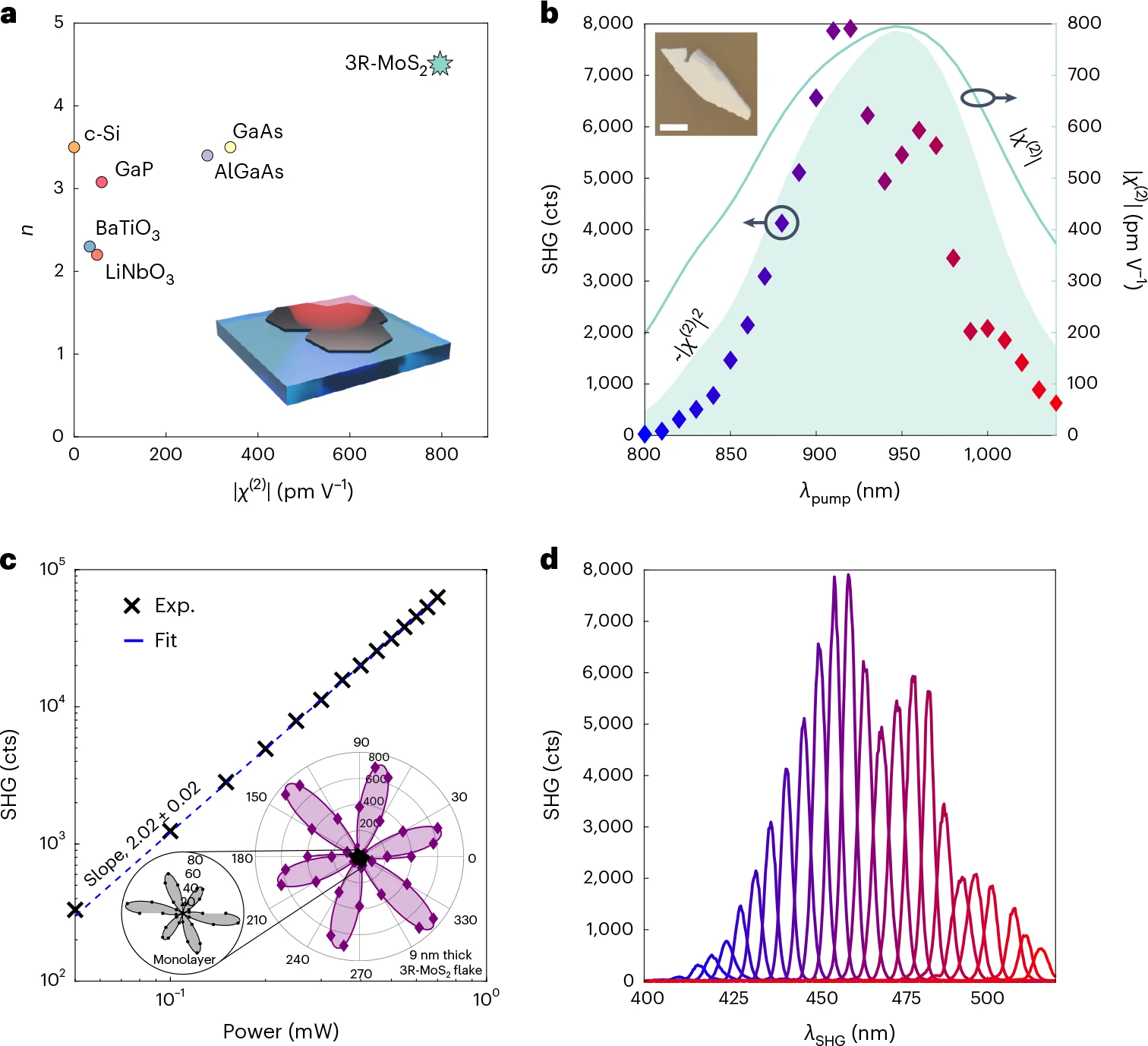
Led by Professor Timur Shegai, the team combined two major research fields – nonlinear and high-index nanophotonics – in a single nanoobject. Doctor Georgii Zograf, lead author of the article published in Nature Photonics, described the achievement as “amazing” and “very efficient”. The researchers used transition metal dichalcogenide, specifically molybdenum disulfide, to fabricate the nanodisk, which preserves its nonlinear properties due to its crystalline lattice broken inverse symmetry.
This innovation could potentially be used in advanced optical and photonic applications, such as integrating these structures into optical circuits or miniaturizing photonics devices.
Researchers Create Ultra-Compact, High-Refractive Index Nanodisks
In a groundbreaking study published in Nature Photonics, researchers have successfully fabricated nanodisks with unprecedented nonlinear optical properties, paving the way for advanced optical and photonic applications. The team, led by Professor Timur Shegai, has created ultra-compact, high-refractive index nanodisks using transition metal dichalcogenide (TMD) materials, which exhibit exceptional nonlinearity and a refractive index of 4.5 in the visible optical range.
The nanodisks, with diameters of approximately 50 nanometers, demonstrate second-harmonic generation, a nonlinear optical phenomenon that is crucial for various applications, including high-energy pulsed laser systems. The researchers achieved this by exploiting the 3R phase of molybdenum disulfide multilayers, which lack inversion symmetry, providing a unique combination of massive second-order susceptibility and extremely high refractive index.
The significance of this breakthrough lies in its potential to dramatically reduce the size and enhance the efficiency of optical devices. The compact dimensions of these nanodisks make them ideal for integration into various kinds of optical circuits or miniaturizations of photonics. According to Professor Shegai, “This is a first tiny step, but a very important one. We are only just scratching the surface.”
The researchers believe that their work will push photonics research forward, enabling future nonlinear nanophotonics experiments and applications in areas such as entangled photon pair generation. The ability to nanostructure TMD materials with unique properties opens up new avenues for advanced optical devices, including nanodisk arrays and metasurfaces.
This study marks a significant milestone in the field of optics research, demonstrating the potential of TMD materials for nonlinear nanophotonics. As the researchers continue to explore the possibilities offered by these ultra-compact, high-refractive index nanodisks, we can expect to see significant advancements in the development of advanced optical and photonic applications.
External Link: Click Here For More

See today’s quantum computing news on Quantum Zeitgeist for the latest breakthroughs in qubits, hardware, algorithms, and industry deals.