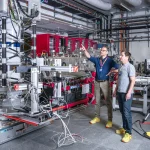
Scientists at the University of Leicester have developed a super-lightweight X-ray telescope mirror for the MXT instrument on the Chinese-French satellite observatory SVOM. The mirror, designed to study the universe’s greatest explosions, is lighter than traditional X-ray mirrors and uses a ‘lobster’ lens to capture wider images of the sky. The lens design is based on the eyes of lobsters, using curved structures of square pores with reflective interior surfaces. The mirror will be used on the SVOM satellite, set to launch in 2022, to study gamma-ray bursts, which signify the creation of new black holes or highly magnetised neutron stars.
Innovative X-ray Telescope Mirror Developed by University of Leicester
A team of academics, researchers, and engineers at the University of Leicester have developed a novel type of super-lightweight X-ray telescope mirror. This mirror is designed to study the most powerful explosions in the universe since the Big Bang. The mirror was created for the MXT instrument, which will be carried on board the Chinese-French satellite observatory SVOM (Space-based multi-band astronomical Variable Objects Monitor). The project was contracted by the French space agency, CNES.
X-ray telescopes are used to study the most energetic forms of matter in the universe. However, they must be launched into orbit to avoid the obscuring effects of the Earth’s atmosphere. Traditional X-ray mirrors are heavy and expensive to carry into space. The new design from the University of Leicester allows telescopes to be much lighter and capture wider images of the sky.
The Lobster Lens: A Revolutionary Design
The new mirror design incorporates a ‘lobster’ lens, named for its similarity to the eyes of lobsters. Lobsters focus visible light using curved structures of square pores with reflective interior surfaces, rather than a lens as mammals do. This design, where light rays bounce off the reflecting inner pore surfaces at very small angles, can provide a field of view thousands of times larger than a conventional X-ray telescope.
Professor Julian Osborne, who leads the project, stated that this is the first assembled lobster X-ray telescope mirror ever made to fly in orbit. The unique lightweight design and enormous field of view capabilities of this new type of X-ray telescope have sparked interest in both the USA and Europe for new satellite observatories.
SVOM Satellite and Gamma-Ray Bursts
The new mirror has been built for the SVOM satellite, which is set to be launched in 2022. The satellite will study gamma-ray bursts, highly energetic flashes lasting just a few seconds that signify the creation of a new black hole or a highly magnetised neutron star. These bursts are detectable to the greatest known distances, helping to identify the very earliest galaxies in the universe and answer some of the most fundamental questions about our Universe.
Construction and Testing of the New Telescope Mirror
The construction of the mirror required high-precision engineering and extensive X-ray testing of the 25 individual 4×4 cm plates that provide the reflecting surfaces. These glass plates, just a millimetre or so thick, are mounted on a lightweight frame using a technique designed to withstand the vibrations of the rocket launch. The plates are made up of a vast number of square pores, which are just four hundredths of a millimetre across. They are aligned to a common focus to give the telescope the best sensitivity to locate new gamma-ray bursts.
The new telescope mirror has undergone rigorous testing, including vibration to simulate the rigours of its rocket launch, heating and cooling to mimic being in orbit, and extensive verification of its imaging performance in Germany before final delivery to the French Space Agency in Toulouse.
University of Leicester’s Legacy in Space Research
The University of Leicester has a long history of space research, dating back more than 60 years. During that time, the University’s experts have flown 90 instruments in space and there has been at least one Leicester-built instrument operating in orbit continuously since 1967. There are currently eight operational Leicester-built experiments in space.
Space Park Leicester, due to open in 2021, is currently being developed by the University of Leicester in collaboration with local, national and international partners. The new facility will provide state-of-the-art, high-tech facilities for research, innovation and new educational pathways. There are also plans for a commercial Low Cost Access to Space (LoCAS) satellite manufacturing facility for the manufacture of mid-range satellites.
External Link: Click Here For More
See today’s quantum computing news on Quantum Zeitgeist for the latest breakthroughs in qubits, hardware, algorithms, and industry deals.