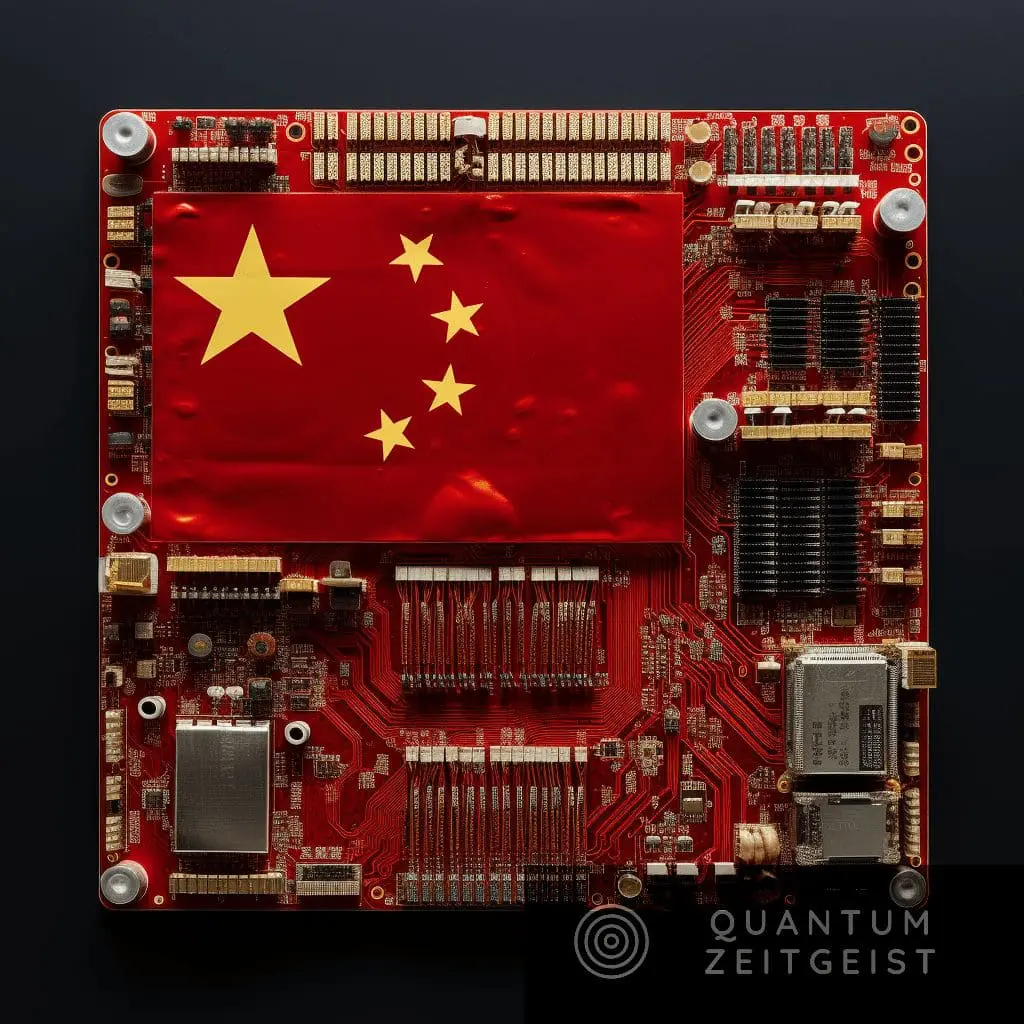
China is very much in the news currently. First, there was the BRICS conference, which looks to expand the reach of economies such as China and India. Now, there are what appear to be severe economic headwinds that are impacting China. Plus, there is the trade war, which has recently spooked makers of American products, such as Apple. The feeling is mutual with the United States banning the export of critical technologies, such as semiconductors, to the Chinese.
We look at the current state of Quantum Computing and the Quantum Industry in China and ask whether recent events could severely impact the entire Quantum Industry. Will there be a substantial Quantum China effort to secure control of the technological future?
Quantum Research in China
The country’s commitment to becoming a global leader in quantum science and technology is evident from its massive investments in research and development. Several universities, institutions, and companies are deeply involved in quantum research, contributing to China’s growing prominence. We delve into the major players in China’s quantum research landscape and highlight some of their notable scientific milestones.
Universities Engaged in Quantum Research
Several top-tier Chinese universities are heavily involved in quantum research. Tsinghua University, Peking University, and the University of Science and Technology of China (USTC) are among the most prominent. USTC, in particular, has pioneered, with its researchers, achieving a record for quantum key distribution. Another significant milestone was establishing the Shanghai Research Center for Quantum Sciences, a joint initiative by multiple universities, including Fudan University and Shanghai Jiao Tong University. This centre aims to promote interdisciplinary research in quantum sciences and foster international collaborations.
Institutions Leading the Quantum Revolution
Several dedicated institutions also support China’s quantum research. The Chinese Academy of Sciences (CAS) is a significant player, with its institutes like the Shanghai Institute of Optics and Fine Mechanics and the Institute of Physics making remarkable advancements in quantum communication and quantum computation. The National Laboratory for Quantum Information Sciences, established in Hefei, Anhui province, is another testament to China’s commitment to quantum. With a planned investment of over $10 billion, this laboratory aims to be a world leader in quantum research by 2030.
Companies Pioneering Quantum Innovations
The private sector in China is not far behind when it comes to quantum research. Companies like Alibaba, Tencent, and Baidu have set up their quantum research labs to integrate quantum technologies into their existing services. In collaboration with the CAS, Alibaba established the Alibaba Quantum Laboratory, focusing on quantum cryptography and quantum computing. Another notable company, QuantumCTek, became the first quantum communication company to go public in 2020, highlighting the growing commercial interest in quantum technologies in China.
Notable Chinese Quantum Milestones
Several groundbreaking achievements have marked China’s quantum research journey. China launched its first quantum satellite, Micius, which successfully established ultra-secure quantum communications between space and ground. The launch of the Micius satellite (in 2016), which successfully demonstrated quantum entanglement (sending simultaneous streams of entangled photons to the ground stations to establish a direct link between the two of them.) over a distance of 1,200 km, is a significant milestone.
Another significant milestone was the quantum teleportation of photons over a record distance. Furthermore, in 2020, China’s Jiuzhang quantum computer achieved “quantum supremacy” by performing a specific task faster than the world’s most advanced classical computer, showcasing the potential of quantum computing.
Chinese Quantum Computing Players
As you might expect, and we have written about previously, China is no slouch regarding research. It has the research clout of many Western countries and publishes on Quantum and related industries. What does the Chinese commercialisation of Quantum technology look like as the technological battleground hots up? You’ll likely even see some familiar companies like Baidu and Alibaba.
Alibaba Cloud Quantum Laboratory (ACQL)
The Alibaba Cloud Quantum Laboratory (ACQL) is an initiative by Alibaba, one of the world’s largest e-commerce giants. The laboratory was established to explore the frontiers of quantum computing and its potential applications in various fields. Alibaba’s foray into quantum computing signifies the company’s ambition to be at the forefront of next-generation technologies.
ACQL primarily focuses on quantum algorithms, Quantum Machine Learning (QML), and the hardware required to facilitate quantum computations. Their research aims to bridge the gap between theoretical quantum algorithms and practical applications, especially in cloud computing. Alibaba’s vast cloud infrastructure provides a platform for quantum research, allowing for large-scale simulations and experiments.
The team at ACQL consists of leading experts in quantum physics, computer science, and engineering. Dr. Shi Yaoyun, a renowned quantum physicist, leads the laboratory. Under his guidance, the team collaborates with academic institutions worldwide. ACQL is poised to significantly contribute to both the theoretical and practical aspects of quantum computing. Their collaboration with the Chinese Academy of Sciences has already resulted in the launch of a quantum computing cloud platform, which allows researchers to access and experiment with quantum processors. This move indicates Alibaba’s vision to make quantum computing accessible to a broader audience.
Baidu Quantum Computing Institute
Baidu, often called the “Google of China,” established the Baidu Quantum Computing Institute to delve into the mysteries and potentials of quantum computing. Led by the eminent quantum physicist Dr. Duan Runyao, the institute aims to be a world leader in quantum research and its applications.
The institute’s research encompasses various topics, from fundamental quantum theory to practical quantum algorithms. Baidu believes quantum computing can significantly enhance its existing services, such as search algorithms and artificial intelligence. Like Alibaba, the company’s vast data resources provide a fertile ground for quantum experiments and simulations.
The current quantum computing technology (QIAN SHI Quantum Hardware and Software Platform) sports a 10-qubit high-fidelity superconducting quantum computer, offering users stable and substantial quantum services facilitated by Baidu’s massive expertise in the cloud space.

Tencent Quantum Laboratory
Tencent, a global tech giant known for its diverse portfolio of internet services, has also ventured into the realm of quantum computing by establishing the Tencent Quantum Laboratory. The lab aims to advance quantum research and explore its applications in the digital world.
One of the lab’s primary focuses is quantum algorithms and their potential to enhance existing digital services. Tencent believes that quantum computing can solve computational challenges that classical computers struggle with, especially in quantum cryptography, optimization, and machine learning.
TensorCircuit from Tencent is a new generation of quantum circuit and quantum algorithm simulation open source software platform self-developed by the laboratory. Based on the tensor network simulation engine, it perfectly supports modern machine learning paradigms such as just-in-time compilation, automatic differentiation, vector parallelization and heterogeneous hardware acceleration, and provides Rich and efficient quantum-classical hybrid computing models and algorithm implementations.
The laboratory boasts a team of distinguished scientists and researchers led by Dr. Zhang Shengyu, a prominent figure in the quantum community. Their combined expertise ensures a comprehensive approach to quantum challenges, from theoretical physics to practical algorithms.
The quantum laboratory develops materials research platforms and drug discovery platforms on Tencent Cloud and establishes ecosystems in materials, pharmaceuticals, energy, chemicals and other related fields. At the same time, the laboratory continues to pay attention to research-related issues in full-stack quantum computer systems.
China – USA Trade War
The United States has long accused China of unfair trade practices, including theft of U.S. intellectual property. In response, China’s National People’s Congress endorsed a new foreign investment bill in 2019, which was to take effect in 2020. This bill prohibited the forced transfer of IP from foreign companies and granted more robust protection to foreign intellectual property and trade secrets.
The U.S. Department of Commerce expanded sanctions, implicating fifty Chinese companies, including Huawei, in June 2021. Export controls were introduced for chip makers like Nvidia, Yangtze Memory Technologies (YMTC), and ChangXin Memory Technologies. Sanctions were expanded to include companies like DJI and BGI Genomics.
China has recently reportedly ordered officials at central government agencies not to bring iPhones into the office or use them for work. This decision has led to a sell-off in Apple shares. The ban on the use of Apple products is believed to be a sign of Beijing pushing back on its reliance on technology from the United States. The ban on Apple products has reportedly been extended to more workers.
Implications for Quantum Computing
With relations between China and the US fraught, we can expect a knock-on effect in the competitive high-tech industries such as Quantum Computing. Making predictions is challenging, but we think we’ll see more of a push from China and the USA to support their Quantum Industries. The same goes for other countries, as they realise the strategic importance of quantum technologies.
China has versions of almost anything the West has, from Starbucks clones (or lookalikes such as Lukin Coffee) to its search engines, cloud technology providers and research institutes. One common thread we predict (pretty obviously) is that there will be more of a push for complete independence from both sides. China will invest heavily in semiconductors and core research to avoid reliance on semiconductor chips from the likes of Intel, Nvidia and AMD. This will apply to any technology, including quantum, and one can argue the gap is smaller for the nascent quantum industry compared to traditional established semiconductor operations, which require massive fabrication facilities. The result will be that China is now on notice that it needs to “up its game” concerning quantum technologies.
Quantum China
Resultingly, China will see Quantum as a massive opportunity that can drive other fields, even military-wise, such as using QKD for secure communication. What better marketing than China beating the US to technological milestones? We name this Quantum China. It will be a massive feature of the Chinese future because, unlike semiconductors, where some pundits think China is ten years behind, the gap might be easier to close in the Quantum space.
TikTok has seemingly emerged from nowhere to become a social media leader. Funds are, therefore, flowing into the coffers of “China Inc“., which can support the emergence of other industries. AWS (Amazon Web Services) emerged from Amazon and retail dominance. AWS now includes quantum services named Braket. TikTok uses its cloud, but last year, it moved its US data centres to Oracle. But the point remains that its expertise in provisioning of cloud services can reinforce its expertise in rolling out and finding the applications for quantum technology.
United States Quantum Initiatives
Signed into law in December 2018, the NQIA (National Quantum Initiative Act) aims to accelerate quantum research and development in the U.S. over ten years. The act provides for the establishment of quantum research centres, funding for quantum research, and the promotion of quantum education and workforce development.
In 2020, the U.S. Department of Energy announced the establishment of five new Quantum Information Science (QIS) research centers. These centers are intended to push the current boundaries of quantum computing, networking, and sensing capabilities. The National Quantum Initiative Act provides for the continued leadership of the United States in QIS and its technology applications. It calls for a coordinated Federal program to accelerate quantum research and development for the economic and national security of the United States.
The NSF (National Science Foundation) has been funding Quantum Leap Challenge Institutes, which are large-scale interdisciplinary research projects that aim to advance the frontiers of quantum information science and engineering.
The mission of QED-C (Quantum Economic Development Consortium) is to enable and grow a robust commercial quantum-based industry and associated supply chain. The QEDC is a consortium of stakeholders that aims to enable and grow the U.S. quantum industry. It was established in response to the NQIA and is supported by the National Institute of Standards and Technology (NIST).
Air Force Research Laboratory (AFRL) Quantum Programs has been involved in quantum research, particularly in quantum sensing and timing. DARPA has multiple programs focused on quantum research, including the Quantum-Assisted Sensing and Readout (QuASAR) program and the Optical Lattice Emulator (OLE) program. QuAIL is NASA’s hub for quantum computing research, focusing on solving aerospace-related computational problems.
Quick Summary
America will be watching and will not want to cede technology to China. Therefore, we predict and have already observed a raft of quantum initiatives to push quantum technologies with massive funds earmarked for developing quantum technology. D-wave, Rigetti and IonQ are all pure-play quantum computing companies listed on the American stock exchange. China has no fully pure-play quantum computing company listed on its stock market.
We’ll likely see more funds flow into commercial ventures and core research. Coupled with the competition around AI, we can see this extend to the Quantum field. In fact with the overlap such as QML (Quantum Machine Learning), we expect the conversation around AI and competitiveness to spillover to Quantum.

See today’s quantum computing news on Quantum Zeitgeist for the latest breakthroughs in qubits, hardware, algorithms, and industry deals.