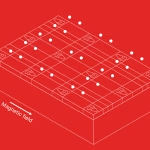
As part of the German Quantum Computing Initiative, the Universal Quantum Deutschland GmbH, a subsidiary of British startup Universal Quantum, has been assigned by the German Aerospace Center (DLR) to develop a fully scalable trapped ion quantum computer.
Germany is helping to move the needle on quantum computing becoming useful to society and we’re thrilled that another major government is becoming a supporter and customer of our stellar team and technology, building on our recent successes with the UK government.
This is a huge validation of how unique and promising our technology is, and represents a major step forward in our mission to build quantum computers that will help enable people to solve the biggest challenges humanity is facing. We are looking forward to expanding our technology into new markets, building on our recent successes with partners that share our values.
Sebastian Weidt, CEO and co-founder of Universal Quantum
The DLR brings in the two world-first innovations to Hamburg, with an investment worth €67 million. The first innovation will be a single-chip quantum computer with an advanced electronic quantum computer chip. While the second innovation will be a multi-chip quantum computer with up to 100 qubits in its initial configuration. The most potent chip ever created for a quantum computer will serve as the foundation for both devices. The DLR facilities in Hamburg will construct the quantum computers within four years and make them available to partners.
One of the most developed methods for creating
One of the most developed methods for creating quantum computers is trapped ion technology. Millions of qubits, according to experts, will be needed to solve some of the most difficult societal problems. The reliable connection of chips, also known as modules, as well as cooling temperatures and other engineering requirements, are some of the difficulties in achieving this. With only moderate cooling temperatures needed and allowing modules to be connected like a jigsaw puzzle to scale to high qubit numbers, Universal Quantum’s novel approach resolves both of these problems and more.
Until now, researchers had limited access to working prototypes. Universal Quantum and the DLR will pave the way for the next step in quantum computing by constructing these two computers, which will enable the development of real-world applications on a scalable quantum computer. The two machines will allow researchers to test new software development concepts while also building on existing skills, which are critical in today’s global quantum race.
Universal Quantum has focused on building scalable quantum computers since its inception, and Germany is now the second government to support this critical mission, following the UK government. As part of a UK government-funded project, Universal Quantum leads a consortium that includes Rolls Royce in the development of a quantum computer that can aid in the development of more fuel-efficient turbines for aviation, reducing emissions and fuel consumption.
Our team has worked intensively on the development of our technology
Our team has worked intensively on the development of our technology. With the DLR contract, we have reached an important milestone and received further recognition of the quality of our technology.
Key to our technical concept is the inherent scalability of the quantum computers we are building. Our mission is to solve many fundamental problems of our time – this is the next step along the way.
Professor Winfried Hensinger, chief scientist, co-founder and chairman of Universal Quantum
The project is part of the German government’s strategic promotion of quantum technology, with the largest investment coming from Europe’s Ministry of Research and Economics. DLR is allocating one-third of this funding to establish a quantum computing cluster of excellence with innovation centers in Hamburg and Ulm.
Ion trap systems allow universal arithmetic operations. They are not dedicated to solving specific tasks, Quantum computers based on ion traps have a number of advantages: the qubits are comparatively stable and offer superlative gate properties – a prerequisite for building high-quality quantum computers. Integration on microchips and innovative chip designs mean that scalability is now within reach. The technologies required for construction have now reached maturity. Integration on microchips has also proven successful.
Karla Loida, Project Manager for the Quantum Computing Initiative
Read more about the news here.
See today’s quantum computing news on Quantum Zeitgeist for the latest breakthroughs in qubits, hardware, algorithms, and industry deals.