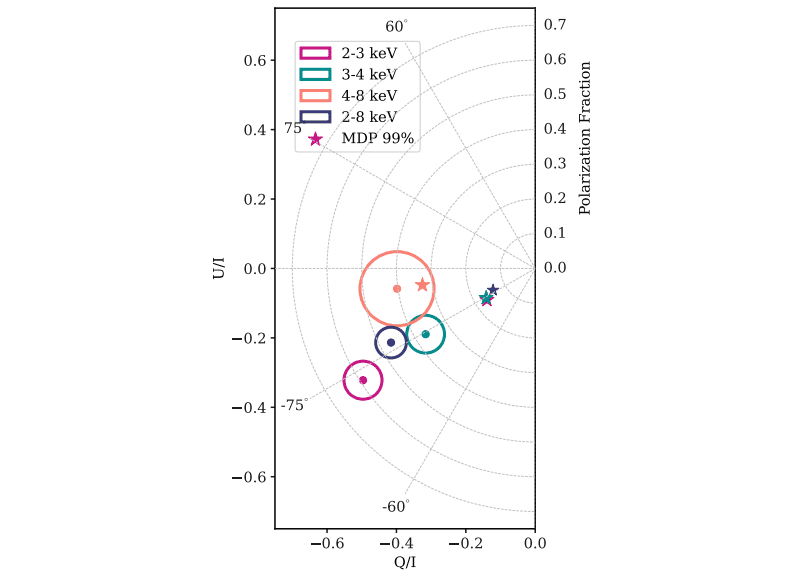
The search for vacuum birefringence, a fundamental prediction of quantum electrodynamics, drives investigations into the most extreme magnetic environments in the universe, and recent observations offer compelling evidence for this elusive effect. Rachael E. Stewart from George Washington University, Hoa Dinh Thi and Matthew G. Baring from Rice University, alongside George Younes from NASA Goddard Space Flight Center, and colleagues, report the detection of highly polarised X-ray emissions from the magnetar 1E 1547. 0-5408, providing strong support for vacuum birefringence occurring in these ultra-magnetic objects. The team’s analysis of data from the Imaging X-ray Polarimetry Explorer, combined with observations from other telescopes, reveals a significant degree of polarisation that cannot be explained by conventional atmospheric models, but requires the inclusion of effects predicted by vacuum birefringence. This achievement represents a crucial step towards confirming a key prediction of quantum electrodynamics and opens exciting possibilities for future investigations into strong-field physics using advanced X-ray polarimetry.
The team employed sophisticated data analysis techniques, including timing analysis to study the object’s pulse profile and spectral analysis to determine its composition and temperature. They also utilized computer simulations to model the emission and polarization of X-rays and radio waves, allowing them to test different theories about the object’s geometry and magnetic field.
The research involved carefully calibrating and processing the data from each instrument, then combining the results to create a comprehensive picture of the object. Scientists analyzed the timing variations in the object’s emission, the spectrum of its light, and the polarization of both X-rays and radio waves. By comparing the observations with theoretical models, they aimed to determine the geometry of the emission regions, the strength and structure of the magnetic field, and the physical processes responsible for the observed emission.
Magnetar Vacuum Birefringence Directly Observed with IXPE
Scientists have achieved a landmark confirmation of a key prediction of quantum electrodynamics (QED) by directly observing vacuum birefringence in the magnetar 1E 1547. 0-5408. This elusive phenomenon, where the fabric of space itself alters the polarization of light, arises in the incredibly strong magnetic fields surrounding magnetars. This strong polarization indicates a clear alignment between the direction of the light’s oscillation and the magnetar’s magnetic field.
Measurements showed that the polarization increased to nearly 80% at certain points in the magnetar’s rotation and remained above 40% throughout the radio beam crossing, further supporting the alignment between light polarization and the magnetic field. The team observed a significant decrease in polarization at higher energies, a crucial signature predicted by theoretical models of vacuum birefringence and mode conversion within the magnetar’s atmosphere. Detailed modeling of the atmosphere, combined with constraints derived from radio polarization data, demonstrated that the observed polarization behavior could not be explained without considering the effects of vacuum birefringence. 0-5408. By analyzing the polarization of X-rays emitted by the magnetar, combined with radio observations, scientists detected a high degree of polarization that varied with the star’s rotation. Detailed modeling, incorporating constraints from radio polarization data, demonstrated that the observed polarization behavior could not be adequately explained without considering the effects of vacuum birefringence. This work represents a significant step towards confirming a fundamental prediction of quantum electrodynamics in a natural astrophysical setting.
The observed decrease in polarization at higher energies is consistent with theoretical expectations and suggests a magnetic field strength consistent with independent estimates. While the current analysis simplifies certain complexities, the findings align with predicted energy levels and provide a foundation for future investigations. Further observations with next-generation X-ray polarimeters will be crucial to fully explore this phenomenon and test the limits of quantum electrodynamics in extreme environments.
👉 More information
🗞 Vacuum birefringence in the polarized X-ray emission of a radio magnetar
🧠 ArXiv: https://arxiv.org/abs/2509.19446