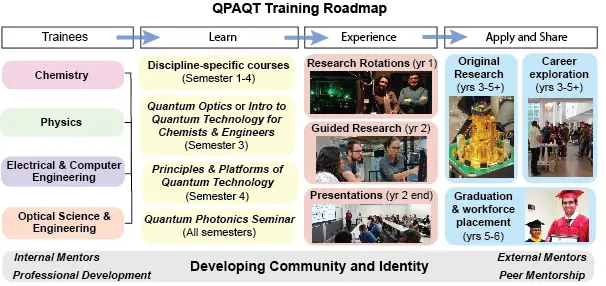
The University of New Mexico’s Center for High Technology Materials is currently in its second year of the Quantum Photonics and Quantum Technology (QPAQT) graduate program, commencing a new cohort in August 2025. Established in 2024 with a $3 million grant from the National Science Foundation’s NRT-QL initiative, the interdisciplinary program trains PhD students from six graduate programs – including Physics, Chemistry, and Engineering – to become leaders in quantum technology. Fifteen trainees in the initial cohort have begun research projects relevant to the field, drawing on expertise from diverse academic backgrounds. The program reflects the University’s commitment to advancing both quantum research and education.
The Quantum Photonics and Quantum Technology (QPAQT) graduate program is commencing its second year at the University of New Mexico’s Center for High Technology Materials (CHTM), with the next cohort of students beginning studies in August 2025. Designed to prepare graduates as generalists in quantum technology and future leaders in the field, the program adopts an interdisciplinary approach to equip them for diverse applications within Quantum Science and Technology. Fifteen trainees commenced their PhD research in 2024, undertaking projects relevant to quantum technology within departments including Physics, Chemistry, and Engineering.
The program was established in 2024 with a $3 million grant from the National Science Foundation (NSF), awarded in 2023. This funding was specifically allocated to the NRT-QL: Quantum Photonics Interdisciplinary Training to Advance Quantum Technologies initiative, demonstrating the NSF’s commitment to quantum technology education and facilitating programmes like Quantum Photonics Training.
Joseph Yelk, the program coordinator, highlights the cross-disciplinary nature of the program, noting that participants originate from six graduate programs within the University of New Mexico and possess varied undergraduate degrees. He believes this diversity is crucial, as significant scientific progress frequently arises from the intersection of traditional disciplines, fostering innovation and new fields of study.
More information
External Link: Click Here For More