

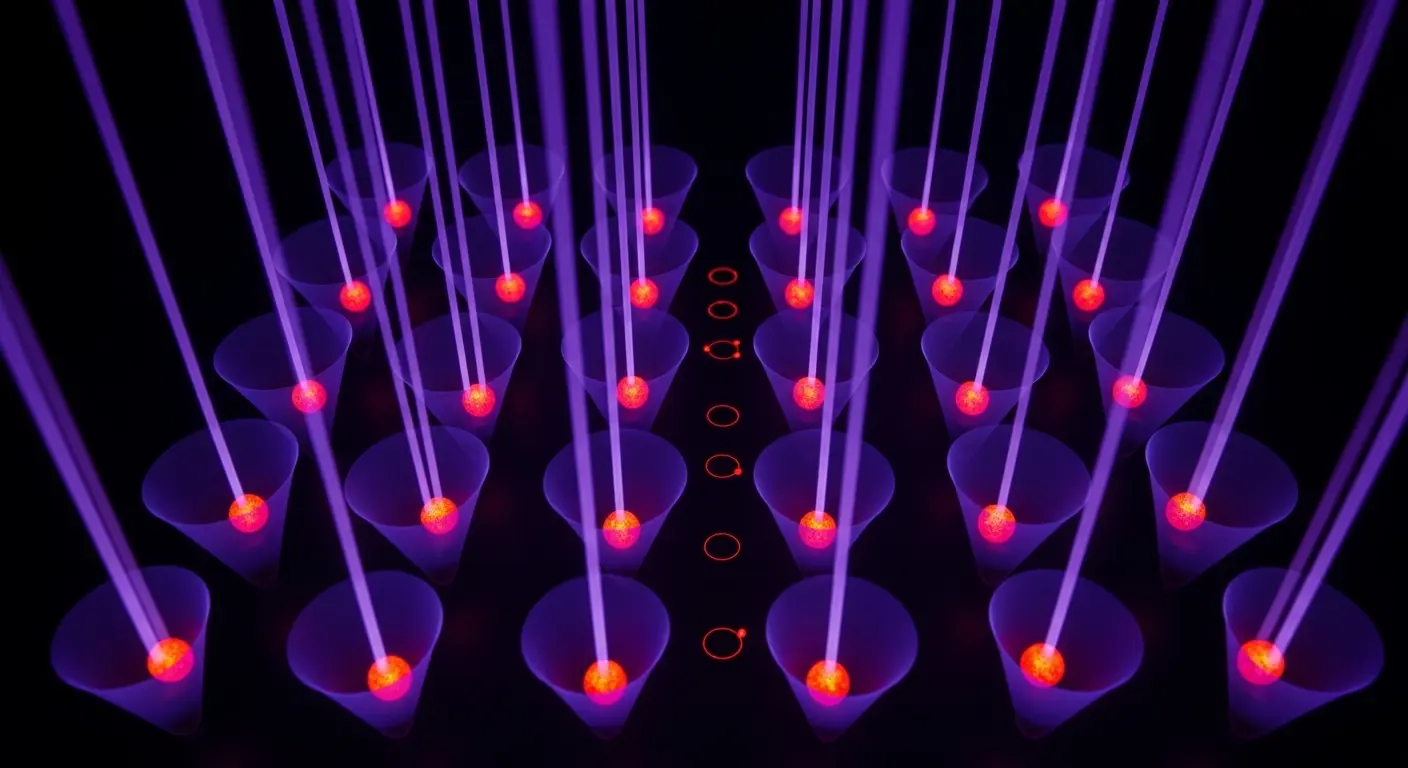
Mikhail D. Lukin of Harvard University and QuEra Computing Inc., alongside Antoine Browaeys of CNRS, Université Paris-Saclay, and Mark Saffman of the University of Wisconsin, Madison, have received the ninth John Stewart Bell Prize for their work advancing quantum simulation and computing. The award, presented by the University of Toronto’s Centre for Quantum Information and Quantum Control, recognizes their pioneering contributions to utilizing neutral atoms in optical tweezer arrays for building scalable quantum processors. Their research specifically addresses the challenge of increasing quantum system size while maintaining crucial experimental control, a necessary step for developing robust quantum architectures. “These results address a central challenge in quantum computing: growing system size without sacrificing experimental control,” highlighting the significance of their achievements in the field. Established in 2009, the Bell Prize honors the legacy of John Stewart Bell and acknowledges major advances in quantum science published within the preceding six years.
Lukin, Browaeys, and Saffman Win John Stewart Bell Prize
**A system demonstrating hundreds of individually addressable atoms has earned Mikhail D. The researchers were specifically recognized for advances including reconfigurable optical tweezer arrays and coherent transport of entangled atomic registers, alongside Rydberg-mediated interactions that enable controlled multi-qubit dynamics. QuEra Computing Inc. shared news of the award, linking to a detailed announcement on the CQIQC website, while numerous colleagues offered congratulations on the social media platform LinkedIn. The Bell Prize emphasizes recent, high-impact results, and this biennial recognition highlights the ongoing progress in harnessing quantum mechanics for computational power.
Rydberg Interactions and Scalable Neutral Atom Quantum Systems
Neutral atom quantum computing currently relies on trapping individual atoms with focused laser beams, known as optical tweezers, and manipulating their quantum states to perform calculations. Recent advances, recognized by the 9th Biennial John Stewart Bell Prize awarded to Mikhail D. Lukin, Antoine Browaeys, and Mark Saffman, have focused on scaling these systems to larger numbers of qubits while maintaining precision. Specifically, the researchers developed reconfigurable optical tweezer arrays operating with hundreds of individually addressable atoms, a significant step toward practical quantum processors. The award also acknowledges the demonstration of coherent transport of entangled atomic registers and the utilization of Rydberg-mediated interactions. These interactions, involving highly excited atomic states, enable controlled multi-qubit dynamics essential for complex quantum algorithms. QuEra Computing Inc., where Lukin serves as co-founder and Chief Scientist, has been instrumental in translating these theoretical advances into demonstrable hardware.
Preserving coherence, programmability, and control during system scaling is paramount for benchmarking, algorithm development, and ultimately, achieving fault-tolerant quantum architectures. The researchers’ work represents a critical progression in the field, allowing for more complex quantum simulations and computations than previously possible with neutral atom platforms. The prize emphasizes recent, high-impact results published within the preceding six years, solidifying the significance of this work within the quantum computing community.
These results address a central challenge in quantum computing: growing system size without sacrificing experimental control, which is critical for benchmarking, algorithm development, and progress toward fault-tolerant architectures.


