Researchers from the University of Tokyo and international collaborators have developed AR glasses that receive images from an external projector using a beaming display approach, reducing weight and eliminating onboard power needs. The system incorporates diffractive waveguides, expanding light reception angles from five to 20 to 30 degrees for improved usability. Their findings will be presented at the IEEE VR conference in Saint-Malo, France, in March 2025.
Overcoming AR Glasses Limitations
Augmented reality overlays digital elements onto real-world environments, enhancing applications in gaming, education, healthcare, manufacturing, and retail. While AR technology has gained widespread adoption in mobile applications, wearable AR devices, particularly AR glasses, have struggled due to issues related to weight, battery life, and computational power.
Traditional AR glasses rely on integrated microdisplays, necessitating internal processing units and power sources, which contribute to their bulk and discomfort. Despite advances in optics and hardware miniaturization, these devices have yet to reach mass adoption due to ergonomic and functional constraints.
Beaming Display: A Novel Approach
Researchers from the University of Tokyo and collaborating institutions have introduced an alternative approach that eliminates the need for onboard power sources by allowing AR glasses to receive images from external projectors. This system, termed the “beaming display” approach, addresses critical issues of weight and usability while maintaining high-quality visuals.
“This research aims to develop a thin and lightweight optical system for AR glasses using the ‘beaming display’ approach,” said Yuta Itoh, project associate professor at the University of Tokyo and first author of the study. “By eliminating the need for built-in displays and power sources, we can enhance comfort and portability without sacrificing image quality.”
Expanding Viewing Angles with Diffractive Waveguides
A major challenge with previous light-receiving AR glasses was their limited angular range for capturing projected images. Earlier models could only display clear images when tilted within five degrees of the light source, significantly restricting their practicality.
The team overcame this issue by incorporating diffractive optical waveguides—patterned grooves that control the direction of incoming light. This innovation expanded the glasses’ operational angle range to approximately 20-30 degrees, allowing users to move their heads more freely while maintaining a stable AR experience.
“By adopting diffractive optical waveguides, our beaming display system significantly expands the head orientation capacity,” Itoh explained. “This advancement enhances usability, making AR glasses more practical for everyday applications.”
How the Beaming Display System Works
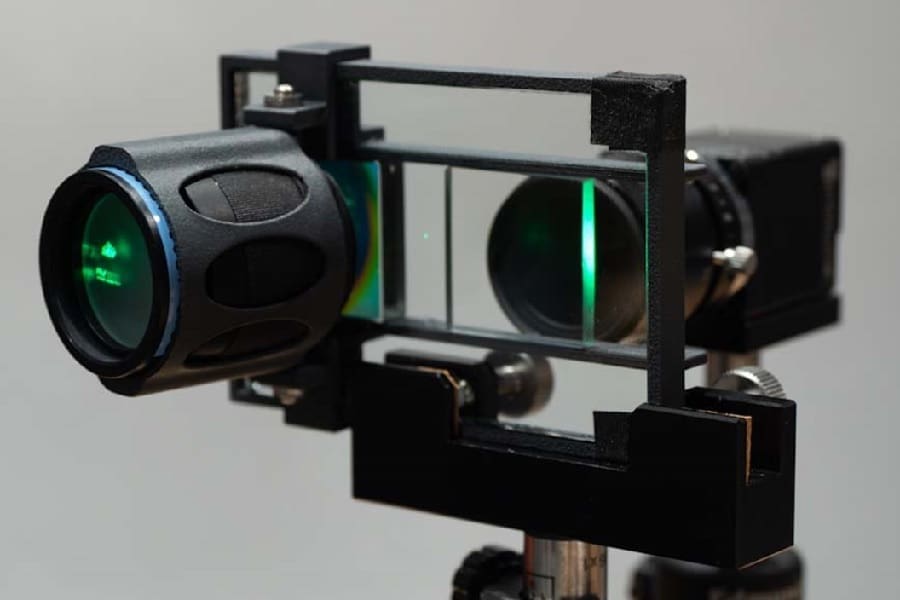
The researchers designed a two-component light-receiving system: a screen and waveguide optics. The process works as follows:
- A laser-scanning projector beams an image toward a diffuser, which distributes the light evenly.
- A lens focuses the light onto a diffractive waveguide embedded in the glasses’ material.
- The waveguide channels the light toward specific gratings on the glasses’ inner surface.
- These gratings extract and direct the image light toward the user’s eyes, creating a clear AR display.
To test this technology, the team developed a prototype that successfully projected a 7-millimeter image onto AR glasses from a distance of 1.5 meters at various angles (0-40 degrees). The integration of waveguides significantly improved the glasses’ ability to receive images at wider angles without sacrificing image clarity.
Future Developments and Challenges
While the beaming display system marks a significant step forward, the researchers acknowledge that additional refinements are necessary. Future research efforts will focus on enhancing wearability, integrating head-tracking technology, and expanding the field of view.
“Ideally, future setups will incorporate steerable projectors that adjust in real-time to the position of AR glasses, ensuring a more seamless AR experience in dynamic environments,” said Itoh.
Other areas of improvement include:
- Addressing ghost images and enhancing image contrast
- Developing prescription-compatible curved waveguides
- Introducing full-color displays instead of monochrome projections
- Exploring higher-resolution light sources for better image clarity
Conclusion
The beaming display system offers a promising solution to the long-standing challenges of AR glasses, significantly improving comfort and usability. By offloading computational and power requirements to an external projector, this technology paves the way for more practical, lightweight AR devices. As research progresses, these advancements could revolutionize the way we interact with digital content, bringing AR glasses closer to mainstream adoption.
More information
External Link: Click Here For More