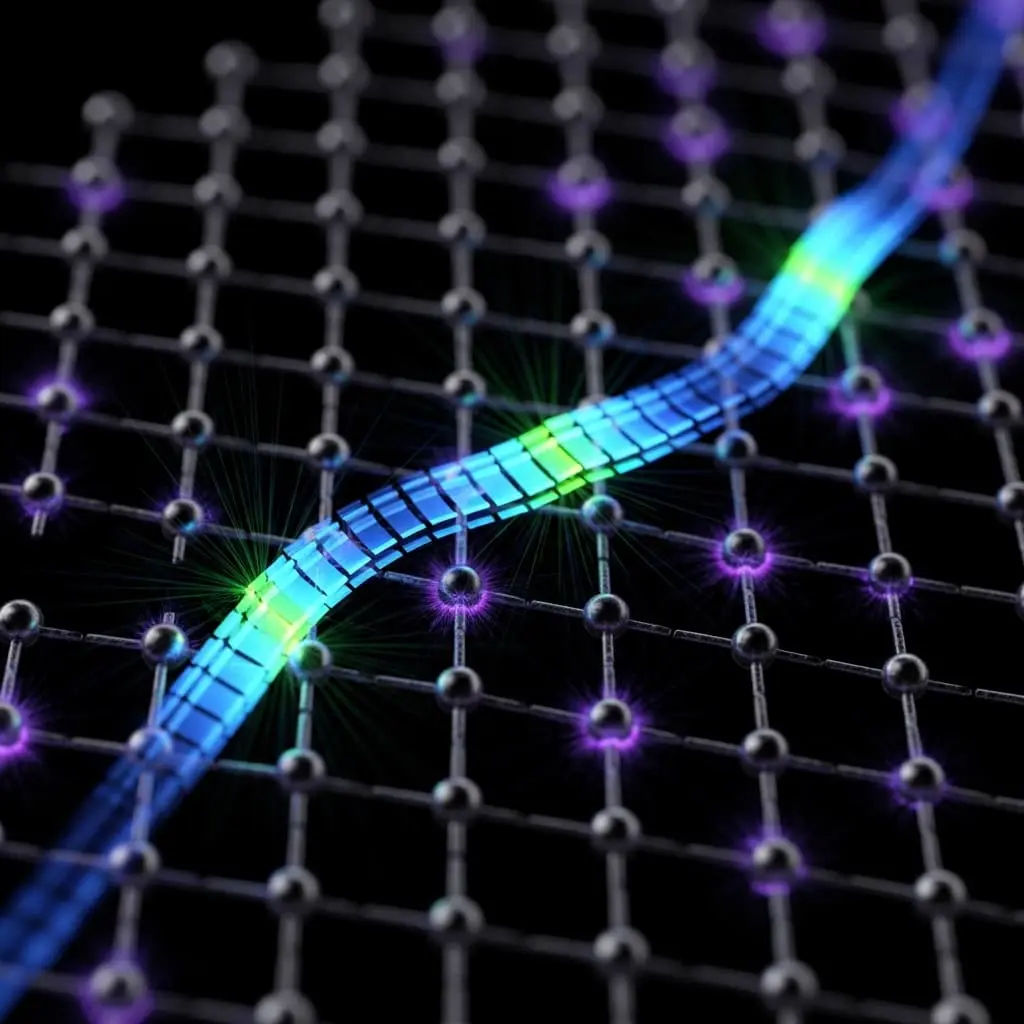
Scientists investigate the fundamental energy flows underpinning ultrafast dynamics in magnetic materials, a crucial area for advancing high-speed technologies. Arnau Romaguera, Elizabeth Skoropata, and Yun Yen, leading the research from the PSI Center for Photon Science, Paul Scherrer Institute, and Ecole Polytechnique Fédérale de Lausanne (EPFL) respectively, present compelling evidence of hierarchical energy pathways in the antiferromagnet CuO, working in collaboration with colleagues at the Department of Physics, University of Fribourg, Institut des Matériaux de Nantes Jean Rouxel (IMN), UMR 6502, Nantes Université, CNRS, ESRF, The European Synchrotron, and the PSI Center for Neutron and Muon Sciences. Their study, utilising time- and momentum-resolved X-ray scattering, overcomes previous limitations by directly observing low-energy magnons and revealing a process of picosecond quasi-thermalization followed by nanosecond recovery governed by momentum-selective magnon-phonon scattering. This detailed microscopic framework moves beyond simplified models, offering fundamental design principles for controlling material properties at ultrafast timescales and potentially revolutionising the field of magnetism.
Scientists have unlocked a new understanding of how energy flows within complex magnetic materials, paving the way for potentially faster and more efficient technologies. Research focused on cupric oxide (CuO), an antiferromagnet, has revealed a hierarchical system governing the movement of energy at incredibly short timescales. By employing a combination of time-resolved X-ray scattering techniques and advanced quantum simulations, researchers have mapped the pathways of energy transfer following photoexcitation, the process of energizing a material with light.
Tracking Energy Flow in Non-Thermal Magnons
Tracking non-thermal magnons and energy flow in solids
This work demonstrates how initial light absorption generates non-thermal magnons, or spin fluctuations, throughout the material within femtoseconds, units of time one quadrillionth of a second. The study’s core achievement lies in momentum-resolved tracking of these magnons, revealing a two-stage process of quasi-thermalization occurring over picoseconds, followed by recovery over nanoseconds via interactions with phonons, quantized units of vibrational energy.
Analysis of quasiparticle dispersion mismatch identified recovery bottlenecks controlling the non-equilibrium lifetimes of these magnons. This detailed observation clarifies that mismatches in the energy available to different quasiparticles create bottlenecks that ultimately dictate how long the material remains in a non-equilibrium state. These findings move beyond simplified models of ultrafast magnetism, offering a microscopic framework applicable to a broad range of materials.
The ability to manipulate these energy pathways opens
Advanced Implications for Spintronic Devices
Implications for next-generation spintronic devices
The ability to manipulate these energy pathways opens possibilities for advancements in spintronics, magnonics, and ultrafast magnetic storage, potentially leading to the development of next-generation high-speed devices. The combination of experimental data with quantum-kinetic simulations and density-functional theory calculations established a comprehensive understanding of the ultrafast sublattice demagnetization process in antiferromagnetic insulators.
The Full Cascade of Energy Transfer Dynamics
The full cascade of energy transfer and relaxation
Specifically, the team observed that photoexcitation triggers rapid spin disorder and the generation of non-thermal magnons, initiating a cascade of energy transfer. Subsequent magnon-phonon coupling released energy to phonons, recovering magnetic order on nanosecond timescales via anomalous scattering and annihilating magnons. Initial measurements revealed near-instantaneous spin disorder following above-bandgap excitation in cupric oxide, generating non-thermal magnons distributed throughout reciprocal space within femtoseconds.
Real-time momentum-resolved tracking then demonstrated picosecond magnon quasi-thermalization, a process where magnons approach thermal equilibrium, followed by nanosecond recovery mediated by momentum-selective magnon-phonon scattering. The effective magnon-phonon coupling strength, estimated from the magnon relaxation timescale, reached approximately 59 microelectronvolts, despite the generally large spin-phonon coupling in cupric oxide which can be as high as 6.2 millielectronvolts.
This unexpectedly small coupling strength arises from restrictions in available phase space for the scattering process. A time-resolved resonant diffuse scattering (tr-RDS) technique underpinned this work, exploiting its ability to directly access the time- and momentum-dependent magnon distribution following ultrafast spin disorder. Unlike time-resolved resonant inelastic X-ray scattering (tr-RIXS), which is limited by energy resolution, tr-RDS measures the time-integrated spin-spin correlation function, providing complementary insights into low-energy magnetic excitations.
The intensity of the RDS signal, IRDS(q, t), is proportional to the sum over Cartesian coordinate directions of the product of incoming and outgoing polarization vectors and the momentum-dependent spin-spin correlation function, Sαα′(q, t). This correlation function is determined by the magnon distribution, fμ(q, t), and prefactors specific to the magnetic ground state of the antiferromagnet CuO.
Crucially, the experimental setup leveraged the suppression of dynamical charge susceptibility and phonon contributions via the phase factor around the half-integer momentum point, isolating the magnon signal. Data acquisition involved tracking the RDS intensity at various time points to map the hierarchical energy pathways among correlated systems within the photoexcited material.
To separate the RDS signals from those originating
To separate the RDS signals from those originating from resonant X-ray diffraction (RXD), a global suppression of antiferromagnetic order, the researchers employed a two-exponential function fitting procedure applied to the momentum-dependent intensities along the b∗ reciprocal lattice vector. Simulations were performed using a quantum-kinetic approach, solving the quantum Boltzmann equation for magnons derived from a spin-charge-coupled model based on the Hubbard model.
This model, implemented for a simplified orthorhombic unit cell to reduce computational demands, accurately reproduces the low-energy magnon dynamics and allows for theoretical investigation of the observed phenomena. observing the initial energy flows at the atomic level. This work, detailing the behaviour of excited electrons in cupric oxide, represents a step towards overcoming that hurdle.
Researchers have, for the first time, directly mapped the pathways of energy transfer from light to spin fluctuations, magnons, with both high temporal and spatial resolution. It’s not simply that energy moves, but how it moves, that’s crucial for designing materials with tailored, high-speed properties. The observed ‘bottlenecks’ in magnon recovery offer a new lens through which to understand and potentially control non-equilibrium dynamics.
However, the study remains focused on a single material, and extrapolating these findings to a wider range of magnetic systems will require further investigation. The precise role of specific phonon modes in the recovery process, while identified, demands more detailed characterisation. Future work could explore manipulating these magnon-phonon interactions, perhaps through strain engineering or chemical doping, to accelerate or decelerate the energy flow.
🗞 Hierarchical quasiparticle dynamics in antiferromagnets revealed by time- and momentum-resolved X-ray scattering
🧠 ArXiv: https://arxiv.org/abs/2602.13113