We at Quantum Zeitgeist love the Julia language and think you will. We liken it to the natural successor to Python. It does a great deal of what Python does today but natively. Julia is also a great language for quantum computing simulations because its inbuilt libraries can handle Linear Algebra with total ease. We have written about Julia before and some of the advantages the language can offer.
Whilst the Python language seems to be the language of choice these days for just about everything, it is not always the best tool for the job. There is an increasing role for new languages such as Julia, which can help researchers and developers with the quest towards quantum computing. There are libraries such as Yao which enable Differentiable Quantum Programming In Julia. Such libraries are crucial in developing variational algorithms used in such issues as machine learning. Yao can use native GPU programming in Julia and specialisation based on multiple dispatches, also achieving state-of-the-art performance on intermediate-sized quantum circuits.
Julia Language vs Python for Data Science
Performance: One of the most touted advantages of Julia is its speed. Julia is designed from the ground up to be fast. Its just-in-time (JIT) compiler translates high-level code into machine-level instructions, enabling it to achieve performance comparable to low-level languages like C or Fortran. While Python often requires integration with C or Cython to optimize performance-critical segments, Julia allows developers to write high-performance code without moving away from the language.
Multiple Dispatch: Julia uses multiple dispatch as a core paradigm, allowing methods to be defined based on multiple argument types. This not only leads to more generic and extensible code but also helps the compiler make better optimization decisions. In contrast, Python uses single dispatch by default, which can sometimes limit expressiveness and optimization.
Built-in Support for Parallelism and Concurrency: Julia has built-in primitives for parallel and concurrent computing. This makes it easier to write code that can leverage multiple cores or machines. While Python does offer libraries for parallelism and concurrency, the language’s Global Interpreter Lock (GIL) can be a bottleneck for true multithreaded applications, a limitation Julia doesn’t have.
Technical Computing: Julia was designed with scientific computing in mind. This means that, out of the box, Julia provides excellent support for linear algebra, differential equations, and various other mathematical and technical operations. Python, while robust in these areas thanks to libraries like NumPy and SciPy, wasn’t designed specifically for this purpose.
Seamless Integration with Other Languages: Julia programming language makes it straightforward to call C, Fortran, and Python functions natively. This allows developers to leverage existing libraries in these languages without significant overhead. While Python can also interface with C and Fortran, Julia’s built-in capability offers more straightforward integration, especially for performance-critical applications.
Rich Ecosystem for Mathematical and Scientific Work: While Julia is newer than Python, it has quickly developed a rich ecosystem of packages for mathematical, scientific, and general-purpose computing. The Julia package manager is robust and efficient, and packages such as JuMP for optimization, DifferentialEquations.jl for solving differential equations, and Flux.jl for machine learning ensure that researchers and developers have powerful tools.
Unified Treatment of Code and Data: In Julia, code and data are treated in a unified manner. Functions are first-class citizens, and the language’s metaprogramming capabilities allow developers to manipulate code as data. This leads to highly flexible and expressive programming paradigms. While Python does offer metaprogramming capabilities, Julia’s approach is more intrinsic to the language’s design and promotes a more profound level of code manipulation and introspection.
The new features of Julia 1.6 are given in the latest release.
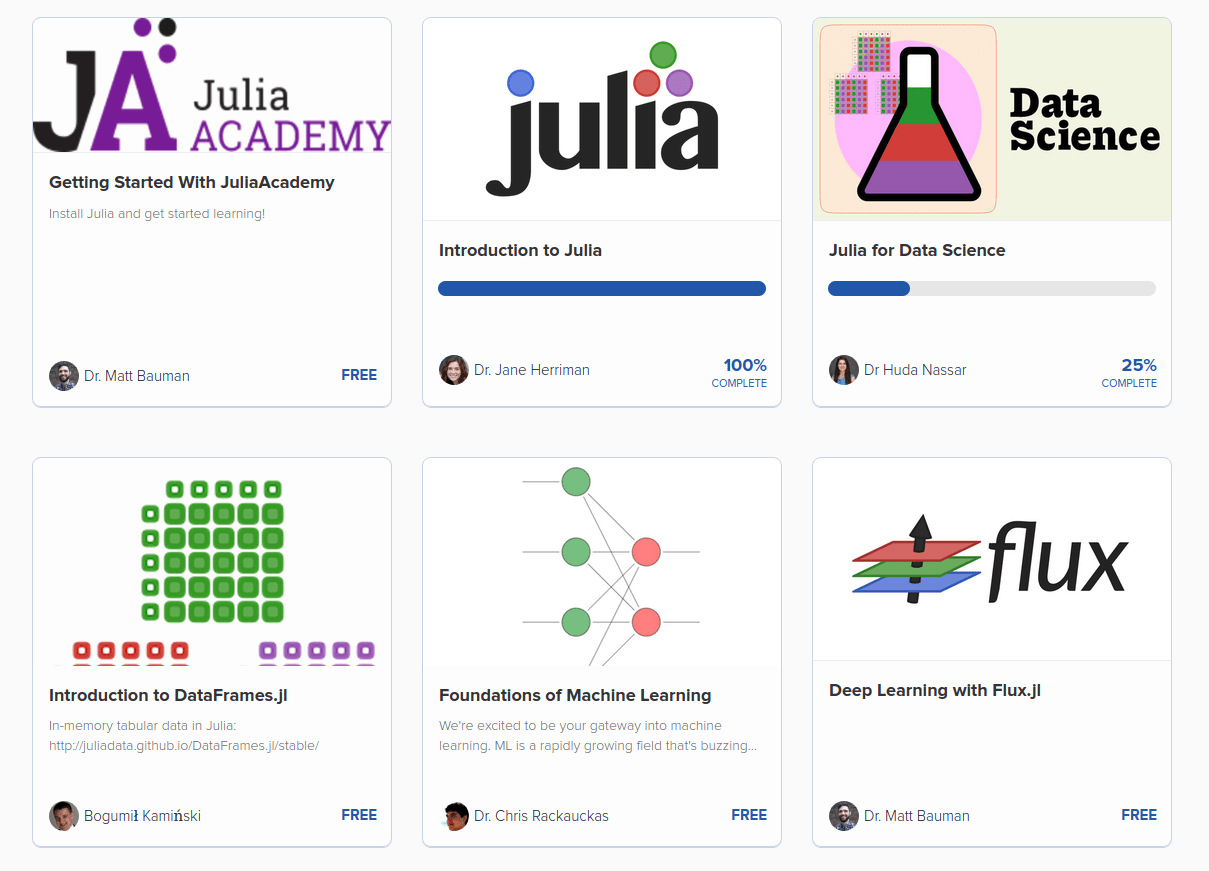
Check out our previous article on whether Julia could replace Python and be transformational in Quantum Computing. We have also highlighted some basics of the Language Julia with a ‘101’ Julia tutorial and briefly written about how would-be learners can get access to learning Julia.