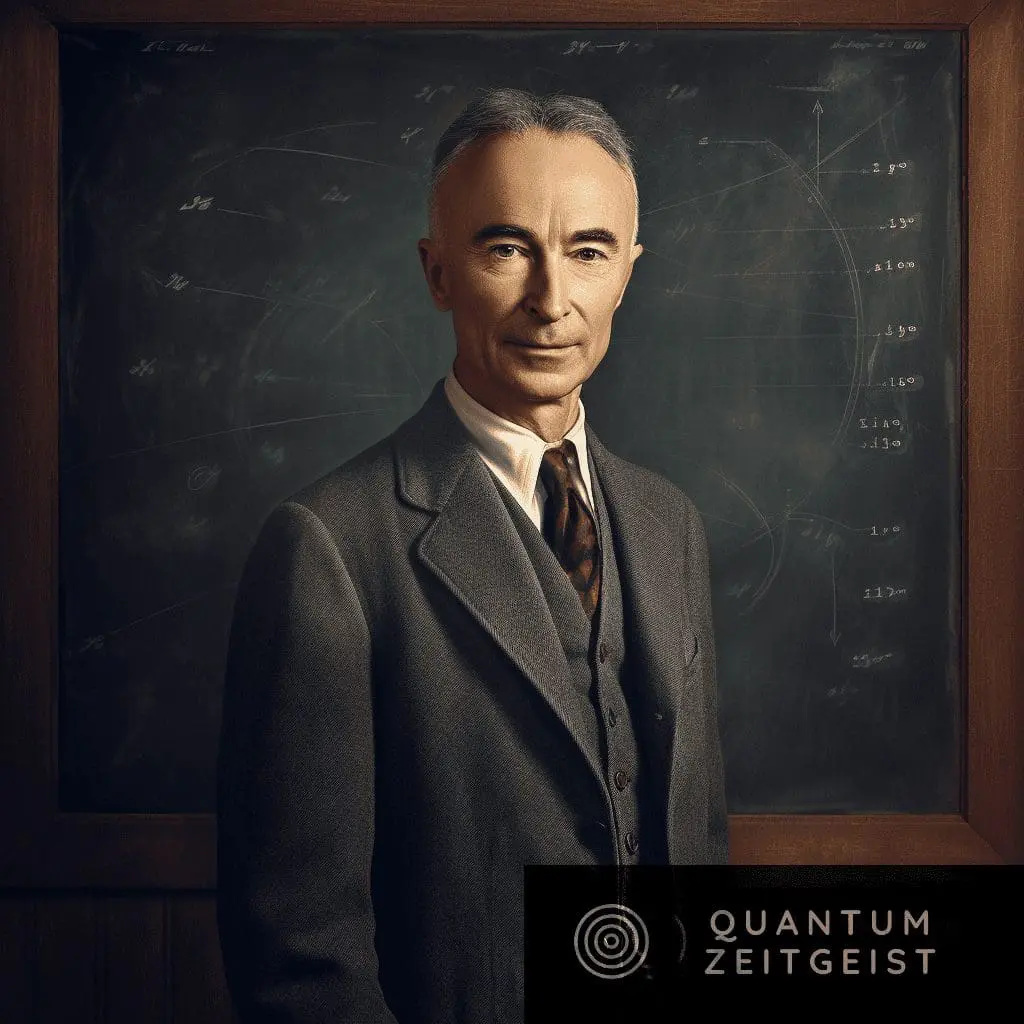
J. Robert Oppenheimer was a brilliant physicist best known for his role as the scientific director of the Manhattan Project during World War II. The project led to the development of the first atomic bombs. His main contributions in the field of quantum mechanics pertained to the study of cosmic ray showers and the development of the “Oppenheimer-Phillips process”, a model that explains certain nuclear reactions.
The era of quantum mechanics, where Oppenheimer made significant contributions, started in the early 20th century. Quantum mechanics, as a theory, describes the behaviours of particles at the most minor scales, such as atoms and subatomic particles. It involves principles vastly different from classical physics, with concepts such as superposition and entanglement, which are fundamental to quantum computing. Some of his key contributions include:
Born-Oppenheimer Approximation
This is one of Oppenheimer’s most significant contributions to quantum mechanics. In collaboration with Max Born, he proposed this approximation which significantly simplifies the mathematical analysis of molecular systems. According to the Born-Oppenheimer Approximation, the motion of atomic nuclei and electrons in a molecule can be separated, allowing scientists to study molecules’ electronic structure independently of nuclear motion. This approximation forms the basis of most quantum chemistry and is fundamental in the study of molecular physics.
Oppenheimer-Phillips Process
This process, named after Oppenheimer and his student Melba Phillips, describes a type of deuteron-induced nuclear reaction. The proposed model explains the observed behaviour of these nuclear reactions more accurately than earlier theories.
Study of Black Holes
Oppenheimer also made major contributions to understanding black holes and neutron stars. Alongside his student Hartland Snyder, Oppenheimer proposed a model of a star collapsing under its gravitational pull to form what we now call a black hole.
Quantum Tunneling
Oppenheimer conducted substantial research on quantum tunnelling, the quantum mechanical phenomenon where a particle tunnels through a barrier that it couldn’t classically surpass. His studies on this subject were vital to understanding alpha decay, a type of radioactive decay.
Cosmic Ray Showers
Oppenheimer wrote multiple papers on cosmic rays and worked out the theory of cosmic ray showers, which occur when high-energy cosmic rays collide with atomic nuclei in the Earth’s atmosphere.
The advent of quantum computing was several decades after Oppenheimer’s time. Still, the seeds of the concepts upon which quantum computing is built were sown during the development of quantum mechanics, a period in which Oppenheimer was active. Quantum computing, which harnesses quantum mechanics to process information, is a field that could potentially revolutionize computing by solving problems that are currently too complex for classical computers.
It’s important to clarify that while Oppenheimer’s contributions were crucial to developing quantum mechanics, he did not directly contribute to quantum computing. His work was one of many building blocks that physicists later used to develop the field of quantum computing. In this sense, his legacy indirectly influences the ongoing advancements in quantum computing.
It was pioneers like Richard Feynman and David Deutsch who took quantum mechanics forward into the realm of computation. Feynman, in the 1980s, proposed the idea of a quantum computer that could simulate the behavior of quantum systems, a task impossible for classical computers. Deutsch further expanded on this idea, providing the theoretical foundation of quantum computation. This wouldn’t have been possible without the earlier work of Oppenheimer and his contemporaries, who laid the groundwork in quantum mechanics that these later scientists built upon.
In conclusion, J. Robert Oppenheimer, a central figure in the development of quantum mechanics, indirectly impacted the field of quantum computing. His work laid the foundation for key concepts in quantum mechanics, which later physicists like Feynman and Deutsch used to develop the principles of quantum computing.