The quest to harness uniquely quantum phenomena continues with new insights into parity-time-symmetric systems, which balance gain and loss in unconventional ways, and their potential for creating powerful quantum states. Jan Peřina Jr. from Palacký University and the Institute of Physics of the Czech Academy of Sciences, alongside Karol Bartkiewicz, Grzegorz Chimczak, Anna Kowalewska-Kudlaszyk, Adam Miranowicz, and Joanna K. Kalaga, investigate the subtle hierarchies of quantum correlations within these systems. Their work demonstrates how the interplay between a system’s inherent nonlinearity and the specific balance of dissipation and amplification affects the generation of nonclassical states, revealing that systems experiencing only loss or only gain often outperform standard parity-time-symmetric designs. This research clarifies the conditions needed to create strongly nonclassical states and highlights the advantages of systems dominated by loss, paving the way for improved designs in quantum technologies.
Non-Hermitian Optics, Exceptional Points and Quantum Properties
This research comprehensively explores non-Hermitian quantum optics, focusing on exceptional points (EPs) and diabolical points (DPs) and their influence on fundamental quantum properties like nonclassicality, entanglement, and steering. Researchers investigate how these unique points in a system’s parameter space affect the behaviour of quantum states and correlations, aiming to understand the interplay between these points and the degree of quantum properties exhibited by a system. The work concentrates on continuous variable (CV) systems, which describe quantum fields like light, and considers the effects of environmental interactions and dissipation, crucial for realistic experimental implementations. The investigation employs a combination of analytical techniques, numerical simulations, and theoretical tools, including the Lindblad master equation to describe open quantum systems, the Fokker-Planck equation to model stochastic processes, and Wigner functions to represent quantum states.
This allows scientists to thoroughly examine the behaviour of these complex systems, establishing relationships between proximity to EPs and DPs and the degree of quantum properties. A significant contribution lies in the investigation of how dissipation affects quantum properties near EPs and DPs, demonstrating how environmental interactions can either enhance or degrade these properties. The authors extend the study beyond single EPs and DPs to consider systems with multiple such points and even hybrid points combining characteristics of both, creating a more complex and realistic scenario. This research has potential implications for quantum technologies, such as quantum communication, sensing, and computation, as controlling and manipulating quantum properties near EPs and DPs could lead to new functionalities and improved performance. The work also connects theoretical findings to experimental systems like spin-VCSELs and semiconductor lasers, a significant step towards realizing practical quantum devices.
Nonclassicality in Parity-Time Symmetric Bosonic Systems
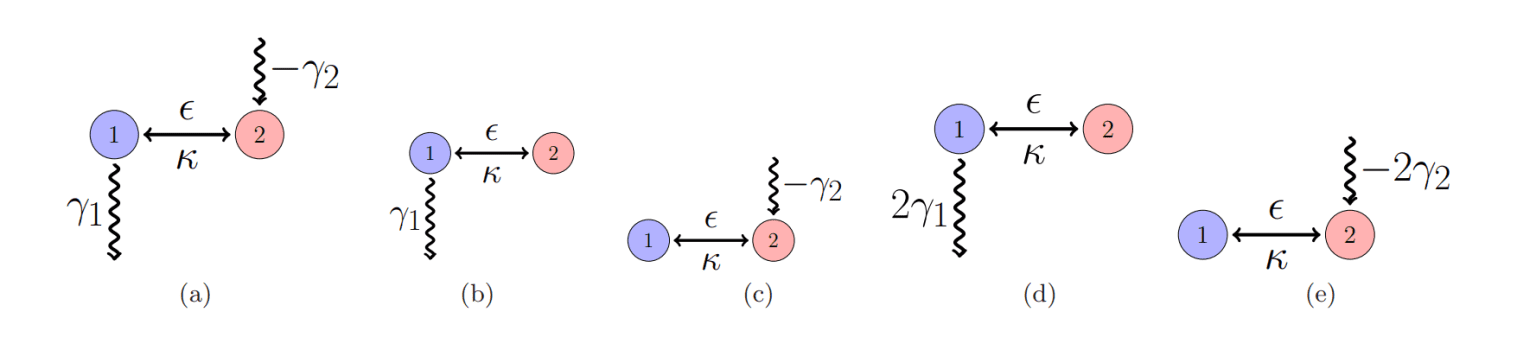
This study investigates correlations within a quadratic bosonic parity-time-symmetric system, meticulously examining the interplay between nonlinearity and the dynamics of dissipation and amplification. Researchers employed a comprehensive set of quantifiers, including local and global nonclassicality depths, negativity, steering parameters, and the Bell parameter, to characterize the system’s nonclassical behaviour and assess the impact of damping and amplification. By systematically comparing three distinct two-mode systems, standard, passive, and active, scientists revealed the crucial role of fluctuations associated with gain and loss in determining the system’s quantum properties. To model the system’s dynamics, scientists developed a Heisenberg-Langevin equation approach, solving Langevin-Heisenberg equations including Langevin noise terms.
This method not only revealed the system’s eigenfrequencies but also facilitated the derivation of Gaussian-state parameters by averaging over chaotic noise forces. The system was described using photon annihilation and creation operators for each mode, coupled by linear and nonlinear interactions, and subject to damping and amplification via Langevin forces representing reservoir interactions. Researchers carefully defined the characteristics of the reservoirs responsible for damping and amplification, establishing that they followed independent quantum random Gaussian and Markovian processes.
Dissipation Enhances Quantum Correlations in Bosonic Systems
This work investigates the hierarchy of quantum correlations within quadratic bosonic parity-time-symmetric systems, exploring how dissipation and amplification channels influence nonclassical behaviour. Researchers elucidated the interplay between physical nonlinearity and the dynamics of these systems, utilizing a suite of quantifiers to assess nonclassicality, asymmetric steering, and Bell nonlocality. Results demonstrate that standard parity-time-symmetric systems generally exhibit weaker quantumness compared to configurations affected solely by damping or amplification, both in terms of maximum values attained by these quantifiers and the duration of their generation. Detailed analysis across the parameter space revealed that passive parity-time-symmetric systems, experiencing unequal levels of damping, yield the most strongly nonclassical states.
The team measured local and global nonclassicality depths, negativity, steering parameters, and the Bell parameter to characterize quantumness, finding that the passive system consistently outperformed its counterparts. Researchers discovered that the detrimental effects of chaotic noise are generally weaker with damping than with amplification, due to the susceptibility of amplified systems to spontaneous photon emission. Further investigation of a passive system with double damping on one mode revealed optimal conditions for generating quantumness. This research provides a rigorous framework for analysing these systems through analytical solutions of Langevin-Heisenberg equations, allowing for detailed comparison between standard, passive, and active configurations.
🗞 Quantumness and its hierarchies in PT-symmetric down-conversion models
🧠 ArXiv: https://arxiv.org/abs/2510.06171