Quantum-speed limits, fundamental constraints on how quickly quantum systems evolve, underpin precision technologies such as gravitational-wave detection and advanced clock networks, but existing theoretical benchmarks often overlook the crucial influence of relativity. Salman Sajad Wani from Qatar Center for Quantum Computing, Aatif Kaisar Khan from the University of Florida, and Saif Al-Kuwari, also from Qatar Center for Quantum Computing, alongside Mir Faizal, now demonstrate how relativistic effects modify these limits for systems employing coherent and squeezed states of light. Their work establishes first-order relativistic corrections to established quantum bounds, revealing that motion slows evolution and introduces a phase drift dependent on both amplitude and squeezing. Remarkably, the team calculates that this drift should be detectable in a single electron within a Penning trap, using current quantum measurement techniques, offering an accessible experimental test of quantum speed limits in extreme conditions and paving the way for improved precision in future technologies.
Continuous Variable Quantum Key Distribution Limits
Scientists are exploring the fundamental limits and potential improvements of quantum technologies, particularly continuous-variable quantum key distribution (CV-QKD) and precision measurements. This work investigates how relativistic effects, quantum gravity corrections, and various noise sources impact the performance of these systems, and how to overcome these limitations, emphasizing the importance of understanding the underlying physics governing these systems. The core of this research focuses on CV-QKD, a secure communication method utilizing the continuous properties of light. Scientists are addressing the challenges of implementing CV-QKD over long distances, for example, in satellite-to-ground communication, by investigating pilot-assisted techniques, local oscillator stability, and the impact of phase noise.
The work also delves into the effects of special and general relativity on quantum systems, employing advanced mathematical tools to solve complex quantum mechanical problems. A crucial aspect of this work is understanding and mitigating noise sources that degrade quantum system performance, including noise in homodyne and heterodyne detection schemes. Researchers utilize squeezed states of light to reduce quantum noise and connect quantum technologies to fundamental physics, exploring how they can be used to measure fundamental constants with greater precision, potentially revealing new physics beyond the Standard Model.
Relativistic Quantum Speed Limits and Squeezing
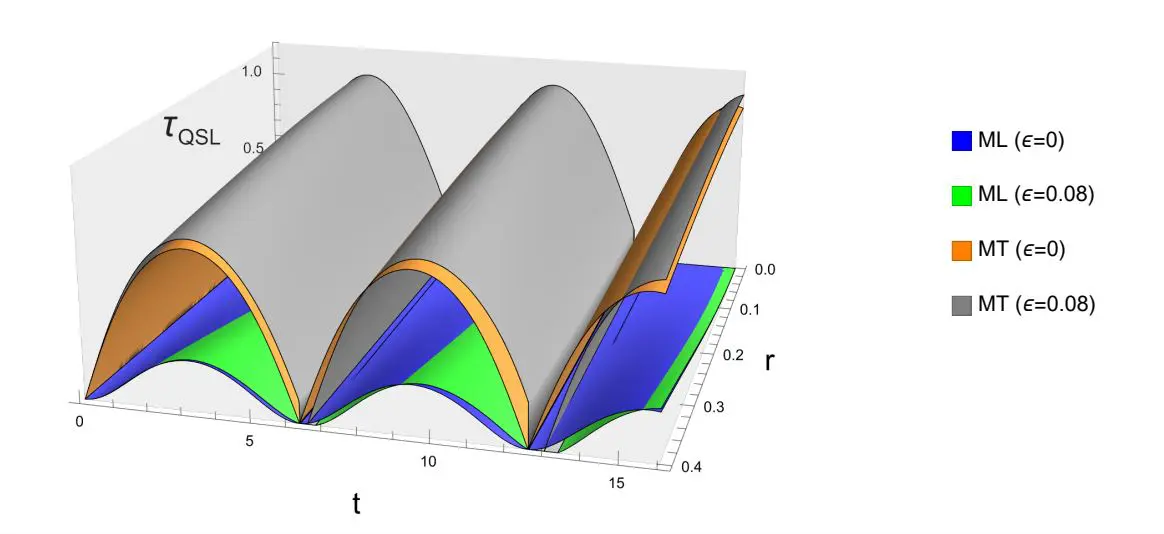
Scientists investigated quantum speed limits and relativistic effects relevant to precise timing in advanced technologies like satellite-based gravitational-wave detectors and space-borne clock networks. They pioneered a method for calculating relativistic corrections to established quantum limits, specifically the Mandelstam-Tamm and Margolus-Levitin bounds, which govern the minimum time required for quantum evolution. Researchers derived closed-form expressions for these quantum speed limits and the quantum Cramér-Rao bound by treating a harmonic oscillator as a perturbation and propagating Gaussian states. The team demonstrated that relativistic kinematics slow down quantum evolution in a manner dependent on both amplitude and squeezing, increasing the quantum speed limits and introducing a phase drift that weakens timing sensitivity while modestly enhancing the squeeze factor.
To benchmark these theoretical predictions, scientists analysed a single electron trapped in a Penning trap, read out using quantum-limited balanced homodyne detection, predicting that the relativistic drift would be detectable within fifteen minutes, well within known electron hold times. To connect these findings to practical applications, the study integrated the predicted phase drift into a standard Gaussian-modulated coherent-state quantum key distribution (QKD) model, revealing potential mitigation strategies such as raising pilot signal-to-noise ratio, shortening the estimation window, and applying linear prediction. The team further developed a relativistic Hamiltonian for a particle in a harmonic oscillator, expanding it to first order in momentum to account for relativistic effects, demonstrating the growing influence of relativistic effects at higher energy levels.
Relativistic Quantum Speed Limits for Light States
Scientists have derived first-order relativistic corrections to fundamental quantum speed limits, specifically the Mandelstam-Tamm and Margolus-Levitin bounds, for both coherent and squeezed states of light. Building upon the Foldy-Wouthuysen expansion and treating relativistic effects as a harmonic-oscillator perturbation, researchers propagated Gaussian states to obtain closed-form quantum speed limits and the quantum Cramér-Rao bound. These calculations reveal that relativistic kinematics slow evolution in an amplitude and squeezing-dependent manner, increasing both bounds and introducing a phase drift proportional to ε²t², where ε represents the relativistic parameter and t is time. Experiments demonstrate that a single electron, with ε ≈ 1.
5 × 10⁻¹⁰, trapped in a 5. 4 Tesla Penning trap and read out with 149GHz quantum-limited balanced homodyne detection, should reveal this timing drift within approximately fifteen minutes, well within known electron hold times. The team calculated that for coherent states, relativistic kinematics shorten intervals of accelerated evolution, but beyond a certain amplitude, enforce an overall slowdown, increasing the fastest gate time for photon-number qubits. For squeezed states, the calculations show that relativistic effects modify the squeeze factor, impacting the precision of measurements. These results provide a benchmark for relativistic corrections in continuous-variable systems and identify a pathway to experimentally test the quantum speed limit in high-velocity or strong-field regimes. The team’s analysis of balanced homodyne detection reveals that this method can saturate the Cramér-Rao limit, offering a precise means of verifying the predicted timing drift and advancing the understanding of fundamental quantum limits in relativistic scenarios.
Relativistic Quantum Speed Limits and Phase Drift
This research establishes the first special-relativistic corrections to fundamental quantum speed limits, specifically the Mandelstam-Tamm and Margolus-Levitin bounds. By incorporating relativistic effects into the standard harmonic oscillator model, the team derived a revised quantum Cramér-Rao bound, demonstrating that relativity introduces a slight reduction in the advantage gained from quantum squeezing. The findings reveal that relativistic kinematics slow quantum evolution in a manner dependent on both amplitude and squeezing, and introduce a phase drift that impacts timing sensitivity. Importantly, the team identifies a practical means of testing these predictions using a Penning trap and quantum-limited detection, estimating that the predicted phase drift could be observed after approximately fifteen minutes of averaging, a timeframe consistent with existing single-electron hold records. This suggests that measurable limits on quantum dynamics exist even at relatively low velocities and in moderate field strengths, with implications for technologies such as satellite quantum key distribution, squeezed-light interferometry, and optical clock-based dark matter searches.
🗞 Relativistic Quantum-Speed Limit for Gaussian Systems and Prospective Experimental Verification
🧠 ArXiv: https://arxiv.org/abs/2511.20707