Researchers are tackling the challenge of deploying robotic teams in complex and hazardous environments, moving beyond reliance on constant human control. David Oberacker, Julia Richer, and Philip Arm, from FZI Forschungszentrum für Informatik, Karlsruhe Institute for Technology, and ETH Zürich respectively, alongside Marvin Grosse Besselmann, Lennart Puck et al., introduce MOSAIC, a novel framework for coordinating heterogeneous robotic teams with scalable autonomy. This work is significant because it enables a single operator to supervise multiple robots performing scientific tasks by dynamically allocating responsibilities and leveraging team redundancy, demonstrated through a successful field experiment simulating a space prospecting mission where the team achieved 82.3% task completion despite a robot failure.
Multi-robot exploration using dynamic task allocation and redundancy offers improved efficiency and robustness
Unveiling the MOSAIC autonomy framework system
The MOSAIC Framework for Multi-Robot Autonomy
Scientists have unveiled MOSAIC, a new scalable autonomy framework designed to facilitate multi-robot scientific exploration with limited operator intervention. The research addresses the limitations of current robotic systems in hostile environments, such as space or disaster relief, which often rely on direct human teleoperation, restricting deployment scale and requiring consistent low-latency communication.
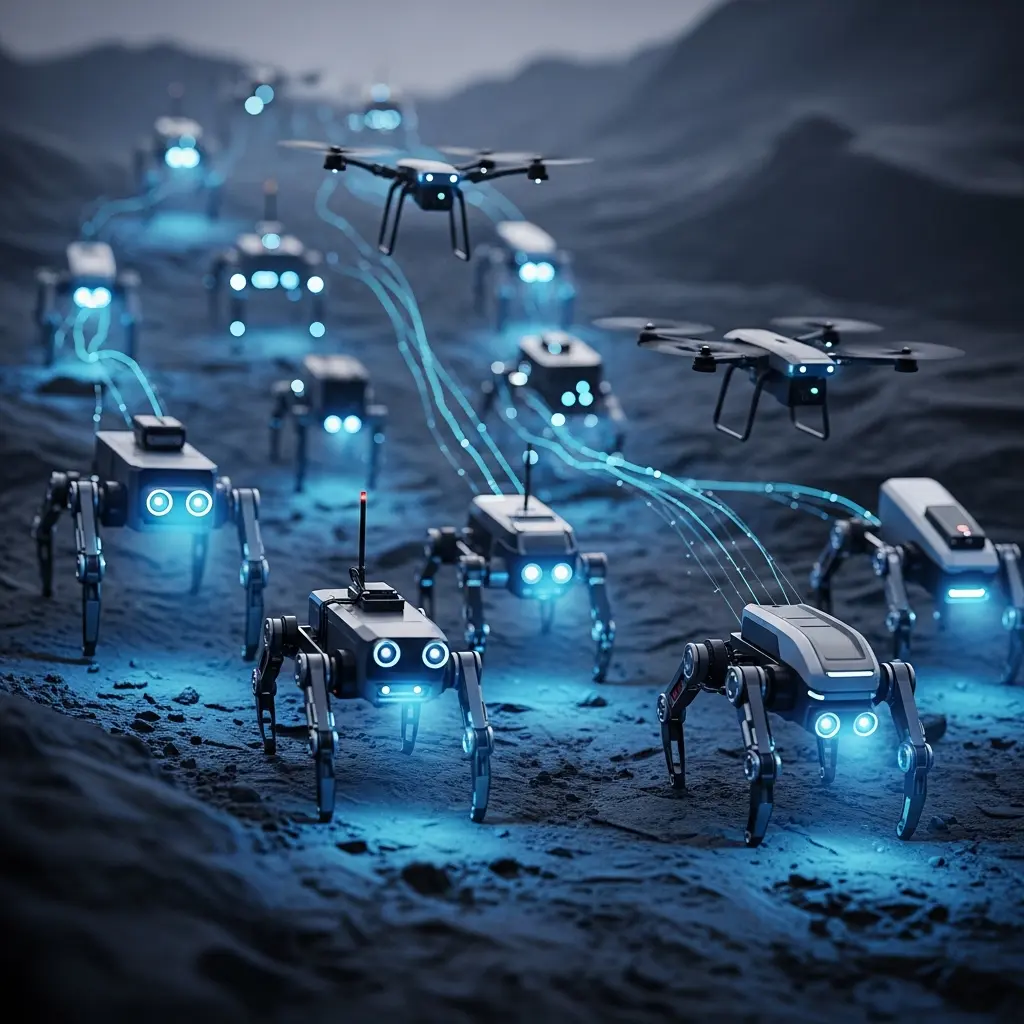
MOSAIC employs a unified mission abstraction based on Points of Interest (POIs) and multiple layers of autonomy, enabling a single operator to supervise a team of robots performing complex tasks. The team achieved robust operation through dynamic task allocation, assigning exploration and measurement duties based on each robot’s unique capabilities.
Leveraging team-level redundancy and specialization, MOSAIC ensures continuous operation even in the event of individual robot failures. This innovative approach moves beyond single-robot designs, which can be vulnerable to complete mission failure due to a single point of failure, and addresses the challenges of scaling up manual control in larger robotic teams.
Design for robustness through team specialization
Achieving Robust Tasks Through Team Specialization
The framework’s design prioritizes both operational efficiency and reduced manpower demands through increased levels of autonomy. Experiments show that a heterogeneous team of five robots, operating under the control of a single operator, completed 82.3% of assigned tasks during a space-analog field experiment emulating a lunar prospecting scenario.
Despite the complete failure of one robot during the mission, the team maintained an Autonomy Ratio of 86% and kept operator workload at only 78.2%. These results demonstrate the framework’s ability to deliver robust, scalable multi-robot scientific exploration with minimal human intervention. This breakthrough reveals practical lessons learned regarding robot interoperability, networking architecture, team composition, and operator workload management.
Future applications in space and disaster response
Foundations for Future Space and Disaster Missions
The research establishes a foundation for future multi-robot missions, offering insights into how to optimise team performance and resilience in challenging environments. The work opens possibilities for more efficient and reliable robotic exploration of space, disaster response, and other hazardous areas, paving the way for more ambitious scientific endeavours.
Optimizing coverage using points of interest
Optimizing Area Coverage Using Points of Interest
Multi-robot prospecting utilising a Points of Interest mission abstraction and online task management enables efficient area coverage
Scientists developed MOSAIC, a scalable autonomy framework for multi-robot scientific exploration, employing a unified mission abstraction based on Points of Interest (POIs) and multiple layers of autonomy to enable single-operator supervision. The research team validated this framework in a space-analog field experiment, simulating a prospecting scenario with a heterogeneous team of five robots.
Despite the complete failure of one robot during the mission, the team successfully completed 82.3% of assigned tasks, demonstrating robustness and scalability. Experiments utilised the ESA Space Resources Challenge (SRC) simulation, a lunar surface prospecting scenario requiring autonomous detection of boulders and Rare Earth Elements (REE) oxide patches.
The study pioneered an online task management system addressing the challenge of unknown exploration waypoints at mission start, initially defining subgoals as frontier points or pre-specified inspection targets. Robots incrementally constructed spatial representations, with the system dynamically generating, sequencing, and allocating tasks based on individual robot capabilities and team-level redundancy.
Researchers engineered a system where robots autonomously navigate to waypoints, avoiding obstacles, a technique central to deployments like SubT, Skylight Exploration, LUNARES, AMADEE-24, and ARCHES. Beyond navigation, the team incorporated science-focused tasks such as spectral rock analysis and sample localization, demanding accurate target identification and stable positioning.
The approach enables task distribution through task-bidding frameworks, explicitly encoding task requirements and robot capabilities to ensure tasks are assigned to appropriately equipped agents, reducing operator workload. The study harnessed autonomy modes ranging from full autonomy, where robots independently generate and execute tasks, to task-level autonomy with human-in-the-loop intervention.
This allows operators to adapt mission priorities or recover from failures when autonomous decision-making is insufficient. The team achieved an Autonomy Ratio of 86% and maintained operator workload at only 78.2%, highlighting the framework’s potential for robust, scalable multi-robot scientific endeavours with limited operator intervention.
Successful lunar prospecting simulation with 86% autonomy and low operator workload demonstrated promising results
Scientists have developed MOSAIC, a scalable autonomy framework for multi-robot scientific exploration, enabling supervision by a single operator. The research team validated the framework in a space-analog field experiment, simulating a lunar prospecting scenario with a heterogeneous team of five robots.
Despite the complete failure of one robot during the mission, the team successfully completed 82.3% of assigned tasks. Experiments revealed an Autonomy Ratio of 86%, demonstrating the system’s ability to operate with limited operator intervention. The team measured operator workload at only 78.2%, indicating a manageable cognitive load during the complex mission.
These results demonstrate robust, scalable multi-robot scientific exploration is achievable with a single operator overseeing the team. MOSAIC dynamically allocates and measurement tasks based on each robot’s capabilities, leveraging team-level redundancy and specialization for continuous operation. The framework utilizes a unified mission abstraction based on Points of Interest (POIs), converting them into robot-specific tasks for execution.
Scientists recorded that this approach facilitates parallelized scientific exploration of an area by the robotic team. The study’s KPI framework quantitatively evaluated system performance in terms of efficiency, robustness, and precision. Tests prove that the proposed framework enables a significant reduction in operator workload while maintaining high task completion rates.
Researchers further derived practical lessons learned regarding robot interoperability, networking architecture, team composition, and operator workload management to inform future multi-robot missions. Measurements confirm that the MOSAIC framework offers a viable path towards achieving full operational autonomy in multi-robot systems.
The breakthrough delivers a system capable of adapting to unforeseen circumstances, such as robot failure, without compromising overall mission success. This work represents an important step towards scalable and efficient robotic exploration in challenging environments.
Field validation demonstrates robust multi-robot prospecting with limited operator input, yielding promising results
Scientists have developed MOSAIC, a scalable autonomy framework for coordinating teams of mobile robots in scientific applications. This framework enables a single operator to supervise multiple robots operating in challenging environments, such as those found in space or during disaster relief. MOSAIC utilises a unified mission abstraction based on Points of Interest (POIs) and implements multiple layers of autonomy to dynamically allocate tasks based on each robot’s capabilities.
The validation of MOSAIC involved a field experiment simulating a prospecting scenario with five robots, demonstrating robust performance despite the failure of one unit. The team successfully completed 82.3% of assigned tasks with an autonomy ratio of 86%, while maintaining a manageable operator workload of 78.2%.
These results suggest that the framework facilitates effective multi-robot scientific work with limited human intervention. The authors acknowledge limitations related to communication blackouts and the scalability of operator management, and future work will focus on achieving fully autonomous operation during extended communication loss through mesh networking and decentralised task management.
They also plan to extend operator management to reduce workload and integrate additional specialised operators, aiming to manage larger teams with fewer personnel. Finally, the researchers intend to standardise the interface for integrating ROS 2-based robots, simplifying the incorporation of new systems into the MOSAIC architecture.
🗞 MOSAIC: Modular Scalable Autonomy for Intelligent Coordination of Heterogeneous Robotic Teams
🧠 ArXiv: https://arxiv.org/abs/2601.23038