

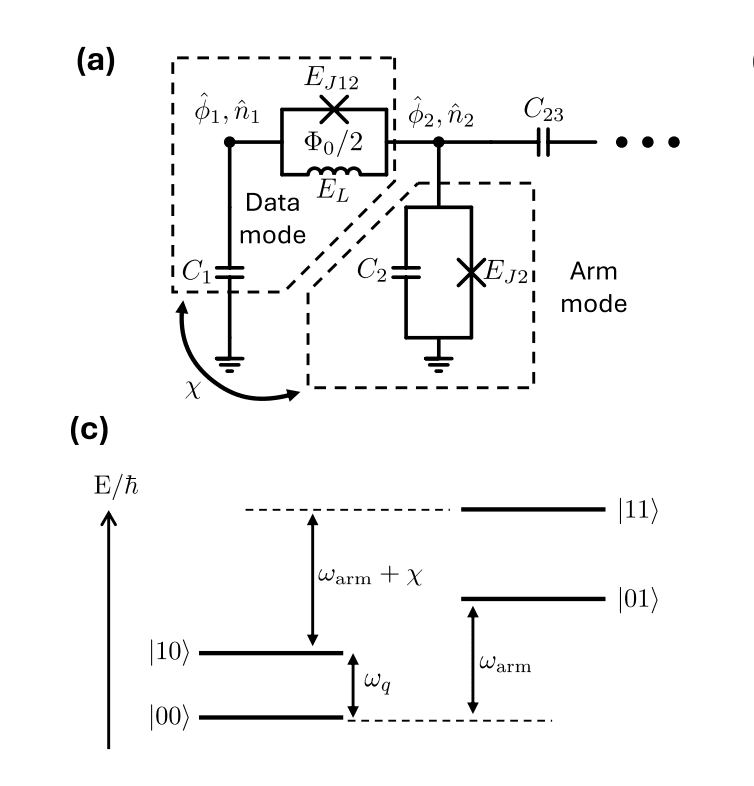
A superconducting qubit architecture achieves microwave-only CZ gates with 17 ns infidelity and always-on ZZ interaction below 0.4 kHz. Readout exhibits 27 ns state assignment error and 167 ms lifetime without filtering, alongside shot-noise dephasing suppression. Single-qubit gate infidelities remain below, utilising capacitive coupling for scalability.
The pursuit of stable and rapidly interacting quantum bits – qubits – remains central to realising practical quantum computation. Current architectures often face limitations in balancing qubit coherence – the duration a qubit maintains quantum information – with the strength of interactions needed for complex calculations. Researchers at the Massachusetts Institute of Technology, led by Jeremy B. Kline, Alec Yen, Stanley Chen, and Kevin P. O’Brien, detail a novel superconducting qubit design in their paper, ‘The Arm Qubit: A Superconducting Qubit Co-Designed for Coherence and Coupling’. Their approach utilises a distinct architecture featuring dedicated modes for data storage and qubit-qubit coupling, demonstrating potential for significantly faster and more accurate quantum gate operations and readout, crucial elements in building a scalable, fault-tolerant quantum computer.
Novel Superconducting Qubit Architecture Demonstrates Enhanced Performance
Researchers have detailed a new superconducting qubit architecture employing two strongly coupled modes to manage data storage and qubit interactions, potentially advancing the development of practical quantum computers. The design centres on prioritising capacitive coupling – the electrostatic interaction between components – between qubit elements, offering a potentially scalable route towards fault-tolerant quantum computation.
Superconducting qubits, tiny electronic circuits exhibiting quantum properties, are a leading candidate for building quantum computers. However, achieving both strong interactions between qubits and minimising unwanted interactions amongst them has proven a significant challenge. This new architecture circumvents this traditional trade-off by dedicating a specific mode to facilitate coupling.
The team demonstrated microwave-only controlled-Z (CZ) gates – a fundamental two-qubit operation – with an infidelity below 17 nanoseconds. Infidelity represents the probability of an error occurring during a gate operation; lower values indicate higher accuracy. Furthermore, the architecture supports a continuous, or ‘always-on’, ZZ interaction at less than 0.4 kHz. ZZ interaction allows qubits to influence each other even when no gate is actively being applied, increasing connectivity and enabling more complex quantum algorithms.
Simulations predict this configuration supports rapid, high-fidelity gate operations and readout. The researchers anticipate state assignment errors – errors in determining the qubit’s state after a measurement – below 27 nanoseconds, assuming a 90% detection efficiency. Crucially, the qubit exhibits a Purcell lifetime of 167 milliseconds even without a Purcell filter – a component typically used to extend qubit coherence. Purcell lifetime describes how long a qubit maintains its excited state before decaying, and longer lifetimes are desirable.
The team also incorporated a mechanism to suppress shot-noise dephasing – a source of quantum decoherence caused by fluctuations in measurement signals. This resulted in dephasing times exceeding 1 millisecond. Dephasing time measures how long a qubit maintains its quantum phase, a critical property for performing calculations. Finally, simulations predict single-qubit gate infidelities remain below 10-3, even when accounting for the effects of decoherence – the loss of quantum information.
👉 More information
🗞 The Arm Qubit: A Superconducting Qubit Co-Designed for Coherence and Coupling
🧠 DOI: https://doi.org/10.48550/arXiv.2506.05315


