The ability to precisely sculpt light offers unprecedented control over interactions with matter, and a new framework for achieving this is now emerging. Sergio Carbajo, Seung-Whan Bahk, and Justin Baker, alongside Andrea Bertozzi, Abhimanyu Borthakur, and Antonino Di Piazza, present a comprehensive overview of how advanced techniques in structured light are poised to revolutionise high-field laser physics. Their work details a powerful combination of innovative electromagnetic tools, intelligent optimisation algorithms, and groundbreaking applications, ranging from programmable electron beams to the generation of novel forms of radiation. This research signifies a shift from simply observing light-matter interactions to actively commanding them, promising significant advances in fields from materials science to high-energy physics.
Tailoring Light’s Structure for Matter Interactions
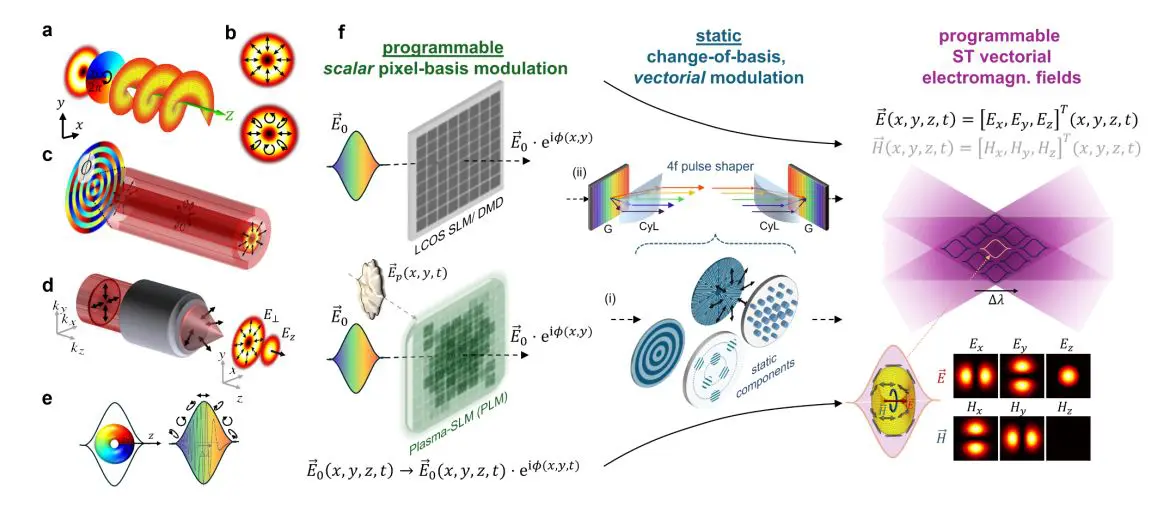
Structured light offers unprecedented control in high-field laser-matter interactions, representing a critical advancement in manipulating light’s spatial and temporal properties. This review charts a new paradigm built upon three synergistic pillars, harnessing intelligent structuring of light. Researchers are developing an advanced electromagnetic toolkit, moving beyond conventional spatial light modulators to include robust static optics and the promising frontier of plasma light modulators, enabling tailored light characteristics for specific interactions with matter. The review details innovative methods for encoding information onto light beams, including techniques for creating complex spatiotemporal waveforms and polarization states, and explores applications in diverse areas of high-field physics, such as attosecond science, particle acceleration, and the generation of novel states of matter. This research demonstrates how intelligent structuring of light fundamentally alters laser-matter interactions, opening new avenues for scientific discovery and technological innovation.
The team details an optimisation engine for this high-dimensional design space, focusing on physics-informed digital twins and artificial intelligence-driven inverse design to automate the discovery of optimal light structures. Groundbreaking applications include programmable electron beams, orbital-angular-momentum-carrying gamma rays, compact terahertz accelerators, and robust communications. The path forward requires overcoming challenges in material science, achieving real-time adaptive control at megahertz rates, and extending these principles to the quantum realm. This review serves as a call to action for a coordinated, interdisciplinary effort to command, rather than merely observe, light-matter interactions at the extreme.
Automated Light Structure Discovery and Beam Control
Recent work details a transformative framework for controlling light-matter interactions, built upon advanced electromagnetic tools, optimised design processes, and groundbreaking applications. Scientists are moving beyond conventional spatial light modulators, incorporating robust static optics and exploring the potential of plasma light modulators to achieve precise control over light. This research focuses on developing an optimisation engine that leverages physics-informed digital twins and artificial intelligence to automate the discovery of optimal light structures for specific applications. Experiments demonstrate the ability to generate stable self-modulation of an electron beam within a magnetic wiggler, a crucial step towards advanced particle beam control, and the observation of photons carrying orbital angular momentum in undulator radiation, confirming the generation of light with twisted properties.
Further studies reveal the generation of entangled photon pairs through photon-photon scattering, demonstrating a pathway to novel quantum light sources, and the photoexcitation of the nuclear clock transition in Thorium-229 using twisted light, opening possibilities for precision spectroscopy and quantum technologies. Measurements confirm the generation of optical Schrödinger cat states in intense laser-matter interactions, demonstrating the creation of superposition states of light with potential applications in quantum information science, and the achievement of high-harmonic generation driven by quantum light, producing bright, squeezed vacuum states and controlling photon bunching. Experiments demonstrate the generation of massively entangled bright states of light during harmonic generation in resonant media, paving the way for advanced quantum communication protocols, and reveal detailed information about the interaction between light and matter at the quantum level through measurements of photoelectron quantum states. Furthermore, scientists are exploring the use of laser Compton backscattering for precision beam intensity control in future colliders, and investigating the potential of X-ray free-electron laser-based gamma-gamma colliders for Higgs factory applications. These advancements promise to revolutionise fields ranging from quantum computing and materials science to high-energy physics and medical imaging.
Light Control, Angular Momentum, and AI Integration
This work presents a new framework for controlling light in high-field laser-matter interactions, moving beyond traditional beam shaping techniques. Researchers demonstrate that precise control over the spatial and temporal properties of light is crucial for unlocking new phenomena in these extreme conditions, and highlight the potential to transfer orbital angular momentum from laser pulses to electrons, creating twisted gamma-ray beams with applications in nuclear photonics and secure communications, and to enhance electron acceleration and coherent radiation generation using vector beams. A key achievement is the proposal of an integrated approach built upon three pillars: advanced optical techniques, physics-informed digital twins for optimisation, and artificial intelligence-driven inverse design. This combination allows for systematic exploration of the complex parameter space governing high-intensity light-matter interactions, overcoming the limitations of trial-and-error methods.
The authors acknowledge current limitations in existing optical components, particularly spatial light modulators, which struggle with shorter wavelengths, high intensities, and broader spectral ranges. Future research directions include developing real-time adaptive control systems operating at megahertz rates and extending these principles to quantum systems and single-particle interactions. The team also emphasises the need for standardization, community adoption of benchmarks, and open-source tools to accelerate progress in this field. Ultimately, this work advocates for a coordinated, interdisciplinary effort to actively command, rather than simply observe, light-matter interactions at the extreme, paving the way for novel applications and a deeper understanding of fundamental physics.
🗞 Structured Light at the Extreme: Harnessing Spatiotemporal Control for High-Field Laser-Matter Interactions
🧠 ArXiv: https://arxiv.org/abs/2512.05042