Researchers are increasingly focused on optimising the delivery of high-fidelity quantum information for future networks. Elif Tugce Ceran from the Department of Electrical and Electronics Engineering at Middle East Technical University, and colleagues, have introduced the Age of Entanglement (AoE) as a crucial new metric to assess the freshness of bipartite entanglement within repeater chains. This work investigates a satellite-assisted repeater network, accounting for probabilistic entanglement generation, memory decoherence, and the intermittent nature of satellite links, modelled as a two-state Markov chain. By formulating an infinite-horizon Markov decision process and deriving AoE-optimal policies using relative value iteration, the study demonstrates how dynamic control strategies can substantially improve performance compared to simpler approaches. These findings offer valuable design guidelines for realising practical, continuous distribution protocols in satellite-enabled quantum repeater chains.
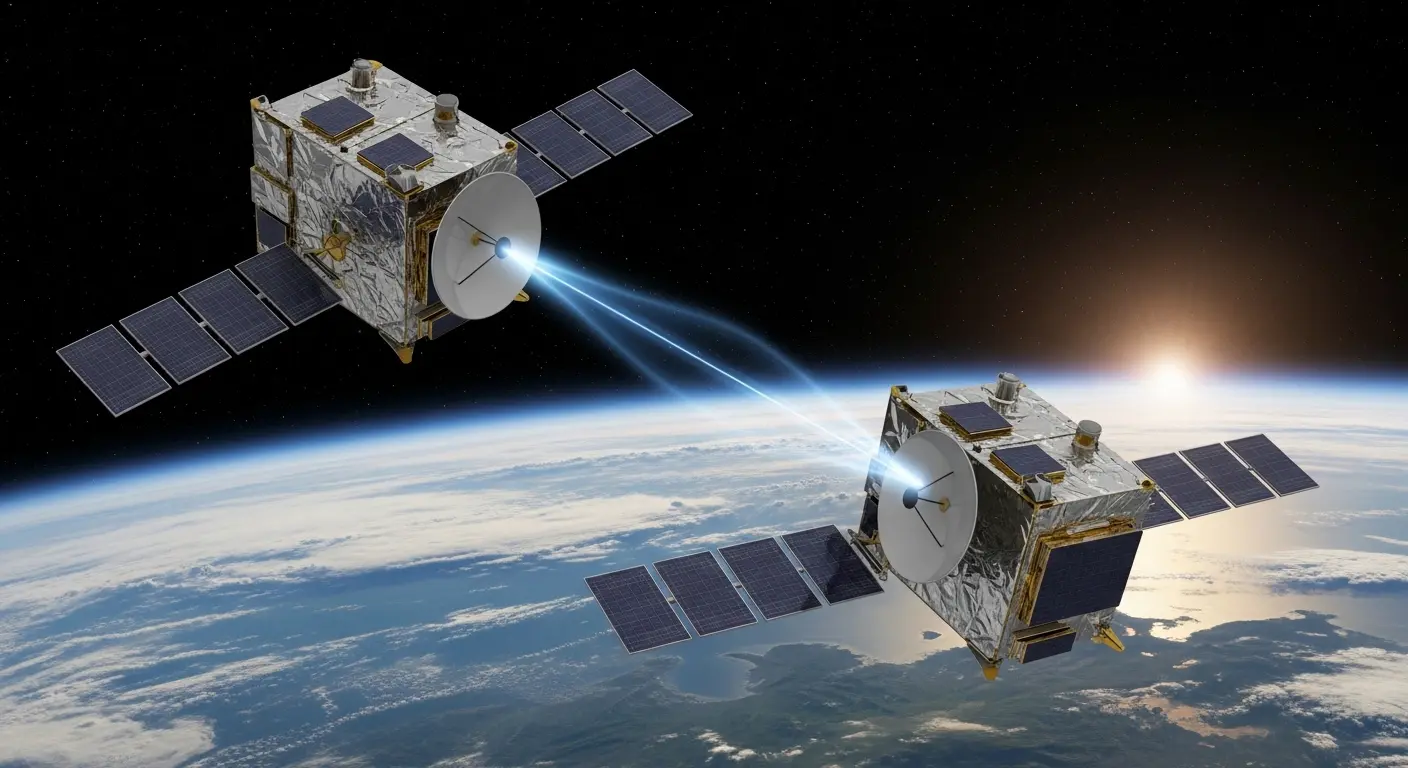
Scientists study probabilistic entanglement generation and swapping within a satellite-assisted quantum repeater network. Entangled pairs are generated probabilistically, stored in quantum memories subject to decoherence. Then combined to establish end-to-end entangled links. Satellite, ground connectivity is intermittent and is modelled as a two-state Markov chain, and the resultant area of entanglement (AoE) minimisation problem is formulated as an infinite-horizon Markov decision process (MDP). Where control actions dictate the timing of entangled pair generation, storage, or swapping.
Age of Entanglement enhances long-distance quantum communication performance
Once established, maintaining entanglement quality over long distances is a considerable challenge. Active policies, guided by the newly introduced Age of Entanglement (AoE) metric, deliver substantial improvements in entanglement distribution within satellite-assisted quantum repeater networks. Specifically, these policies markedly outperform both the ‘swap-as-soon-as-possible’ and greedy entanglement generation strategies, a key finding for advancing quantum communication.
Quantifying the ‘freshness’ of entanglement, considering its recent establishment and current fidelity, required a new metric. Scientists introduced AoE to address this need, extending classical Age of Information (AoI) concepts to account for quantum-specific factors like decoherence and probabilistic operations. AoE resets upon successful creation of an end-to-end entangled link. But crucially incorporates the degradation of quantum states during storage and processing.
The performance gains achieved through AoE-optimised policies are not merely theoretical. Using relative value iteration, scientists characterised policies that minimise AoE and then evaluated their performance numerically. Proactively managing entanglement, considering both its age and quality, yields better results than simply reacting to requests or greedily generating new pairs.
When considering the specifics, the project focuses on a network where satellite-ground connectivity is modelled as a two-state Markov chain, representing intermittent link availability. By formulating the AoE minimisation problem as an infinite-horizon Markov decision process, the team could determine optimal control actions for generating, storing, and swapping entangled pairs.
Inside this framework, the active policies consistently delivered superior performance. Decoherence, the loss of quantum information over time, and imperfect operations impact entanglement quality. Through actively managing these factors through AoE-based control, the proposed policies demonstrably surpass simpler strategies in maintaining high-fidelity links. Beyond improving performance, these findings provide practical guidelines for designing and controlling satellite-enabled quantum repeater chains that support continuous entanglement distribution.
Quantifying entanglement lifetime improves satellite quantum communication
Maintaining quantum entanglement across considerable distances remains a formidable undertaking — recent work introduces a refined approach to optimising entanglement delivery in satellite-assisted quantum networks. Moving beyond simple strategies towards policies informed by a new metric, the ‘Age of Entanglement’, and this project addresses a practical hurdle: how to sustain the quality of this fragile resource as it traverses a network. Rather than merely confirming the possibility of long-distance quantum communication.
The significance lies not in achieving entanglement, but in preserving its fidelity over time and distance. Through framing the problem through the lens of ‘Age of Entanglement’, The team provide a way to quantify how ‘fresh’ a quantum link is. Accounting for the inevitable decoherence and imperfect operations inherent in real-world systems. Unlike prior work which often focused on simply establishing entanglement on demand, this effort prioritises continuous distribution and the active management of existing links.
Researchers’ demonstration that active policies outperform more straightforward methods, such as attempting swaps as soon as possible, is a valuable contribution. It is important to acknowledge that the model employed, a two-state Markov chain to represent satellite connectivity, represents a simplification of complex orbital mechanics and atmospheric conditions.
While the project builds upon existing approaches such as ED-HL and those utilising Markov decision processes, it does not definitively demonstrate superiority across all network topologies or operational scenarios. Inside the broader effort to build a quantum internet, this effort represents an incremental but important step, and at a time when multiple groups are exploring reinforcement learning and other advanced control techniques. Yet the introduction of AoE offers a potentially powerful tool for evaluating and refining entanglement distribution strategies, while beyond satellite networks, the AoE metric itself could find application in other quantum communication architectures. Guiding the development of more resilient and efficient quantum networks for secure communication and distributed quantum computing.
🗞 Age of Entanglement in Satellite Repeater Chains with Intermittent Availability
🧠 ArXiv: https://arxiv.org/abs/2602.23985