

The pursuit of robust quantum computation relies on identifying and manipulating particles exhibiting exotic properties, and recent research focuses on quasiparticles known as Majorana bound states. Maximilian Nitsch, Viktor Svensson, and William Samuelson, along with colleagues from Lund University, the University of Oslo, and other institutions, investigate how to reliably manipulate these elusive particles through a process called braiding. This work addresses a critical challenge in realising topological quantum computation, demonstrating a method to overcome imperfections in Majorana bound states that typically arise in real-world systems. The team’s findings reveal a pathway to achieve predictable and robust braiding outcomes, even when Majoranas aren’t perfectly isolated, bringing practical topological quantum computation a step closer to reality.
Imperfect Majorana States and Braiding Challenges
The promise of topological quantum computing hinges on quasiparticles exhibiting exotic exchange properties, known as non-abelian anyons. Unlike ordinary particles, these anyons change their quantum state when exchanged, offering a pathway to build inherently error-resistant quantum computers. Majorana bound states (MBSs), zero-energy excitations predicted to emerge in certain superconducting materials, are among the most promising candidates for realizing these anyons. Demonstrating the non-abelian braiding of these states, a definitive proof of their topological nature, remains a central challenge in modern physics.
However, creating perfect MBSs proves remarkably difficult. Real-world systems inevitably contain imperfections, such as disorder and variations in material properties, which prevent complete isolation of the Majorana states. This leads to states that aren’t purely topological, but rather a blend of true MBS characteristics and conventional fermion behavior. This blurring of the lines poses a significant obstacle, as these imperfect states can lose the robust braiding properties essential for quantum computation. A key issue is that imperfections can break the crucial degeneracy of the system’s ground state, disrupting the stable exchange needed for successful braiding.
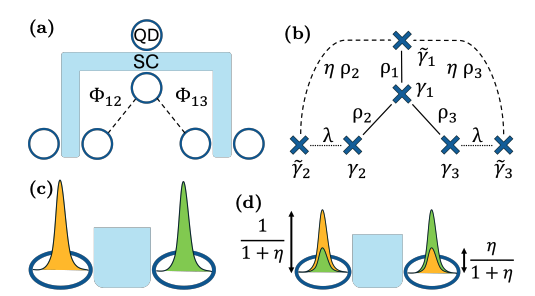
Researchers have now investigated how to perform robust braiding even with these imperfect Majorana states. They developed a theoretical framework and a specific protocol to compensate for the ground state splitting caused by these imperfections. Their approach focuses on a braiding procedure involving three interconnected systems, where the coupling between them is carefully controlled. By strategically manipulating these couplings, they can maintain the necessary degeneracy throughout the braiding process, effectively stabilizing the operation despite the imperfections. The team’s calculations reveal that while the braiding outcome deviates from that of perfect MBSs, it remains non-abelian, meaning the exchange still affects the quantum state, as long as the states aren’t fully conventional fermions. This protocol provides a pathway to achieve stable braiding even with imperfect Majorana states, offering a crucial step towards realizing the potential of topological quantum computing. The results demonstrate that even in the presence of real-world imperfections, the fundamental principles of non-abelian braiding can be preserved, paving the way for more robust and practical quantum technologies.
Reliable Majorana Braidings Overcome Material Imperfections
Researchers have demonstrated a pathway to reliably braid quasiparticles known as Majorana bound states, bringing topological quantum computing closer to reality. These states are considered promising for building robust quantum computers because their properties are protected from environmental noise, but realizing them in practice has proven challenging. This work addresses a key obstacle: the imperfections inherent in creating isolated Majorana bound states within physical systems. Typically, demonstrating successful braiding requires perfectly isolated Majorana bound states. However, real-world materials exhibit disorder and variations that cause these states to overlap and lose their ideal properties.
This overlap introduces unwanted energy splitting, disrupting the braiding process and leading to errors. The team developed a protocol to compensate for this splitting, effectively restoring the conditions needed for reliable braiding even with imperfect Majorana bound states. The researchers achieved this by carefully controlling the coupling between three systems, each hosting a pair of Majorana bound states. By tuning the interactions, they maintained the necessary ground-state degeneracy throughout the braiding process, preventing errors caused by unwanted energy differences. The results show that the braiding outcome remains non-abelian, and is stable even with varying coupling strengths and braiding speeds.
Importantly, the team demonstrated a smooth transition between true Majorana braiding and conventional fermion behavior as the degree of overlap between the bound states increases. This allows for a controlled exploration of the boundary between these two states, providing valuable insights into the nature of topological quantum computation. The protocol offers a significant step towards building practical quantum computers that leverage the inherent robustness of topological states, even in the presence of material imperfections.
Robust Braiding Beyond Perfect Isolation
This research investigates the properties of quasiparticles known as Majorana bound states, which are considered key to building topological quantum computers. The team demonstrates a method to perform braiding, even when the Majorana bound states are not perfectly isolated. They achieve this by compensating for ground state splitting that occurs during the braiding protocol through additional couplings between the particles. Importantly, the results show that a non-abelian braiding outcome, essential for quantum computation, remains robust unless the Majorana bound states behave like conventional fermions. This work expands the understanding of what constitutes a non-abelian state, potentially impacting both the development of topological quantum computing and the identification of topological phases in materials. The researchers propose that quantum-dot-based systems offer an ideal platform for implementing their protocol, as these systems allow precise control over the necessary parameters.
🗞 Adiabatic nonabelian braiding of imperfect Majoranas
🧠 DOI: https://doi.org/10.48550/arXiv.2507.11039


