
In the capital-intensive and technologically complex world of quantum computing, Rigetti Computing, Inc. (NASDAQ: RGTI) represents a unique and highly speculative investment opportunity. As the only publicly traded, pure-play company focused on the dominant superconducting qubit modality, it offers investors direct, unadulterated exposure to the risks and potential rewards of this transformative technology. An analysis of Rigetti necessitates a detailed examination of its technological underpinnings, competitive positioning, and the strategic imperatives that will dictate its trajectory in a market defined by long development cycles and profound uncertainty.
Rigetti’s core value proposition is intrinsically linked to its expertise in superconducting transmon qubits. This modality involves the creation of artificial atoms from superconducting circuits, which, when cooled to cryogenic temperatures, exhibit the quantum mechanical properties of superposition and entanglement necessary for computation. The firm’s strategic decision to pursue vertical integration—designing and fabricating its proprietary multi-chip processors in-house at its Fremont, California “Fab-1” facility—is a key differentiator. This “full-stack” approach includes providing access via its Quantum Cloud Services (QCS) platform. It is designed to accelerate R&D cycles and protect intellectual property. This is a critical advantage in a rapidly evolving field.
The past 18-24 months have been characterized by significant corporate and market-driven events. A pivotal leadership transition occurred with the departure of founder Chad Rigetti and the appointment of Dr. Subodh Kulkarni, a seasoned semiconductor industry executive, as President and CEO. This transition signals a strategic shift from a founder-led, vision-oriented phase to a more pragmatic focus on operational execution, commercialization, and scaling. This new strategic direction has been bolstered by significant partnerships and a fortified balance sheet, including a collaboration with and a $35 million equity investment from Quanta Computer to accelerate development of next-generation systems.
An assessment of Rigetti’s progress is best grounded in its tangible product evolution. The development from its early processors to the current 84-qubit “Ankaa-3” system shows a consistent progression in scale. It also shows an improvement in quality. The latest systems demonstrate marked improvements in gate fidelity. This is a critical metric for computational accuracy.
| Year | Product/Milestone | Qubit Count | Key Features and Significance |
|---|---|---|---|
| 2013 | Company Founded | – | The Company was founded in 2013 by Chad Rigetti. Rigetti Computing established as full-stack quantum computing company |
| 2014 | Y Combinator | – | Emerged from startup incubator Y Combinator as a “spaceshot” company |
| 2016 | First Quantum Processor | 3 | First three-qubit chip made using aluminum circuits on a silicon wafer |
| 2017 | Series A & B Funding | – | Raised $64 million in Series A and B funding. Series A round of $24 million was led by Andreessen Horowitz |
| 2017 | Forest 1.0 Platform | – | Launched Forest, the first programming and execution environment for quantum/classical computing |
| 2017 | 8-qubit Processor | 8 | An 8-qubit quantum processor built by Rigetti Computing |
| 2017 | 19Q “Acorn” | 19 | First processor made available on Rigetti’s Quantum Cloud Services |
| 2017 | MIT 50 Smartest | – | Named to MIT Technology Review’s 2017 list of 50 Smartest Companies |
| 2018 | 128-qubit (announced) | 128 | Announced plans to build 128-qubit quantum computer, demonstrated multi-chip architecture concept |
| 2019 | AWS Partnership | – | Quantum computers made available to users through Amazon Braket |
| 2019 | QxBranch Acquisition | – | Acquired QxBranch, a quantum computing and data analytics software startup |
| 2020 | DARPA Grant | – | Awarded up to $8.6 million from the Defense Advanced Research Projects Agency (DARPA) |
| 2021 | SPAC Announcement | – | Announced definitive merger agreement with valuation around $1.5 billion |
| 2022 | Aspen-M Commercial | 80 | First commercially available 80-qubit system with speed and fidelity metrics |
| 2022 | Public Trading | – | SPAC merger completed, trading on NASDAQ as RGTI |
| 2022 | Leadership Change | – | Chad Rigetti departed as CEO; Dr. Subodh Kulkarni appointed as new CEO |
| 2023 | Strategic Update | – | Board approved updated business strategy, including revisions to technology roadmap |
| 2023 | Novera QPU | 9 | First commercially available QPU with 9-qubit chip featuring tunable couplers |
| 2024 | Ankaa-3 Launch | 84 | Achieved 99.5% median two-qubit gate fidelity milestone |
| 2024 | Equity Offering | – | Completed $100 million at-the-market equity offering program |
| 2025 | 100+ Qubit Goal | 100+ | Announced goal to release system with over 100 qubits by end of 2025 |
Analyzing Rigetti in the Broader Quantum Ecosystem
Comparing Diverse Quantum Technological Modalities
A Comparative Analysis of the Quantum Sector
Strategic Implications for Quantum Market Entry
While Rigetti’s internal progress is critical, its value can only be fully understood within the context of the broader competitive landscape. The following sections compare and contrast its position against its main publicly traded peers, IonQ and D-Wave.
A fundamental analysis of these three firms must begin with their distinct technological underpinnings, which dictate their scientific challenges and potential market applications. A key similarity exists between Rigetti and IonQ, as both are pursuing the development of universal, gate-model quantum computers. This paradigm, analogous to classical computing, aims to create a fault-tolerant machine capable of executing arbitrary algorithms. However, they diverge significantly in their physical implementation. Rigetti is a primary proponent of superconducting transmon qubits, an approach that leverages established semiconductor fabrication techniques but requires extreme cryogenic cooling. In contrast, IonQ utilizes trapped-ion technology, which offers superior qubit stability and fidelity but historically has faced challenges in gate speed. D-Wave stands apart from both, as its strategic focus is entirely on quantum annealing, a specialized form of computation engineered to find the global minimum in complex optimization problems rather than to serve as a universal computer.
The underlying technology directly informs each company’s strategy for market entry and revenue generation. D-Wave’s focus on annealing lends itself to near-term commercial applications, allowing it to pursue a strategy of selling systems and cloud access to enterprise clients with immediate optimization needs. This has given D-Wave a first-mover advantage in generating significant commercial revenue. The path for Rigetti and IonQ is oriented toward a longer-term horizon, centred on achieving quantum advantage with their universal machines. Their approaches to this goal differ; Rigetti employs a vertically integrated, full-stack model, controlling its entire process from chip design to cloud delivery to foster faster innovation. IonQ has adopted an asset-light, partnership-centric model, making its systems broadly accessible via major public clouds to maximize market penetration. Despite these different paths, all three companies share a common reliance on government research contracts and academic partnerships to drive early-stage validation.
A Comparative Financial Analysis of Quantum Stocks
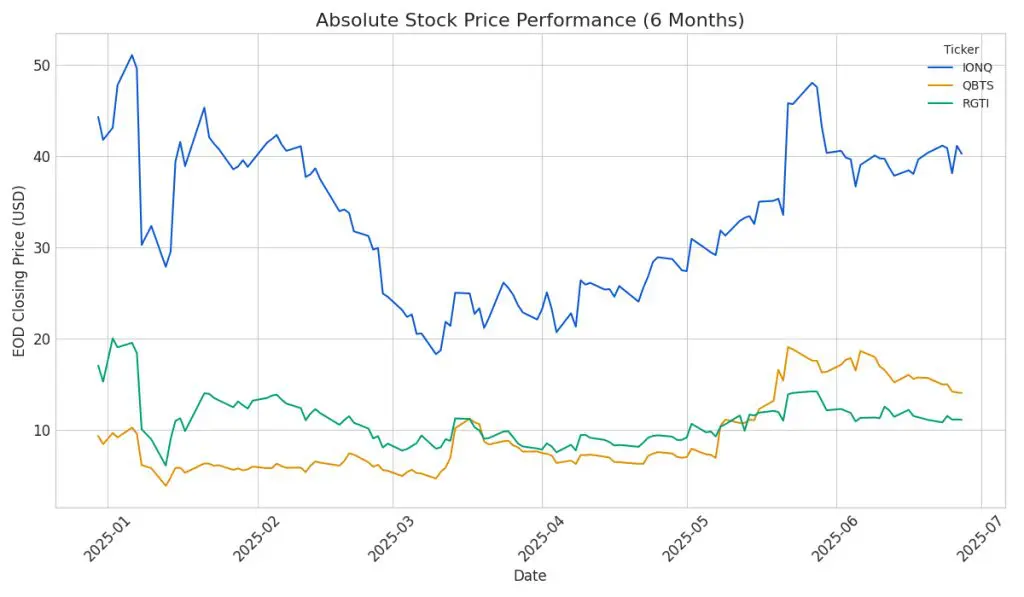
From a financial perspective, the companies exhibit shared sector-wide risks while presenting investors with distinct profiles. A significant commonality is that all three are pre-profitability and operate with a high cash-burn rate to fund intensive research and development. They are high-beta, speculative investments whose valuations are driven by technological milestones and market sentiment rather than traditional financial metrics. There are, however, clear differences in their financial standing and market perception. Market capitalization varies among them. IonQ generally commands the highest valuation. This reflects market confidence in its technological roadmap and stronger revenue growth. D-Wave’s valuation is high due to its tangible commercial successes. Rigetti trades at a more modest valuation. This lower valuation reflects its current revenue stage and potential as a pure-play in the dominant superconducting field.
The long-term economic viability for the gate-model firms, Rigetti and IonQ, depends on their ability to solve a monumental engineering challenge. This challenge involves scaling their systems to a fault-tolerant level. While both share this ultimate objective, their strategies for achieving it are distinct. Rigetti’s scaling pathway is predicated on a modular, multi-chip architecture that links smaller processors together, with the primary challenge being the management of noise and the maintenance of qubit coherence across these complex integrated systems. IonQ’s roadmap, conversely, involves both increasing ion trap density and developing sophisticated photonic interconnects to network multiple quantum cores. Its recent strategic acquisitions are designed to accelerate this path, with the high fidelity of its trapped-ion qubits potentially offering a more efficient route to implementing quantum error correction codes.
An Economic Framework for Future Scenarios For Rigetti
An analysis of Rigetti Computing’s strategic outlook necessitates a framework beyond linear projection. The company’s future trajectory is best understood as a probability distribution across several potential, and in some cases mutually exclusive, scenarios. The following five outcomes represent the most critical paths that will likely define its long-term market position and shareholder value:
The Strategic Acquisition Scenario
Rigetti’s status as a pure-play entity with significant intellectual property in the dominant superconducting modality makes it a non-trivial acquisition target. Unlike peers such as IonQ, which have acted as consolidators, Rigetti’s capital structure and market capitalization position it more as a potential bolt-on for a larger entity. A primary candidate would be a horizontally-integrated competitor like IBM, for whom an acquisition would consolidate market share, absorb a key talent pool, and create synergies in R&D. However, such a move is not without strategic drawbacks for an acquirer; a robust ecosystem with multiple, competing innovators can de-risk technology pathways and suppress supply chain costs. Alternative acquirers include hyperscale cloud providers (e.g., Amazon, Microsoft) seeking to vertically integrate their quantum stack, or major defense and aerospace contractors for whom quantum computation represents a long-term strategic imperative.
The Strategic Merger & De-Risking (“Quantinuum”) Model
An alternative to a full acquisition is a strategic merger designed to de-risk the enterprise and broaden its capabilities. The precedent for this model is the formation of Quantinuum, which fused the hardware and capital-intensive operations of Honeywell Quantum Solutions with the software and algorithm expertise of Cambridge Quantum Computing. For Rigetti, a parallel transaction would likely involve a combination with a major industrial technology firm possessing elite capabilities in a complementary domain, such as cryogenic engineering, high-frequency control systems, or specialized semiconductor manufacturing. Such a merger would provide Rigetti with critical manufacturing scale, access to mature enterprise sales channels, and a fortified balance sheet, thereby reducing its reliance on volatile capital markets for funding its considerable R&D expenditures.
The Base Case. Sustained Independent Operation
The company’s own stated strategy represents a base case scenario wherein Rigetti maintains its corporate independence and continues to execute on its technology roadmap. Success in this scenario is predicated on achieving key performance milestones in error correction and scale, thereby demonstrating a clear path to quantum advantage. The economic viability of this path hinges on the successful commercialization of its Quantum Cloud Services (QCS) platform, establishing a recurring revenue model. This outcome would solidify Rigetti’s position as the premier publicly-traded asset for direct exposure to the superconducting qubit modality, but it also carries the highest degree of idiosyncratic risk tied to its own operational execution.
The Technology Obsolescence Risk
A low-probability, high-impact tail risk is the potential for a paradigm shift in the underlying quantum computing technology. While superconducting qubits currently represent the most mature and heavily invested modality, alternative approaches such as photonics, neutral atoms, or topological qubits could theoretically achieve a disruptive breakthrough that leapfrogs existing architectures. Given the significant capital deployed by Rigetti, IBM, and Google in the superconducting ecosystem, a near-term pivot is economically unlikely. However, from a long-term portfolio perspective, the risk of technological displacement by a more scalable or cost-effective modality cannot be entirely discounted and represents a fundamental threat to Rigetti’s entire enterprise value.
The Capital Allocation & Investor Diversification Headwind
This scenario posits a shift in capital allocation away from pure-play quantum firms towards more diversified technology conglomerates. Investors seeking exposure to the quantum sector face a choice: the high-beta, concentrated risk of a stock like RGTI, or the significantly lower, diluted risk of investing in a company like Alphabet or Microsoft. In the event of a slowdown in Rigetti’s technical progress or a broader “quantum winter” characterized by investor disillusionment, a flight to quality would be probable. This would see capital migrate from high-risk, pre-revenue firms to the fortified balance sheets of tech giants whose survival is not contingent on quantum success. Such a trend would raise Rigetti’s cost of capital and present a significant headwind to its ability to fund operations.